|
Afghan
returnees wall off winter with UNHCR help
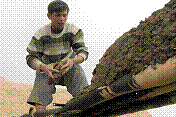
QARABAGH, Afghanistan, Nov 29 (UNHCR) – It is late
autumn, but still mild enough for Akbar Nusrati to enjoy lunch in the garden
of his newly reconstructed house. Until last month, this small patch of earth
with its two apple trees was where Akbar, his wife and their three children
ate, slept and washed – their only shelter a makeshift tent. With the frigid
winter only weeks away, Akbar is grateful to be back in the home he and his
family fled during Afghanistan's civil war 13 years ago.
Following the fall of the Taliban in 2001, hundreds of
other families from the village of Qarabagh, 50 km north of the capital
Kabul, have also taken the decision to return after years living as refugees
in Iran and Pakistan. For most, what they found when they arrived was rubble.
"It wasn't recognizable as my house," said
Akbar. "The Taliban had destroyed it just as they destroyed all the
houses in this area."
Caught on the frontline between the Taliban and the
Northern Alliance which defeated them, residents of Qarabagh as well as
thousands of families from the surrounding Shomali Plain were forced to flee,
seeking safety and shelter where they could find it. Tens of thousands of
homes, once abandoned, were razed by Taliban forces.
"Without the help we received, we'd still be living
in the tent," said Akbar.
The help, which is provided by the UN High Commissioner
for Refugees, has enabled more than 5,000 families in Qarabagh to repair or
completely rebuild their homes. In the Shomali Plain, some 14,000 families
have received UNHCR assistance and more than 300 water points have been
established.

Web Videos -
· Photo Galleries
Plug in to refugee experiences through photo galleries, web videos and
downloadable screensavers for your PC.

COMMITTEE AGAINST
TORTURE CONCLUDES THIRTY-THIRD SESSION
The Committee against Torture today concluded its two-week
winter session and issued its concluding observations and recommendations on
reports from Argentina, the United Kingdom and Greece which it reviewed
during this session.
Those countries are
among the 138 States parties to the Convention against Torture and Other Cruel,
Inhuman or Degrading Treatment or Punishment, and are bound by the terms of
the treaty to submit periodic reports on efforts to ensure that such human
rights violations do not occur on their territories. In addition to
submitting the reports, the countries sent delegations before the Committee
of 10 independent Experts to answer questions.
The Committee said
that among the positive developments in the report of Argentina were the
efforts made by the State party to combat impunity in respect of crimes against
humanity committed under the military dictatorship. The Committee also
welcomed with satisfaction the work accomplished by the National Commission
for the Right to an Identity, which was entrusted with the task of locating
children who disappeared under the military dictatorship. The Committee
expressed its concern about the many allegations of torture and ill-treatment
committed in a widespread and habitual manner by the State's security forces
and agencies and recommended, among other things, that the State party take
vigorous steps to eliminate the impunity of the alleged perpetrators of acts
of torture and ill-treatment.
Cited among positive
developments in the fourth periodic report of the United Kingdom was the
State party's assurance that the United Kingdom Armed Forces, military
advisers, and other public servants deployed on operations abroad were
"subject at all times to English criminal law" including the
prohibition of torture and ill-treatment. The Committee also noted as positive
the State party's reaffirmation of its unreserved condemnation of the use of
torture. Among the Committee's recommendations was for the State party to
review, as a matter of urgency, the alternatives available to indefinite
detention under the Anti-terrorism, Crime and Security Act 2001 and to ensure
that the conduct of its officials, including those attending interrogations
at any overseas facility, was strictly in conformity with the requirements of
the Convention.
Positive developments
in Greece, the Committee noted, included the ongoing efforts by the State
party to revise its legislation and adopt other necessary measures so as to
strengthen the respect for human rights in Greece and give effect to the
Convention. The Committee also welcomed the new Prison Code, the new law on
Legal Aid and the law on combating trafficking in human beings. Among its
concerns was the lack of an effective independent system to investigate
complaints and reports that allegations of torture and ill treatment were not
investigated promptly and impartially. It recommended that the State party
strengthen existing efforts to reduce the occurrence of ill-treatment,
including that which was racially motivated, by police and other public
officials, and to review modalities of offering protection to street children
while ensuring that those measures protected their rights.
SWAZILAND BRIEFING
BACKGROUND
Swaziland is a small,
landlocked country between Mozambique and South Africa with a population of
about one million. It is about the
same size as Wales, with a temperate mountainous region and semi-tropical
lowlands. Ethnically 95% African and 5
% European, the dominant religions are Christianity and indigenous. Economically, Swaziland is largely
dependant on South Africa and exports coal, sugar and textiles. As a British colony, it was never
integrated into the Union of South Africa and gained its independence in 1968
as a monarchy. The Westminster
constitution was repealed in 1973 and the state is now ruled as an absolute
monarchy under King Mswati III (crowned 1982). Tensions have been growing between the
traditions forms of life and government and modern expectations.
ECONOMIC CRISIS
The Prime Minister declared
a National Disaster in early 2004 following Swaziland’s severe drought caused
by the failure of the rains for the past four years. Poverty is widespread and two thirds of the
population live on less than $1 a day – one third of the population is
receiving food aid from the WFP and other agencies. Official unemployment runs at 40% and the
formal economy is in decline, although the informal economy is
expanding. The country has been hit by
globalization, with several major employers closing. Swaziland’s status as a preferred nation
under the US African Growth and Opportunities Act is under threat because of
the poor labor conditions of textile workers.
Also, the preferential agreement with the EU for the export of sugar
is also under review.
PRINCIPAL ISSSUES
1. The Constitution
Historically relatively
stable, pressure has mounted in recent years for the reform of the
traditional modes of government. The
King rules by decree and appoints his own Prime Minister. Parliament is weak and MPs are partly
appointed and partly directly elected.
Political parties are officially banned but in practice
tolerated. Freedom of association and
the media is restricted – most media outlets are state owned.
Tensions focus around the
long running debate over the new constitution to replace that suspended in 1973. A Constitutional Review Commission sat from
1996 to 2001 and recommended no major changes to the system. A new committee is at work and its
proposals are now open to consultation – after many delays, a new
constitution is expected next year.
However, opposition groups and human rights organizations have been
banned from making submissions and the King’s hostility to democracy is
widely known. It is feared that
although civil liberties will be extended, ultimate power will still rest
with the monarchy. Civil society
actors have formed an umbrella organization – the Swaziland Coalition of
Concerned Civil Organizations – to address the political and economic crises
through dialogue.
2. The Rule of Law
Governance and the
government’s commitment to the rule of law have been criticized. The Prime Minister recently refused to
abide by two Appeal Court rulings and the Appeal Court judges resigned in
protest. Attempts have been made to
undermine the independence of the judiciary.
These problems have led foreign donors to restrict the amount of aid
given.
The King has been
criticized for his personal profligacy; requesting money for a jet, lavish
birthday parties and palaces for his 40 wives.
3. HIV-AIDS
AIDS is devastating Swazi society
and the economy. Up to 40% of the
population is thought to carrying HIV.
The available labor force is being reduced and there are a large
number of orphans. The government AIDS
program has been somewhat chaotically implemented with reports of ARV drugs
being improperly administered and consequently causing further deaths from
the side-effects. However, the UN
S-G’s Special Envoy for Humanitarian Needs in Southern Africa has commended
the government’s “large strides in beginning to confront the HIV epidemic.”
01 December 2004
Palestinians begin Advent on an
optimistic note in Holy Land
Bethlehem (ENI). The countdown to Christmas has begun on a
rare optimistic note in Bethlehem as Christians celebrate Advent, the period
of preparation for celebrating the birth of Jesus, and the start of the
festive season. "We hope that this year will be a better year,"
said the Rev. Amjad Sabara, the Roman Catholic pastor for Bethlehem, the town
where Jesus was born, following services to mark Advent at the Church of the
Nativity.
|
UNHCR Goodwill Ambassadors
UNHCR started to work with Goodwill
Ambassadors in the early 1980s, when Richard Burton and James Mason were
first appointed to make media statements and public appearances for the
refugee cause. Today, five UNHCR Goodwill Ambassadors with very different
professional and personal backgrounds use their talents and time to advocate
for refugees: Barbara Hendricks (named in 1987), Adel Imam (2000), Angelina Jolie
(2001), Giorgio Armani (2002) and Julien Clerc (2003).
 Goodwill Ambassadors communicate the message of respect and
compassion for refugees to the general public in a uniquely powerful way;
they capture massive public attention through public events, television
shows, radio interviews and popular magazine articles. They effectively use
their privileged access to mass media and other resources to give a voice to
refugees, who are often victims of forgotten humanitarian crises and who
often suffer from uninformed negative stereotyping. Goodwill Ambassadors also
voice their support for refugees in meetings with world leaders, diplomats,
teachers, national and community officials, as well as the public at large. Goodwill Ambassadors communicate the message of respect and
compassion for refugees to the general public in a uniquely powerful way;
they capture massive public attention through public events, television
shows, radio interviews and popular magazine articles. They effectively use
their privileged access to mass media and other resources to give a voice to
refugees, who are often victims of forgotten humanitarian crises and who
often suffer from uninformed negative stereotyping. Goodwill Ambassadors also
voice their support for refugees in meetings with world leaders, diplomats,
teachers, national and community officials, as well as the public at large.
COMMITTEE
ON ECONOMIC, SOCIAL AND CULTURAL RIGHTS
The Committee on Economic, Social and Cultural Rights
concluded today its three-week winter session by adopting its concluding
observations on the reports of Malta, Denmark, Italy, Azerbaijan and Chile
which were considered during the session.
The five countries are
among the 150 States parties to the International Covenant on Economic,
Social and Cultural Rights which are required to submit periodic reports to
the Committee on efforts to implement the provisions of the treaty, which
entered into force in 1976.
Among the positive
developments in the initial report of Malta, the Committee noted
with appreciation the overall high level of protection afforded to economic,
social and cultural rights in the State party and its continuing efforts to
improve the protection of those rights. The Committee regretted that the
Covenant had not been incorporated into domestic law and therefore could not
be directly invoked before domestic courts. Among its recommendations, the
Committee urged the State party to raise public awareness about gender
equality; and to continue and strengthen efforts to promote the integration
of persons with disabilities into the labor market.
With regard to the
fourth periodic report of Denmark, the Committee noted with appreciation the
State party's continuing efforts to comply with its obligations under the
Covenant and the overall protection afforded to economic, social and cultural
rights in country. It was concerned that the rise in the number of immigrants
and refugees arriving in Denmark over the last years had been met with increased
negative and hostile attitudes towards foreigners. It recommended, among
other things, that the State party closely monitor the incidence of, and
combat racism and xenophobia, and that it continue to promote intercultural
understanding and tolerance among all groups in society.
The Committee labeled
as positive in the fourth periodic report of Italy the measures taken by the
State party to combat the phenomenon of trafficking in persons; the State
party's efforts to reduce unemployment; and the regularization of 700,000
migrant workers. The Committee was concerned that the State party still
considered some economic, social and cultural rights, including the right to
housing, not justifiable since they entailed financial burdens upon the
State. It recommended, among other things, that the State party intensify
efforts to combat domestic violence, especially against women; and that it
take the necessary corrective measures to combat discrimination in the
housing sector against the disadvantaged and marginalized groups,
particularly immigrants and the Roma people.
|