|
Holy Wisdom Peace: Showing that Others Matter! |
|
|
VOLUME XX FALL 2010 |
|
|
Publication of the Syrian Orthodox Church in America on United Nations Affairs. This publication is disseminated to the entire membership of the Church throughout the world on a quarterly basis. Please bring this information to the attention of your parishioners and all those under your care. The Earth is holy and a manifestation of God. Pray for peace and the UN. Anne Riccitelli, Litt, D. United
Nations Representative Antoinette A. DeLuca, Psy.D.
President |
|
EDITOR’S NOTE: It is necessary through the collaboration of NGOs to raise awareness among communities as we promote peace. If you will, the need for community consciousness is a way we can connect parties and others. It is important at this time that all parties begin to realize that they are a part of a larger picture, that they are in it together and they have common concerns. If there is a conflict all parties have contributed to the conflict and they have the power to come together to develop a non-violent intervention to result into a resolution. It is time for us as people to acknowledge that there is something more that exceed our own individual positions and needs. The United Nations, religious institutions and NGO can be an avenue to promote community consciousness to encourage global consciousness, clear and realistic decisions as they promote non-violent solutions to conflicts!
H. H Ignatious Zaka I at Manarkad. A must watch video for all Syrian
Posted by: "Issac K Joseph" Issac K Joseph issacjoseph_k
Sun Aug 29, 2010 3:23 pm (PDT)
His Holiness Ignatius Zakka I Iwas at Manarkad. A must watch video for all
Syrian Orthodox Christians
http://www.youtube.com/watch?v=aGFusqGAwl8&feature=rec-exp_stronger_r2-2r-1-HM
Let enemies of Holy Church also watch this video and confess for their
mistakes.
In Christ
Issac K Joseph
JOINT UN-NGO
CONFERENCE IN AUSTRALIA TO FOCUS ON GLOBAL HEALTH
New York, Aug 29
2010 3:10PM
The joint conference of the United Nations department of public information and
non-governmental organizations, which gets under way in Australia tomorrow,
will this year focus on global health in relation to the Millennium Development
Goals (MDGs), aiming to attract greater participation of civil society from the
Asia-Pacific region.
The 63rd annual DPI/NGO Conference, which will take place in the city of
Melbourne, has attracted more than 2,200 participants from some 70 countries.
The effort to give priority to non-governmental organizations in the Asia-Pacific
region in the annual DPI/NGO conference and increase geographic diversity bore
fruit when an unprecedented number of the region's NGOs joined the department
on 30 June.
In all, 41 such organizations from the Asia-Pacific region were associated this
year, including 32 from Australia, one from Fiji, five from the Philippines,
and
three from the
Pacific Islands.
The new UN policy to offer association to non-governmental organizations in the
region where the conference is being held also presents a chance for
"solidifying the trend of increasing geographic diversity and greater
networking opportunities for NGOs affiliated with the Department of Public
Information," said UN Chief of NGO Relations Maria-Luisa Chavez.
Holding the Conference away from United Nations Headquarters "offers a
unique opportunity to intensify and strengthen our partnerships with the NGOs
and civil society different regions of the world, in this case, the
Asia-Pacific region," she said. Ms. Chavez noted that this year the
Conference has been organized against a backdrop of challenges posed by a
15-hour time difference, geographical distance and even the elections in
Australia. Despite this, she declared the list of participants
"impressive".
"This Conference will be different because it is the first time that a UN
Conference of this size has been hosted in Australia. We are very excited to
meet in this part of the world and to have the strong participation of NGOs
from this country," said Kiyo Akasaka, UN Under-Secretary-General for
Communications and Public Information.
Setting the stage for tomorrow's opening of the conference, which will last
until 5 September, will be a series of public events in Melbourne under the
banner "Making Health Global."
The programme is directed by Professor Philip Batterham, Convenor of the
Australian NGO Focal Group.
"Melburnians already play a role in global health. We give, we volunteer
and our medical researchers are tackling the big killers like HIV, malaria,
diarrhoea and dirty water," Mr. Batterham said.
World Vision Australia, the Australian Football League and Melbourne Football
Club, among others, hosted an event on today at the Melbourne Cricket Ground to
mark the end of the football season before the finals in a game that saw
Melbourne versus North Melbourne. The game was dedicated to raising awareness
around the issue of child health.
A media event featured statements and a question-and-answer period with the
press and Mr. Akasaka, Tim Costello, the Chief Executive Officer of World Vision,
Jim Stynes, President of the Melbourne Football Club, and Glenn Archer, former
North Melbourne champion.
23 August 2010
Church warns of Malawi 'dictatorship' after leader's arrest
Mzuzu (ENI). Malawi is quickly sliding into a dictatorship where it is a crime
to hold dissenting views to government policy, leaders of the Church of Central
Africa Presbyterian - Livingstonia Synod, have warned. The charges come after
the arrest and subsequent release of the synod's general secretary, the Rev.
Levi Nyondo. "We are shocked and surprised that government could
stoop so low to arrest a general secretary of a reputable church," synod
moderator the Rev. Mezuwa Banda told journalists on 23 August in the northern
region city of Mzuzu. Nyondo was arrested on 20 August after speaking at the
funeral of former Cabinet minister Moses Chirambo, who died just days after
being dismissed from the government. [
Scottish church official supports decision to release Libyan bomber
Edinburgh (ENI). The Scottish government was right to show compassion and to
release the Libyan man convicted of the 1988 bombing of a U.S. plane over
Scotland, an official of the (Presbyterian) Church of Scotland has said. The
principle behind the release of Abdul Baset Ali al-Megrahi a year ago was
right, compassion, and my views haven't changed since I welcomed his
release on 20 August last year," the Rev. Ian Galloway, the convener of
the denomination's church and society council, told ENInews.
Turkish PM defends Christian rights against nationalist protests
Warsaw (ENI). Turkish Prime Minister Recep Tayyip Erdogan has defended his
government's attempts to strengthen minority religious rights and criticized
opposition to the staging of a Christian service at one of its oldest
monasteries. "We lose nothing if 500 or 2000 people meet to hold a service
together," Erdogan told an Ankara press conference on 16 August. "Our
country will gain more if it allows greater religious freedom. Turkey itself is
seeking permission for a mosque in Athens, and this process could be speeded up
if the situation improves here."
Philippines Christians mourn missionaries killed in bus crash
Baguio City (ENI). Christians in a northern Philippines community are mourning
the death of a local missionary couple, who died in a bus accident that claimed
42 lives. "I did not know that his sermon last Sunday would be his
last," said Eileen Bandonill, a physician and member of the United Church
of Christ in the Philippines (UCCP) in Baguio City. Bandonill led the service in
her local church on 15 August, and was referring to the Rev. Albert Anthony,
who had preached. Anthony, an evangelical missionary from Mumbai, India, and
his Filipino wife Carlota died when the bus on which they were traveling on 18
August fell into a 150-foot (46-metre) ravine in Sablan, Benguet province, in
northern Philippines.
24 August
2010
Discontented U.S. Lutherans to form new church body
New York (ENI). Dissatisfied members of the Evangelical Lutheran Church in
America are forming a new church body they say will "uphold confessional
principles" after disagreements on issues such as the ordination of clergy
in committed same-sex relationships. The new body is to be called the North
American Lutheran Church and is scheduled to be formed at a 26-27 August
meeting in Grove City, Ohio. In 2009, the ELCA agreed to change its
denominational rules to "open the ministry of the church to gay and
lesbian pastors and other professional workers living in committed
relationships".
Cross at Warsaw palace divides church and nation
Warsaw (ENI). A huge makeshift wooden cross in front of Warsaw's presidential
palace honoring former president Lech Kaczynski, who was killed in a 10 April
air crash, continues to cause tension in Poland. The dispute over the cross has
led the primate of the Roman Catholic Church in Poland, Archbishop Jozef
Kowalczyk, to criticize Catholic protesters who had been refusing to allow the
cross to be removed. "None of this has anything to do with a true
Catholic conscience or the genuine attitude of a Christian, of a believing
person who loves the cross and finds inspiration in it," said Kowalczyk,
who was installed as archbishop of Gniezno and the church's primate on 26 June.
"What we are seeing is an unedifying, shameful manipulation of the cross.
I ask everyone involved in any way to stop."
Religion root of homophobia says Latin American academic
San Jose (ENI/ALC). The aversion to homosexuality, and the violence that can
accompany it, appears to originate less in political ideologies than it does
in, "religious doctrines of power transformed into cultural
sensitivity", says Latin American political scientist Helio Gallardo.
25 August 2010
French Protestants criticize government over Roma repatriation
Geneva/Paris (ENI). France's main Protestant grouping has added its voice to
criticism of a government programme aimed at repatriating Roma migrants and
demolishing unauthorized Roma camps. The Protestant Federation of France (FPF)
said it was "concerned about the new direction of policies concerning the
Roma population, one of Europe's most impoverished populations". The
French government began a crackdown on Roma and Traveller communities at the
end of July, after outbreaks of violence between Roma communities and police following
an incident in which a Traveller was killed by security forces. The statement
by the Protestant grouping follows criticism by Roman Catholic leaders of the
government policy. [514 words, ENI-10-0592]
Indian forum says state agencies colluded in anti-Christian violence
New Delhi (ENI). A "people's tribunal" that heard testimonies from
victims of anti-Christian violence in India's eastern Orissa state in 2008 has
criticized state agencies for aggravating the suffering of those caught up in
the attacks. "There is a shocking level of institutional bias on the part
of state agencies (including police) leading to their collusion in the
violence, connivance in efforts to block the subsequent process of justice and
accountability," declared the jury in New Delhi at the end of the
unofficial 22-24 August National People's Tribunal on the violence in Orissa's
Kandhamal jungles.
Future of destroyed Ground Zero Orthodox Church in doubt
New York (ENI/RNS). Buried by falling rubble from the World Trade Center towers
after the 11 September 2001 terrorist attacks, all that remained of the tiny St
Nicholas Greek Orthodox Church were some candles, two icons and a bell clapper.
These artifacts are being kept at the headquarters of the Greek Orthodox
Archdiocese of America while the church's 70 member families worship at a
cathedral in Brooklyn, praying for the day they can return to a new sanctuary
in lower Manhattan, Religion News Service reports.
Hong Kong and Philippines churches urge action after tragedy
Hong Kong (ENI). Church officials in Hong Kong and the Philippines have called
for justice and forgiveness after eight Hong Kong tourists were killed in
Manila when police stormed a bus in which they had been held hostage. Hong
Kong's Roman Catholic diocesan justice and peace commission urged the
Philippine authorities "to conduct a thorough investigation of this most
appalling and most sad event. How the Philippine police conducted the rescue
operations must be fully-probed."
Religion now among top 10 exam subjects says Church of England
London (ENI). Religious studies has entered the top 10 league of subjects in
exams taken by most 16-year-old school students in Britain, the (Anglican)
Church of England said in a statement marking the publication of examination
results. The results published on 24 August also showed the number of school
students taking religious studies for the General Certificate of School
Education increasing for the 12th year running, said Nick McKemey, the church's
head of school improvement. "This is a phenomenon that indicates students'
appreciation that exploring faith and belief help them to understand the world
and become better global citizens," said McKemey.
31 August 2010
Russian Patriarch unveils Kremlin icon hidden since 1917
Moscow (ENI). A fresco of Christ on the Kremlin Wall in Moscow rediscovered
after being plastered over during the 1917 Bolshevik revolution has been
presented in a ceremony attended by Patriarch Kirill I of the Russian Orthodox
Church and Russian President Dmitri Medvedev. "The history of these icons
is a symbol of what happened with our people in the 20th century," said
Kirill at the 28 August ceremony. "It was claimed that true goals and
values and genuine shrines were destroyed, and that faith had disappeared from
the lives of our people." The fresco of Christ is located over the
Spasskaya, or Saviour, tower of the Kremlin, near St Basil's Cathedral on Red
Square. Experts say it dates to the middle or second half of the 17th century.
Indian churches hail halting of permission for Vedanta's mining
Bangalore, India (ENI). Churches in India have welcomed the government in
Delhi's decision to withdraw its permission for a mining project of the Vedanta
group in the remote tribal areas of eastern Orissa state that stirred
controversy. "The decision of the Ministry of Forests and Environment is
an achievement and a fruit of the peoples' struggle. It is proof that the
peoples' movement and struggle is still powerful," said the National
Council of Churches in India in a statement. Vedanta's mining project in the
Niyamgiri Hills had drawn criticism from environmentalists and human rights
activists who said it was destroying the area's ecosystem and would have wiped
out the Khond people's sacred mountains wile displacing thousands of other
people.
SECURITY
COUNCIL HOLDS FIRST STRATEGIC REASSESSMENT IN NEARLY 20 YEARS
New York, Sep 23
2010 6:10PM
Presidents, prime ministers and foreign ministers gathered today at the
Security Council, the primary United Nations body responsible for keeping the
world at peace, for its first meeting in nearly two decades devoted to updating
the tools at its disposal for its ever-expanding role.
Chaired by President Abdullah Gül of Turkey, which holds this month’s
presidency of the 15-member body, the session was called “to conduct a
strategic review, at the highest political level, of the evolving international
security environment and of the Council’s growing role in the maintenance of
international peace and security.”
The core threat that the UN was created to prevent 65 years ago, war between
States, has been largely overtaken by regional and global security threats of
unprecedented complexity, including intra-State armed conflicts with regional
dimensions, the proliferation of weapons of mass destruction, terrorism and
trans-national organized crime.
Moreover, growing recognition of the linkages between security and development
has given new prominence to the impact of poverty, global economic crisis,
infectious diseases and environmental degradation on the security environment,
demanding a strengthened UN and a renewed commitment to effective multilateral
cooperation through the Council.
It is customary for the Council to meet at the highest level each year on the
opening day of the General Assembly’s annual General Debate, when scores of
heads of State and government are in New York. But this was only the first
session since January 1992 focused on re-energizing the whole process by
providing a comprehensive and integrated political framework and restoring
confidence in the UN’s ability to prevent and resolve conflicts.
<"http://www.un.org/apps/sg/sgstats.asp?nid=4801">Addressing
the Council, whose decisions are legally binding, while those of the 192-member
General Assembly are advisory, Secretary-General Ban Ki-moon cited four
critical areas, beginning with the need to move beyond the idea of a clear-cut
sequence of peacemaking, peacekeeping and peace building.
“These tools should be deployed in integrated fashion, not kept in separate
silos,” he said. “Conflict seldom follows a tidy path. We must
continue to evolve, toward a faster and more flexible architecture of response
that allows us to customize our assistance to the real and immediate needs on
the ground.”
“Second, there is no quick fix for broken societies, which demands patience,
resources and a long-term commitment. Third, greater coherence must be achieved
among the many pieces of the UN system that make up the peace-building picture.
Fourth, we must expand our work on prevention, in particular to improve our
ability to read the warning signs and trigger early action,” he said.
The Council presidency noted that the body must play a stronger and more
comprehensive role in addressing all challenges to international peace and
security, not confining itself only to peacekeeping, but paying even more
attention to preventive diplomacy and peace building, and doing so in a
coherent manner.
Sep 23 2010 6:10PM
________________
UNICEF RUSHING RELIEF SUPPLIES TO FLOOD-HIT INDIAN STATES
New York, Sep 24 2010 1:10PM
The United Nations Children’s Fund
(<"http://www.unicef.org/infobycountry/media_56197.html">UNICEF)
and its partners are assisting the Indian Government in rushing relief supplies
to millions of people who have been uprooted from their homes in the states of
Uttar Pradesh, Bihar, and Uttarakhand by heavy floods.
The agency has supplied tarpaulin sheets, jerry cans, water purification
tablets and mosquito nets, among other items, to more than 8,000 displaced
families in Uttar Pradesh. It has also pre-positioned its supplies in 10
high-risk districts to help 10,000 families.
Heavy rainfall and floods in the major rivers of the state have affected nearly
1.7 million people in Uttar Pradesh, UNICEF noted in a news release.
The state Government there has set up 276 relief posts to distribute food and
health supplies.
Meanwhile, the breach of support embankments of the Gandhak River has resulted
in the flooding of 35 villages in Gopalganj and Siwan districts in Bihar.
UNICEF sent supplies to Gopalganj, including 282 bags of bleaching powder,
208,000 water purifying tablets, 5,000 oral dehydration salt sachets, 1,000
hygiene kits and soap, following a request by the state Government.
In Uttarakhand, close to half a million people in 369 villages across the state
have been affected. A number of roads including national highways have
been damaged or blocked due to landslides.
The central government has rushed in relief to the affected areas and deployed
battalions from the National Disaster Response Force (NDRF) to Haridwar and
Rishikesh in Uttarakhand, Gopalgunj in Bihar and Rampur in Uttar Pradesh.
Sep 24 2010 1:10PM
AT UN, DEVELOPING NATIONS URGE BOOST IN GLOBAL SUPPORT TO FIGHT
CLIMATE CHANGE
New York, Sep 28 2010
9:10PM
Developing nations took to the podium today at the General Assembly’s annual
high-level debate to press for greater global support in responding to climate
change.
Ghanaian Foreign Minister Muhammad Mumuni
<"http://gadebate.un.org/Portals/1/statements/634212699462656250GH_en.pdf">warned
world leaders that poorer nations may soon experience a “promise fatigue” if
developed countries do not carry through pledged funds, including the $30
billion of fast-track funding for developing countries through 2012 committed
at December’s Copenhagen climate change meeting.
At the gathering in the Danish capital, industrialized countries further
pledged to find ways and means to raise $100 billion annually by 2020.
“For developing countries, the early delivery and transparent allocation of
this money will boost our confidence in the dialogue and also show that
industrialized countries are truly committed to progress in the broader
negotiations,” Mr. Mumuni said.
Not only must developed countries honor their commitments to provide financial
and technological to poorer nations in the fight against climate change, they
must also “take the lead to cut their respective carbon dioxide emissions so
that the conference in Cancun could produce tangible results,” <"http://gadebate.un.org/Portals/1/statements/634211899755000000KH_en.pdf">said
Cambodian Deputy Prime Minister and Foreign Minister Hor Namhong.
The next conference of parties to the United Nations Framework Convention on
Climate Change (<"http://unfccc.int/2860.php">UNFCCC) is set to
take place in the Mexican city in November.
“The fruitful outcomes in Cancun rely on efforts by all to save humankind from
much more serious catastrophes,” the Cambodian official said.
Foreign Minister Maxine Pamela Ometa McClean of Barbados acknowledged that a
comprehensive pact will not be achieved in Cancun, but
<"http://gadebate.un.org/Portals/1/statements/634212833423281250BB_en.pdf">said
the November gathering must conclude with the world committing itself to
prioritizing the most vulnerable and providing the fast-track funding.
“Critical to success at Cancun is arriving at a common understanding of how,
when and where an ambitious and legally-binding international climate agreement
will be finalized,” she stressed.
Theodore Brent Symonette, Deputy Prime Minister and Foreign Minister of the
Bahamas,
<"http://gadebate.un.org/Portals/1/statements/634212608166875000BS_en.pdf">called
for special attention to be paid to the needs of small island developing States
(<"http://www.sidsnet.org/">SIDS) and other vulnerable
countries.
The Bahamas, he said, is the fifth most vulnerable country to sea level rise.
“We are a country of negligible greenhouse gas emissions, still we suffer
catastrophic results of emissions are not stabilized and reduced worldwide.”
According to science, a temperature rise of 2 degrees Celsius will result in
the sea level rising two metres, Mr. Symonette said. “Such an occurrence will
submerge 80 per cent of our territory.”
Also calling for urgent action for SIDS today was Arvin Boolell, Foreign
Minister of Mauritius.
With climate change inextricably linked to the realization of the Millennium
Development Goals (<"http://www.un.org/millenniumgoals/">MDGs),
the SIDS should be given simplified access to both fast track and longer-term
resources, he
<"http://gadebate.un.org/Portals/1/statements/634212729543281250MU_en_fr.pdf">emphasized.
“Those adaptation fundings should be in the form of grants and not loans,” Mr.
Boolell added.
President Desiré Delano Bouterse of Suriname, in his address to the Assembly on
Saturday,
<"http://gadebate.un.org/Portals/1/statements/634211870689687500SR_en.pdf">said
that climate change will have a “devastating” effect on developing countries.
His country, he said, can serve as an example for the world “as its laws to
save [forests] and biodiversity date back from the middle of the past century.”
It is called the “greenest country on Earth” for its 90 per cent forest cover,
Mr. Bouterse said.
“It seems that the standing forest and the wealth of Suriname’s biodiversity
are being taken for granted by the global community as there are no structures
in place to provide incentives to continue on the path of sustainability,” he
said.
For his part, Grenada’s Prime Minister Tillman Thomas
<"http://gadebate.un.org/View/SpeechView/tabid/85/smid/411/ArticleID/209/Default.aspx">called
for climate change, which is already undermining small economies, to remain at
the top of the global diplomatic and negotiating agenda.
Fast track funding has only reach a small percentage of developing countries,
and “clearly, this has to be corrected,” especially for SIDS, he said.
30 September 2010
Christians call for calm after Indian verdict on holy site
Bangalore, India (ENI). Churches in India have joined other faiths and
political leaders in calling for calm after a court ruled that a religious
site, vigorously and violently disputed by Hindus and Muslims, should be split
between the two groups. On 30 September, the high court of northern Uttar Pradesh
state handed down its verdict in the protracted case that concerns the
ownership of the site of the former Babri mosque at Ayodhya, 700 kilometers
(420 miles) southeast of New Delhi. The case has been pending for more than
half a century. In a majority verdict, two of the three judges declared that
Hindus have the right of ownership to the main disputed area, where the main
dome of the Muslim Babri mosque once stood. The court granted Muslims and a
Hindu group control of other parts of the site. Hindus consider the location
the birthplace of the god Ram, and placed a Ram idol inside the mosque in 1949
Southern Africa bishops disturbed by Swaziland's rights abuses
Cape Town (ENI). Bishops of the Anglican Church in Southern Africa say they are
deeply disturbed by news of growing human rights abuses in Swaziland, a kingdom
sandwiched between South Africa and Mozambique. The bishops, meeting in Benoni
near Johannesburg from 27 to 29 September for their twice-yearly synod, challenged
their church to become more involved in the quest for democracy in Swaziland.
Archbishop Thabo Makgoba of Cape Town, the leader of the church, said on 30
September he could not remain silent on the issue of democracy in Swaziland,
"where power and wealth is concentrated in the hands of a few, and
political debate is hardly permitted". A state of emergency has existed in
Swaziland for the past 37 years. Freedom of expression is severely limited,
opposition political parties are banned, and reports of police arresting and
beating up critics are frequent.
Evangelical Christian pilgrims converge on Jerusalem
Jerusalem (ENI). Thousands of evangelical Christians from 100 countries have
participated in a 30th "Feast of Tabernacles" event, organized by the
International Christian Embassy Jerusalem, a group strongly supportive of a
united Jerusalem under Israel. The ICEJ says the event, held from 23 to 29
September to coincide with the Jewish holiday of the Feast of Tabernacles
(Sukkot), has become Israel's largest annual tourist event, and the largest
solidarity mission to Israel. Organizers expect the festival to have injected
an estimated US$15 million into the local economy. The event takes place with
the assistance of the Israeli Ministry of Tourism, and, in 2010, about 1000
pilgrims from Brazil made up the largest group at the embassy event.
6 September 2010
Cost of fixing Delhi for Commonwealth Games worries churches
New Delhi (ENI). Indian church leaders say the billions of dollars being spent on
sprucing up the capital city, New Delhi, for the Commonwealth Games in October
is wasteful. "There is a whole lot of public money that could have been
used for the welfare of the poor that is being wasted on Delhi's streets,"
John Dayal, Delhi-based secretary general of the All India Christian Council,
told ENInews. "The politicians and officials have once again proved that
the welfare of the poor is not a major priority for them," noted Dayal, a
member of the National Integration Council chaired by the Indian Prime
Minister. India's leading English daily newspaper, The Times of India, released
the results of a survey on 1 September that said that 76 percent of the people
of Delhi feel that the Commonwealth Games expense is "unjustified",
while many more are worried about their tax liability for the prodigious
spending. The games take place every four years.
Mini Luthers on Wittenberg market square cause offence to some
Trier, Germany (ENI). Eight hundred colorful miniature figures of the
16th-century Protestant Reformer Martin Luther on display on the central market
square of Wittenberg, where he lived and worked, are causing offence. Visitors
have been walking around the market place between the black, green, red and
blue figures, picking them up and placing them in other parts of the town. This
art show has, however, been heavily criticized by prominent theologians such
as Friedrich Schorlemmer from Wittenberg, who played a prominent role in
the peaceful protests that led to the fall of the Berlin Wall more than 20
years ago. Schorlemmer told the Leipziger Volkszeitung, a newspaper in eastern
Germany, in August, "This is theological and aesthetic rubbish. Martin
Luther cannot be mass produced." The installation by German artist Ottmar
is part of the Luther Decade celebrations commemorating the period between
Luther's arrival in Wittenberg in 1508 and the beginning of the Reformation in
1517.
14 September 2010
India churches in appeal for Christians targeted in Quran protests
Bangalore (ENI). Churches in India are asking for support after Christian
institutions became the target of violent protests linked to the reported
desecration of a copy of the Quran in the United States. At least 16 people
were killed and more than 60 injured in clashes on 13 September with security
personnel in India-ruled Kashmir. Most of those people were killed after police
opened fire to quell violent mobs, S. S. Kapur, the chief secretary, or highest
official, of Jammu and Kashmir State, told media. Kapur said the crowds had
come out on to the streets after a "foreign" television station had
reported that a copy of the Quran had been desecrated in the United States.
Tension had been rising in Muslim-majority Kashmir after the announcement by
the Rev. Terry Jones, pastor of a tiny church in Florida, of plans to burn
copies of the Quran on 11 September, the ninth anniversary of the terror
attacks in the United States.
Church grouping says action needed, if one sixth of world hungry
Geneva (ENI). An international grouping of churches and Christian organizations
says that if one sixth of the world's population is hungry when there is
sufficient food to feed the world, then action to address the problem's root
causes is needed. The Geneva-based Ecumenical Advocacy Alliance, which
campaigns for food justice, said in a statement on 14 September that new
figures on world hunger highlight that the food crisis is still acute for
one-sixth of the world's population. The Food and Agricultural Organization of
the United Nations and the World Food Programme had on the same day announced
that 925 million people are estimated to be suffering from chronic hunger in
2010, down from the 1.023 billion estimated in 2009. The release of the
statistics from the U.N. organizations came in advance of New York's 20-22
September United Nations Millennium Development Goals summit and the
publication of FAO's annual flagship report, "The State of World Food
Insecurity", known as SOFI.
Russia's prisons look to faiths to bring moral guidance
Moscow (ENI). Russia's prisons, struggling with a growing crime rate,
overcrowding and shortfalls in funding, are turning to religion to bring moral
guidance to inmates. The move marks a dramatic change from the Soviet system,
when clergy and believers were often imprisoned for their faith. "We have
signed agreements with all of the leading confessions of our country,"
said Aleksandr Reimer, the director of Russia's Federal Correctional Service,
in an interview with the Rossiiskaya Gazeta, an official government newspaper.
Although the Russian Orthodox Church has become increasingly close to the State
in recent years, Reimer said that that imposing Russia's largest religion on
inmates was not the goal.
UN AGENCIES ISSUE TEN TIPS FOR SUCCESSFUL BREASTFEEDING
New York, Aug 1
2010
To unlock the lifesaving potential of breast milk, two United
Nations agencies have unveiled 10 steps to help mothers successfully breast
feed, kicking off World Breastfeeding Week today.
According to the UN World Health Organization (WHO), breast milk is the ideal
food for newborns and infants because it is safe and gives them the nutrients
necessary for healthy development. It also contains antibodies to protect
infants from common childhood illnesses.
Although exclusive breastfeeding for the first six months of life is on the
rise in many countries, the agency believes that further improving these rates
is crucial to bolster the nutrition and health of infants and children.
Too many mothers, WHO said, stop breastfeeding exclusively a few weeks after
delivery for many reasons, such as lack of breastfeeding counseling.
Some 35 per cent of infants between the ages of 0 and 6 months are solely
breastfed worldwide, said Elizabeth Mason, Director of WHO's Department of
Child and Adolescent Health and Development.
"But if all babies and young children were breastfed exclusively for the
first six months of life and then given nutritious complementary food with
continued breastfeeding up to two years of age, the lives of an additional 1.5
million under five would be saved every year," she added.
Developed by the UN World Health Organization (WHO) and the UN Children's Fund
(UNICEF), the Ten Steps to Successful Breastfeeding are aimed at providing the
right start for every infant and are currently used in hospitals in more than
150 countries.
They include helping mothers begin breastfeeding within half an hour of birth,
allowing mothers and infants to remain together for 24 hours a day, and giving
no artificial teats or pacifiers to breastfeeding infants.
One third of the nearly nine million deaths every year among children under the
age of five are due to malnutrition, which causes disease and deaths. Most of
these deaths occur during the first few months of life and are often linked to
inappropriate feeding practices such as bottle-feeding.
"Increasing breastfeeding rates is a key component of the plan to improve
infant and young children nutrition," said Rand Saadeh, Coordinator of the
Nutrition in the Life Course unit at WHO.
"A renewed effort to make more hospitals 'baby friendly' has the potential
to give millions more babies a healthy start in life."
First observed in 1992, World Breastfeeding Week -- which seeks to encourage
exclusive breastfeeding for the first six months of a child's life -- is now
observed in more than 120 countries and is celebrated from 1-7 August annually.
Aug 1 2010 1:10AM
________________
UN RIGHTS EXPERT URGE STATES TO COMPLY WITH CONVENTION AGAINST
TORTURE
New York, Oct 20 2010
The Chairperson of the United Nations independent committee of
experts against torture today urged States to recommit themselves to the values
of the global treaty that prohibits the practice, which, he stressed, cannot be
justified under any circumstances and has to be eradicated.
“The Convention embodies very important values of humanity. Confessions
extracted by torture cannot be used in judicial proceedings,” Claudio Grossman,
who chairs the Committee Against Torture, told reporters at UN Headquarters
after presenting its annual report to the General Assembly.
The UN Convention against Torture and other Cruel, Inhuman or Degrading
Treatment or Punishment was adopted by the General Assembly in 1984 and has
been ratified by 147 States to date.
“Still today, 26 years after the adoption by UN Member States of the Convention
Against Torture, we have not yet achieved our shared objective to eradicate
torture and inhuman treatment,” said Mr. Grossman.
“The absolute prohibition of torture – a non-derogable obligation under
the Convention which means that under no exceptional circumstances whatsoever
can torture be justified – is not yet a reality in many States who have
ratified the Convention,” he adds.
He called upon all UN Member States to say “no to torture; no to torture during
emergency situations; no to torture by any means.”
The Convention provides that “no exceptional circumstances whatsoever, whether
a state of war or a threat of war, internal political instability or any other
public emergency, may be invoked as a justification of torture.”
It also obliges States that have ratified the Convention to refrain from
deporting or returning people to countries where they would face the risk of
torture, and requires ratifying States to extradite or prosecute perpetrators
of torture.
Under the Convention, victims of the scourge have the right to redress,
including compensation.
In its recommendations to States parties, the 10-member Committee has
repeatedly denounced the vulnerability of women in situations of armed
conflict.
He expressed concern at the failure of States to comply with their reporting
obligations under the Convention.
“Initial reports are the essential springboard for ongoing dialogue with States
parties, and I call upon the 32 States which have not yet submitted their
initial reports to do so in order for the committee to contribute to the
realization of the convention,” Mr. Grossman said.
He also reiterated the Committee’s regret that only 64 out of the 147 State
parties to the Convention have accepted its competence to examine individual
complaints alleging violations of the Convention.
“The individual complaints procedure is an important tool for achieving the
goals of the Convention by enabling victims of torture to present their cases
before the international community. It also allows the Committee to apply the
Convention to real-life situations,” Mr. Grossman stressed.
This year, the Committee determined that deporting people to countries where
they run the risk of sexual violence amounts to a breach of the prohibition of
deportation or return to countries where they would face the risk of torture.
Oct 20 2010 10:10AM
________________
MOST OF WORLD’S 200 MILLION MIGRANTS DENIED BASIC RIGHT TO HOUSING
– UN EXPERT
New York, Oct 22 2010 7:10PM
With most of the world’s estimated 200 million migrants facing
discrimination in housing, a United Nations independent expert today called on
nations to view the issue through the lens of human rights.
Raquel Rolnik, the Special Reporter on the right to adequate housing, told
reporters that in her work, she has seen first-hand the “situations of migrant
workers living in metal containers without electricity or water or services,”
as well as others sleeping in bathrooms, closets or the kitchen.
They are also oftentimes subject to violence, sexual harassment and forced
confinement, she told reporters in New York after briefing the General Assembly
on her latest report.
Migrants are sometimes obliged to live in in-service, unplanned settlements
within or on the outskirts of cities because of the impossibility of accessing
public housing or due to discrimination they face in the private market, the
expert said.
The “inadequate and often appalling” housing conditions migrants face can only
be redressed through a “truly human rights-based approach which is based on
international human rights law that protects the rights to adequate housing of
international migrants and prohibits discriminatory, unfair and degrading
treatment,” she stressed.
22 October 2010
Turkish aide wants Hagia restored for Muslim, Christian worship
Warsaw (ENI). A Turkish government adviser says Christians and Muslims should
be allowed to worship again in Istanbul's Hagia Sophia basilica, eight decades
after it was turned into a museum by the country's secularist authorities.
"Hagia Sofia was built as a place of worship. It served people this way as
a church and mosque for more than a thousand years," said Mehmet Akif an
expert with the Presidency of Religious Affairs, which monitors religious sites
in Turkey, including more than 80 000 mosques. "As a Muslim, I'd like it
to become a mosque. But if Hagia Sofia were opened to Muslim worshippers on
weekdays, it should also be opened to Christians on Sundays. It disturbs me
that it's become just a museum and tourist destination." The expert was
commenting on calls for the sixth century landmark to be reopened for religious
events. Turkey, which has witnessed several attacks by Islamic militants on
Christian clergy, including the June killing of Bishop Luigi Padovese,
president of the country's Roman Catholic Bishops Conference.
Spanish Muslim, who advocated tolerance, religious liberty, dies
Cordoba, Spain (ENI). The death of a Muslim leader, who had converted to Islam
and sought to build bridges between people of different faiths, is being
mourned in Spain and has been especially praised in a Spanish newspaper
article. Mansur Escudero, 62, "was considered one of the most important
mediators between the Muslim community and the different government administrations
in Spain", the English-language edition of the El Pas newspaper
reported on 7 October. "He was considered an excellent and creative
orator, who defended laity as well as freedom of religious practice.” In one of
his best known acts of interfaith activism, Escudero asked the Vatican to allow
Muslims - there are around 1.3 million in Spain - to pray at the Cathedral of
Cordoba, one of the most unusual religious sites in the world.
Anglican congregation's plan for Roman exit not seen as exodus
London (ENI). The decision by an Anglican parish in southeast England to leave
the Church of England to become Roman Catholic has taken some by surprise. The
elected parochial church council of St Peter's, Folkestone, south east England,
which has taken the unanimous decision to secede, is seeking a meeting with the
Archbishop of Canterbury, Rowan Williams, to discuss procedure. Earlier this
year Pope Benedict XVI offered special provisions for members of the Church of
England unhappy with the prospect of female bishops. The Rev. Stephen Bould,
the parish vicar, and the church council said they regretted having to take
such action and called for a smooth transition in the interest of both parties.
Bould said he was proud of the courage and faith of the lay people concerned.
He told journalists after the morning service on 17 October he did not know how
many of the congregation would join the Catholic Church.
19 October 2010
Anglican head concerned for failed Zimbabwe asylum seekers
London (ENI). Human rights activists have praised the Archbishop of Canterbury,
Rowan Williams, for showing concern about the safety problems failed Zimbabwean
asylum seekers face if they are forced to return and live under the regime of
President Robert Mugabe. "I would love to see more and more Christians and
church leaders follow his example and warn the British government that there
must be checks and monitoring systems in place before these people are sent
home," Sarah Harland, co coordinator of the Zimbabwe Association told
ENInews. "This is not the time for enforced returns."
Tanzanian theologian says 'Saint Nyerere' is important for Africa
Nairobi (ENI). Some Roman Catholics are making a new push for
the beatification of the former Tanzanian president, Mwalimu Julius
Kambarage Nyerere, describing this as important for Africa due to his example
of good leadership. The Rev. Laurent Magesa from Tanzania's Musoma diocese,
where the leader came from, said that in today's political context where many
African leaders have been criticized for embezzling public funds, Nyerere is
remembered for his honesty. The process of beatification in the Catholic Church
is often seen as a step towards making a person a saint. A person who is
beatified is given the title "Blessed".
Church of North India turns 40, with Archbishop of Canterbury
Nagpur, India (ENI). The Archbishop of Canterbury, Rowan Williams, has led
celebrations to mark the 40th anniversary of the Church of North India, which
was formed by six Protestant denominations, including Anglicans, in 1970. The
six uniting churches in 1970 represented Anglican, Baptist, and Brethren,
Congregational, Disciples, Methodist and Presbyterian traditions. The visit by
Williams visit comes as a time of tension in the worldwide Anglican Communion
after the 2003 consecration by the Episcopal (Anglican) Church in the United
States of a homosexual bishop who has a male partner. The Episcopal Church has
since consecrated as a bishop an openly lesbian cleric, who has lived with a
female partner for 22 years.
United Nations • NEW YORK, NY
10 September 2010
Dear Sub-Committee Co-Chairs, As we all return from our voyage Down Under, I would like to take this opportunity to express my appreciation to all of you for participating in the highly successful 63rd Annual UN DPI/NGO Conference in Melbourne. Your participation in the Planning Committee meetings and then your individual Sub-Committee meetings assured the worldwide NGO community of an outstanding Conference on advancing global health and achieving the MDGs. More than 1,700 representatives from 260 NGOs and 70 countries, as well as representatives of academia, media, the UN system and Member States participated in this year’s Conference. This year’s gathering was historic in that it was the largest UN event to be held in Australia. Most importantly, the high level of interest and participation at the Opening and Closing ceremonies, Roundtable sessions, Workshops and Exhibits by the attendees highlighted the importance of addressing the equally important issues of advancing global health and achieving the MDGs. I am confident that all the participants felt the same way. Finally, the Outcome Document, which you helped shape, will help all participants in presenting the Conference’s recommendations to their national governments so that they could be included in the MDG Summit that will be held 20-22 September 2010 at UN Headquarters. For your information, as has become traditional, regional NGOs were given priority in associating with the DPI in advance of the Conference. As a result, DPI/NGO Relations associated 41 NGOs in the Asia-Pacific region, including: Australia – 32, Fiji – 1, Philippines – 5, Tonga – 1, Vanuatu – 1. There are a lot of lessons to be learned from the Conference, and I urge you to give this some thought, as we will discuss these lessons at an upcoming meeting. I hope that you also found the Conference to be valuable and I look forward to sending you the Final Report. The webcast can be seen at www.undpingoconference.org.
Warm regards,
Maria-Luisa Chàvez, Chief
NGO Relations, Outreach Division
Department of Public Information
EIGHTEEN COUNTRIES ELECTED TO SERVE ON UN ECONOMIC AND SOCIAL
COUNCIL
New York, Oct 25 2010
The General Assembly today elected 18 members to the key United
Nations forum tasked with discussing international economic and social
progress.
Australia, Cameroon, China, Ecuador, Finland, Gabon, Hungary, Latvia, Malawi,
Mexico, Nicaragua, Norway, Pakistan, Qatar, Republic of Korea, Russia, Senegal
and the United Kingdom were elected, and in some cases re-elected, to serve on
the Economic and Social Council
(<"http://www.un.org/en/ecosoc/">ECOSOC).
The Council, comprising 54 members elected by the General Assembly, meets
yearly to further economic and social cooperation and development. Those
elected today will begin their three-year terms on 1 January 2011.
The other current members of the ECOSOC are Argentina, Bahamas, Bangladesh,
Belgium, Canada, Chile, Comoros, Côte d’Ivoire, Egypt, Estonia, France,
Germany, Ghana, Guatemala, Guinea-Bissau, India, Iraq, Italy, Japan, Malta,
Mauritius, Mongolia, Morocco, Namibia, Peru, Philippines, Rwanda, Saint Kitts
and Nevis, Saudi Arabia, Slovakia, Spain, Switzerland, Ukraine, United States,
Venezuela and Zambia.
Among the many issues discussed in the ECOSOC is progress in reaching
objectives such as the Millennium Development Goals
(<"http://www.un.org/millenniumgoals/">MDGs), eight targets for
tackling poverty, hunger and other social ills by 2015, as well as international
development cooperation and the global financial situation.
ECOSOC’s week-long high-level segment this year featured the Development
Cooperation Forum, which centered on development cooperation in times of
crises, the Annual Ministerial Review, which focused on gender equality and the
empowerment of women, and a policy dialogue on the state of the world economy.
Oct 25 2010
________________
|
Sikhs Join Interfaith Efforts in Support of Peace, Tolerance and Religious Liberty |
||||
|
UNITED SIKHS Promotes Unity & Acceptance in Memory of 9/11 |
||||
|
Highlights:
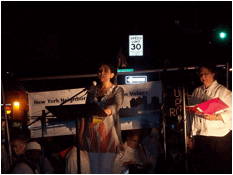
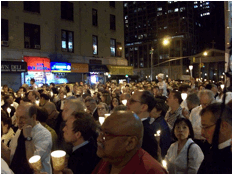
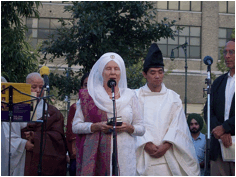
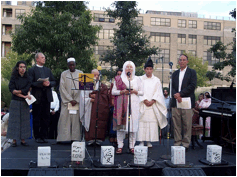
New York, NY: Members and volunteers of UNITED SIKHS joined Interfaith organizations in solidarity against intolerance, discord and prejudice to commemorate the lives lost on September 11, 2001. Through these events and in support of communities unfairly targeted in the backlash of the terrorist attacks on 9/11, UNITED SIKHS and other organizations stand in support of the fact that religious intolerance is not in line with American values.
On Friday, September 10, 2010, UNITED SIKHS attended the “Vigil for American Values”, coordinated by the New York Neighbors for American Values and supported by the Interfaith Center of New York. Centered on the theme of “Understanding, Acceptance and the Love of Neighbors,” the event was attended by elected officials and religious leaders. Dr. Tejal Kaur, UNITED SIKHS volunteer, spoke on the importance of unity among people of different faiths and our duty to protect others from the Sikh perspective. The vigil took place on the corner of Church Street and Park Place in Downtown Manhattan from 7:00 pm – 9:00 pm. Click here to see a part of the event.
Lately, New York City has watched while members of different communities have been victims of hate crimes, including a Muslim Taxi Driver, numerous members of the Latino community, and most recently, members of the Gay community. As Dr. Tejal Kaur says in her speech at the Candlelight vigil, "Sikh head coverings provide the equally important purpose of serving to create an external identity so that a Sikh may always be distinguished in a crowd as someone who must act in the defense of others. Ironically, it is that same external identity which has placed Sikhs at risk for hate crimes and civil liberties violations. Yet, instead of saying, “Do not discriminate against us, we are not Muslim,” the values of the Sikh faith demand that a Sikh stand up and demand that NO ONE, REGARDLESS OF FAITH OR CREED BE BARRED FROM PRACTICING THEIR FAITH FREELY. THAT NO ONE, BE DENIED JUSTICE AND COMPASSION."
On Saturday, September 11, 2010, UNITED SIKHS Volunteer Satkiran Kaur Khalsa joined members of different faith communities and represented Sikhs by reciting verses from the Gurbani in reflection for the loss of life and in the spirit of promoting unity and acceptance at the 9th Annual Floating Lanterns Ceremony. New York Buddhist Church led the ceremony with the assistance of the Interfaith Center of New York at South Side of Pier 40 (W. Houston St. & West Street) from 6:00 pm - 9:00 pm. The ritual replicated the one in Hiroshima Japan, which commemorates the victims of the atomic bombings during WWII. As one of the key partners, UNITED SIKHS provided langar to attendees at the ceremony.
UNITED SIKHS urges community members to be alert, be aware and know your rights.
To
notify UNITED SIKHS of a hate crime or to know more about your rights, please
contact us at law-usa@unitedsikhs.org. |
30th Enthronement anniversary celebrations of His Holiness The Patriarch Moran Mor Ignatius Zakka I Iwas
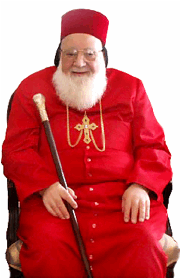
Program Schedule:
Venue: Monastery of St. Ephraim in Ma'arat Saydnaya, Damascus.
13 September 2010; Monday, 7:00 pm: Performance
by St. Ephrem Syriac Choir, followed by Syriac Orthodox Scout March to Salute
HH, Firework.
14 September 2010; Tuesday
- 10:00 am: Holy Qurbono
- Feast of the Exaltation of the Holy Cross, Enthronement day of HH the
Patriarch - felicitations.
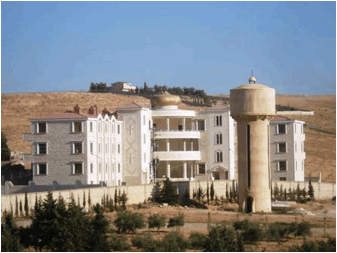
New Guesthouse nearing completion to the St. Aphrem Dayro, to be consecrated on 14 September 2010
14 September 2010 - Tuesday - 6:00 pm - Consecration of the new guesthouse building - Saint Ignatius Patriarchal center and also the consecration of the associated chapel devoted to Saint Ignatius of Antioch.
15 - 19 September 2010: Holy Synod
19 September 2010 Sunday - 10:00 am: Consecration of Holy Mooron (Chrism).
Celebrations held at Monastery of St. Ephrem, Ma`arat Sayyidnaya, Damascus.
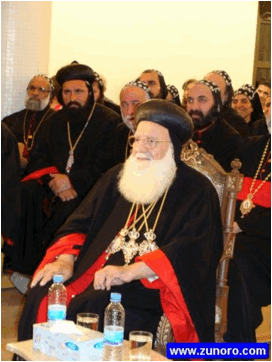
14 September 2010, Ma`arat Sayyidnaya, Damascus: 30th Enthronement Anniversary of His Holiness Moran Mor Ignatius Zakka 1st celebrated at Monastery of St. Ephrem, Ma`arat Sayyidnaya, Damascus yesterday. Metropolitans of sister churches, various dignitaries, Metropolitans of Syrian Orthodox Church, Rembans, Priests, Nuns and faithful participated. The message from His Holiness Pope Shenouda III of Alexandrian Patriarchate was read during the function. His Eminence Geevarghese Mor Athanasius & His Eminence Eldho Mor Theethos represented Malankara. His Beatitude Aboon Mor Baselios Thomas 1 and other metropolitans of church in India will reach Patriarchate to take part in the celebrations and Holy Chrism on Friday.
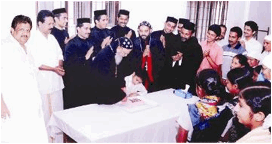
In Malankara the Anniversary of Enthronement of Holy Father celebrated at Puthencuriz Patriarchal Center (Head Quarters of Syrian Orthodox Church in India). Catholicose Aboon Mor Baselios Thomas I lead the Thanksgiving Holy Qurbono at St. Athanasius Cathedral here assisted by H.E Mathews Mor Aprem here. Baretho Mahero Thambu George Thukalan (Church Secretary), Rembans, Priests, Deacons, Nuns, Church officials & lots of faithful attended the Holy Mass & the celebrations held here there after. Catholicose cut the cake, which marked the celebrations at the Church Headquarters in India
His Holiness Patriarch to consecrate the Holy Mooron on 19th September
10 September 2010, Ma`arat Sayyidnaya, Damascus: The His Holiness Patriarch of Antioch & All the East Moran Mor Ignatius Zakka-I Iwas will lead the consecration of Holy Chrism assisted by His Beatitude Catholicos Aboon Mor Baselios Thomas-I & other Metropolitans of Holy Syriac Orthodox Church on 19th September 2010. Catholicos will participate in the Holy occasion as per the special invitation of Holy Father the Patriarch.
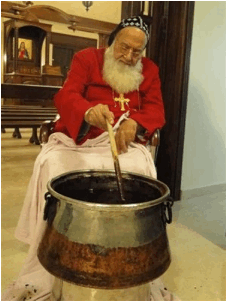 The preparation for the consecration of Holy Chrism has
been started on 10th September at Patriarchal Head quarters here. The Holy
Father along with H.E Philexinos Mathias Nayis (Patriarchal Assistant &
Director of St. Ephrem Theological seminary here), the Rembans & Priests
combined the materials for preparing Holy Chrism on 10th September in an
atmosphere filled with prayers & hymn.
The preparation for the consecration of Holy Chrism has
been started on 10th September at Patriarchal Head quarters here. The Holy
Father along with H.E Philexinos Mathias Nayis (Patriarchal Assistant &
Director of St. Ephrem Theological seminary here), the Rembans & Priests
combined the materials for preparing Holy Chrism on 10th September in an
atmosphere filled with prayers & hymn.
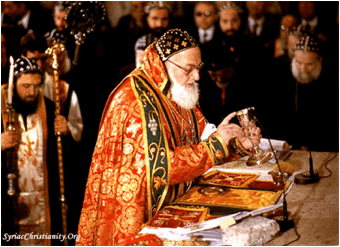
Moran Mor Ignatius Zakka I
Iwas, the 122nd successor to St. Peter in the
Apostolic See of Antioch.
Moran Mor Ignatius Zakka I Iwas, the 122nd successor to St. Peter in the Apostolic See of Antioch, completes 30 years in the Patriarchal See on the day of the Feast of Holy Cross, 2010. The Universal Syrian Church with its flocks spread over many nations, celebrates this unique historic occasion, of His Holiness's Silver Jubilee of the Patriarchal enthronement, with great fervor and enthusiasm. It was on September 14, 1980, the Holy Father was enthroned as the Patriarch of Antioch and All the East and the Supreme Pontiff of the Universal Syrian Orthodox Church. He is one of the very few primates of the Syrian Church who have been in the Patriarchal office for an entire quarter of a century. As a true Shepherd, His Holiness has led the Holy Church to greater glories in these years of his Patriarchal See.
His Holiness was born on April 21, 1933 into the faithful family of 'Iwas' in Mosul, Iraq. He was born as the fourth child and was named 'Seenaherib' (name of the father of St. Behnam). His Holiness had three brothers and three sisters. The forbears of Patriarch Zakka, the Iwas family, originally belonged to Jessera on Tigris; they migrated to Mosul about three hundred years ago. Some of his ancestors adorned very important posts in the Kingdom. His grand father has received an award from King Faisal I of Iraq for his excellence in his job as Chief craftsmen and architect of the State.
The father of His Holiness, Basheer Iwas, who graduated from the University in Istanbul, the then capital of Ottoman Empire, later became a Professor in the Military Engineering College there. A faithful member of Church, he was very enthusiastic in attending the Church Services regularly and also inspired others to follow his path. It was his ardent desire to mould one of his sons as a priest to serve the Holy Church. After a few years of teaching, he left for his home state in Iraq where he started a woodworking factory of his own. But unfortunately, misfortune struck the family a few years later; Basheer Iwas died of a Cardiac arrest. His Holiness was only 10 at that time. Two years later in 1945, his wife, the mother of His Holiness, also passed away. Thus the young Seenaherib, who later came to be known as Zakka, becomes parentless at a tender age of 12.
Ecclesiastical life & Graduation
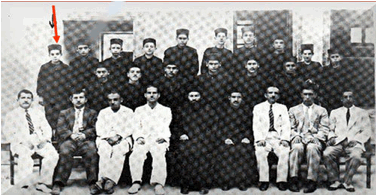
After the death of his parents, Young Zakka decided to enter into the ecclesiastical life, thus fulfilling the wishes of his beloved father. But then some of his family members who felt bad about the parentless child being dragged into difficult circumstances, tried to discourage him. However our holy father, who from the age of six dreamt of becoming a monk, remained determined in his choice that finally paved the way for the family too to comply with his decision. Thus he joined the St. Ephrem Theological Seminary in Mosul in 1946 at the age of 13 and was henceforth came to be called 'Zakka'.
On November 28, 1948, young Zakka was ordained 'Koroyoo' (Deacon) by H. E. Mor Athanasius Touma Kasseer and on February 8, 1953, he was elevated to the rank of 'Afodyaknoh' (Half Deacon) by H.E. Mor Gregorios Paulos Behnam. The very next year he graduated with a diploma from the seminary.
 June
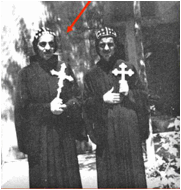
6, 1954, is an important date in the life of His Holiness. The Holy Father
accepted the order of monastic life on that day. He was then 21. It was Mor
Gregorios Paulos Behnam who ordained him Rabban (monk). His Holiness recalls
this as a very special day in his life. He used to say that he always felt the
God caring him greatly though his parents left him in his childhood; he
prayed to God and He cared him greatly.
June
6, 1954, is an important date in the life of His Holiness. The Holy Father
accepted the order of monastic life on that day. He was then 21. It was Mor
Gregorios Paulos Behnam who ordained him Rabban (monk). His Holiness recalls
this as a very special day in his life. He used to say that he always felt the
God caring him greatly though his parents left him in his childhood; he
prayed to God and He cared him greatly.
On December 18, 1955, H.E. Mor Divanasious Jirges Behanam promoted the new monk to the rank of full deacon. In the year 1955, he joined the Patriarchal Staff in Homs as an assistant to the Patriarchal Secretary.
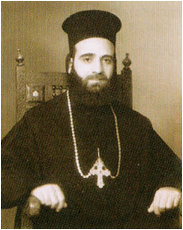 Young
Zakka's performance in schools was always excellent; he consistently scored
high marks. His elementary education was in the schools at the Al-Tahra
Al-Dakhilyah's church (Our Lady's church) and Mor Touma's school (St.Thomas
school) at Mosul. In 1957 he graduated from the college with 97 % of
marks. Thus he completed his studies with success on the fields of
history, philosophy, theology and church-law. He advanced in Syriac, Arabic and
English languages, and received diplomas in each of these fields.
Young
Zakka's performance in schools was always excellent; he consistently scored
high marks. His elementary education was in the schools at the Al-Tahra
Al-Dakhilyah's church (Our Lady's church) and Mor Touma's school (St.Thomas
school) at Mosul. In 1957 he graduated from the college with 97 % of
marks. Thus he completed his studies with success on the fields of
history, philosophy, theology and church-law. He advanced in Syriac, Arabic and
English languages, and received diplomas in each of these fields.
Soon after the graduation, he joined the faculty of the seminary where he taught Syriac, Arabic and the Bible. Little later, Rabban Zakka was called to the Patriarchate by the then Patriarch of Antioch Moran Mor Ignatius Aphrem I, one of the most erudite scholars and efficient administrators the Church has seen in modern times. Rabban Zakka became the second, and later the first, Secretary to the Patriarch. After the demise of Moran Mor Aprem I, he continued as First Secretary to the new Patriarch, Moran Mor Ya`qub III
On November 17, 1957, Patriarch Mor Ya`qub III ordained him a priest. On April 15, 1959, the Patriarch decorated him with ‘the Holy cross of the grand monk.
From 1955 to 1958 Rabban Zakka studied journalism as a part-time student and took a diploma in journalism. In 1960, he joined the General Theological College of the Episcopal Church in New York in the United States, where he studied oriental languages, philosophy and pastoral theology and mastered in the English language. The college, later in 1983, offered His Holiness an Honorary Doctorate in theology.
Rabban Zakka traveled widely, both on his own and in the company of Patriarch Ya`qub III. He was at that time fortunate to visit all the countries in the Middle East and the America. In 1962 and 1963 he was delegated by the late Patriarch to attend the two Sessions of the Second Vatican Ecumenical Council as an observer. It was while at the Vatican that he was called to the Episcopal office.
Metropolitan.
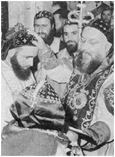 On
November 17, 1963, Rabban Zakka was ordained Metropolitan by the Patriarch Mor
Ya`qub III for the Mosul Archbishopric with title 'Severious'. Thus he came to
be known as Mor Severios Zakka.
On
November 17, 1963, Rabban Zakka was ordained Metropolitan by the Patriarch Mor
Ya`qub III for the Mosul Archbishopric with title 'Severious'. Thus he came to
be known as Mor Severios Zakka.
The very next year in 1964 he visited India along with the Patriarch where he participated in the Universal Synod of the Syrian Orthodox Church, held in Kottayam. He later assisted the Patriarch Mor Ya`qub III during the consecration of the first canonical Catholicos of Malankara, Mor Baselios Augen I, on May 21, 1964.
Discovery of St. Thomas relic.
On September 1, 1964, during the
renovation of the Madboho of the ancient St.Thomas Church at Mosul, Mor
Severious Zakka discovered the remains of Apostle Thomas in the sanctuary
wall. It was a memorable event in the Episcopal life of the Holy
Father. In the first sermon of the Holy Father when he visited India as
Patriarch of 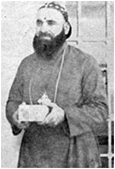 Antioch in 1982 he said, “When we think of St. Thomas, our heart
is particularly thrilled because we are very closely connected to St. Thomas.
Even though St. Thomas enjoyed his martyrdom here in India, and was entombed in
Mylapore, we were the Metropolitan of the church in which the holy relics of
St. Thomas have been kept for the past many centuries. One day, unexpectedly,
by the grace of God, we were led to reveal the Holy Relics of St. Thomas once
again to humanity. It was unknown to the present generation, as to where the
holy relic of St. Thomas was kept. But in 1964, according to the will of God,
we were able to discover the Holy Relics which were kept in the walls of the
sanctuary of our St. Thomas’ church in Mosul, Iraq which is the Cathedral
church of our Archdiocese of Mosul."
Antioch in 1982 he said, “When we think of St. Thomas, our heart
is particularly thrilled because we are very closely connected to St. Thomas.
Even though St. Thomas enjoyed his martyrdom here in India, and was entombed in
Mylapore, we were the Metropolitan of the church in which the holy relics of
St. Thomas have been kept for the past many centuries. One day, unexpectedly,
by the grace of God, we were led to reveal the Holy Relics of St. Thomas once
again to humanity. It was unknown to the present generation, as to where the
holy relic of St. Thomas was kept. But in 1964, according to the will of God,
we were able to discover the Holy Relics which were kept in the walls of the
sanctuary of our St. Thomas’ church in Mosul, Iraq which is the Cathedral
church of our Archdiocese of Mosul."
A portion of this Holy relic discovered by Mor Severios Zakka was presented to Malankara Church when Catholicos Mor Augen I paid a visit to the Patriarchate in 1965. In 1994, a small portion of the Holy Relic was again presented to Malankara to be kept at the ancient Mulanthuruthy Marthoman Church that is known as the 2nd Jerusalem of the Syrian Church. Three fathers of the Syrian Church who arrived from Near East were entombed in this church. The Holy Mooron was consecrated in this church once by Patriarch Moran Mor Ignatius Abded 'Aloho, in 1911. This ancient church has also been the venue for two historical Synods of the Malankara Church, one in 1876 and the other in 2004; both were held under the auspices of the Patriarchs of Antioch.
Additional charges as Metropolitan
As Metropolitan of Mosul the Holy Father took special interest in youth activities. Under him, the diocese flourished spiritually and materially. In 1967 he was given additional charge of the European Diocese. In 1969 he was transferred to the Archdiocese of Baghdad and Basra, perhaps the most prestigious archbishopric in the Middle East. In Baghdad he built churches and opened secondary schools and high schools. As in Mosul, in Baghdad also he took keen interest in the spiritual life of the youth.
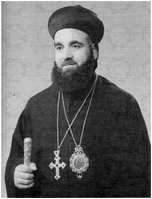 Following
the demise of H.E. Thimotheos Yacoub, Metropolitan Mor Severious Zakka was
given the additional charge of the ancient monastery of St. Mathew (Mor
Mattai Dayro) in Iraq. In 1976, he was appointed as the Metropolitan of
Middle Europe and Scandinavian countries and in 1978 Mor Severios Zakka was
given additional responsibility for the new diocese in Australia. He
consecrated several churches and organized congregations in Melbourne, Sydney
and a few other places.
Following
the demise of H.E. Thimotheos Yacoub, Metropolitan Mor Severious Zakka was
given the additional charge of the ancient monastery of St. Mathew (Mor
Mattai Dayro) in Iraq. In 1976, he was appointed as the Metropolitan of
Middle Europe and Scandinavian countries and in 1978 Mor Severios Zakka was
given additional responsibility for the new diocese in Australia. He
consecrated several churches and organized congregations in Melbourne, Sydney
and a few other places.
On June 26, 1980, the Patriarch Mor Ya`qub III passed away and was entombed at
the St. George Cathedral, Damascus. Consequent to this, the Episcopal Synod was
called to choose the new successor to the Apostolic See. The Holy Synod
held on July 11, 1980, with His Beatitude the Catholicos of the East Mor
Baselios Paulose II in the chair, unanimously elected Mor Severios Zakka,
Archbishop of Baghdad and Basra as the new Patriarch of Antioch and All the
East. This marked the beginning of a new era in the history of the Church.
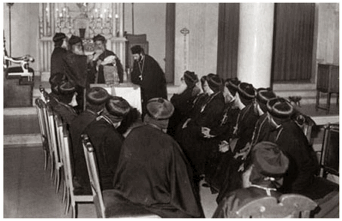
Catholicos Mor Baselios Paulose II presiding the session of the
Holy Episcopal Synod at Damascus that elected
Mor Severios Zakka as the 122nd Patriarch of Antioch and All the East
Patriarchal Enthronement
On September 14, 1980, Mor Severios was installed as the 122nd Patriarch of
Antioch & all the East, by name IGNATIUS ZAKKA I, in a rite officiated by
the late lamented Catholicos of the East Aboon Mor Baselios Paulose II, along
with the archbishops of the Universal Syrian Orthodox Church. It was for
the first time in the history of the Universal Syrian Church that the chief
celebrant for the Patriarchal enthronement was an Indian.
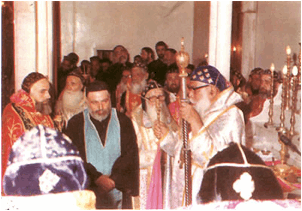
Catholicos of the East H.B. Mor Baselios Paulose II heading the Enthronement ceremony of
His Holiness Ignatius Zakka I Iwas as the 122nd Patriarch of Antioch and All the East
at the Patriarchal Cathedral, Damascus, on 14th September 1980.
Since that blessed day, the Syrian Orthodox Church has witnessed a remarkable revival through the guidance of the Holy Spirit and the pastoral care of H. H. Ignatius Zakka I Iwas. The 25 years of Mor Ignatius Zakka's Patriarchate have been eventful and significant. In his very first address after adorning the Patriarchate, he stressed the need for a major seminary and center for the Church. This was a great dream of the new Patriarch. The Syrian Orthodox Patriarchate after moving from the Monastery of Mor Hananyo (Deir ez-Za`faran/Kurkumo Dayro) in Turkey, to Syria in the last century, lacked a proper center in the new circumstances. It was the Holy fathers' vision that filled this gap. He acquired extensive lands, about 20 miles away from Old Damascus, where he built a magnificent Seminary with all facilities for theological students, accommodations for the visiting dignitaries, residence of the Patriarch etc. Though officially, the Patriarchate still functions in the St. George Cathedral, Bab Touma, in the city of Damascus, His Holiness resides at the Mor Ephrem Seminary in Ma`arat Sayyidnaya, in the suburb of Damascus, Syria.
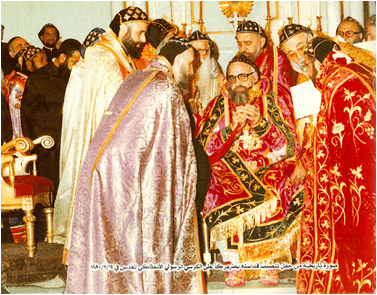
The Church that was in turmoil for a while because of persecution is now
witnessing a revival with establishment of churches and institutions in all
parts of the world where the Syrian Christians has migrated. The largest
congregation of the Church outside the Middle East and India is now situated at
Germany where about 100,000 Syrian Orthodox Christians has settled. Similarly
the Church has grown to other nations like Holland, Australia, USA, Canada and
South America. And in all such countries, Monasteries, churches and other
institutions have come up. Young bishops selected and ordained by the
Holy Father increased the pace of growth in all these place.
On July 26th 2002, His Holiness installed Mor Dionysius Thomas, the president
of the Episcopal Synod of Indian Church, as the Catholicos of India with the
title Baselios Thomas I. This was a great event in the history of the
Church in India.
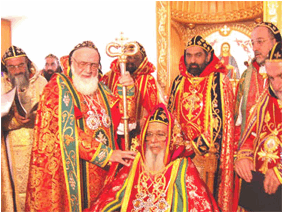
Holiness Mor Ignatius Zakka I Iwas, the Patriarch of Antioch and all the East consecrating His Beatitude the Catholicos Aboon Mor Baselios Thomas I
The new Catholicos was consecrated as the immediate successor to the late Mor Baselios Paulose II who led the enthronement ceremony of His Holiness in 1980. Now the Holy Synod of the Universal Syrian Orthodox Church consists of 64 prelates besides the Patriarch and the Catholicos, of which 34 were ordained by our Patriarch Moran Mor Ignatius Zakka I Iwas.
6 October 2010
New Orthodox patriarch says Kosovo remains Serb 'sacred land'
Warsaw (ENI). The Serbian Orthodox Church's new patriarch has reiterated his
country's claim to Kosovo during an enthronement service in the newly
independent republic that was boycotted by the Kosovo government. "Kosovo
and Metohija are today without hundreds of thousands of expelled Serbian
people. All traces of their spiritual historical roots are being
eradicated," said Patriarch Irinej, whose sermon was published by the
Serbian church's information service. "There are still tens of thousands
of refugees from this sacred land," said the Patriarch. They remain turned
toward their age-old bosom, and with tearful eyes and painful hearts anticipate
the day and possibility in which they can return to their destroyed and burned
homes." The 80-year-old church leader was preaching on 3 October at the
13th century monastery of Pec, traditionally regarded as the see of Serbian
patriarchs. In January he had been enthroned in Serbia.
South African churches among exhibitors at 'Sexpo' show
Johannesburg (ENI). Three churches were among exhibitors at a sex exposition in
South Africa, saying they aim to promote healthy sex within marriage. The
churches were among non-sex industry organizations at the four-day Health,
Sexuality and Lifestyle Expo – South Africa that included, a cancer
prevention group, rhino protection charities and cosmetic companies. In 2009
there had been strong criticism about the exposition from some religious
groups, but those churches that had exhibits felt the time was opportune to
preach about the word of God, and sex, within marriage.
Inter-faith council condemns West Bank mosque burning
Jerusalem (ENI). The Council of the Religious Institutions of the Holy Land has
expressed "grave concern" over the 3 October burning by militant
Israeli settlers of a mosque in the West Bank village of Beit Fajar near
Bethlehem. "The CRIHL strongly condemns these and similar acts of
vandalism and arson which have taken place in the past year," said the
council in a 5 October statement. It added, the council, "calls upon
people from all faiths - Christians, Jews and Muslims - Palestinians and
Israelis - to refrain from any assault on places of religious significance and
not to resort to extremism and the exploitation of religion for a political and
territorial gain." The religious council represents the Chief Rabbinate of
Israel, the Palestinian Ministry of Religious Affairs, the Palestinian [Islamic]
Sharia Courts and the assembly of the Heads of [Christian] Churches of
Jerusalem.
7 October 2010
South African 'moral compass' Tutu officially retires
Cape Town (ENI). Nobel Peace Prize Laureate, Archbishop Desmond Tutu,
often described as South Africa's moral compass, officially retired on his 79th
birthday saying he wishes to devote time to his wife, Leah, and family. Tutu,
who was a major figure in the struggle against apartheid, announced in July
that he would step down from public life, and would stop giving media
interviews, from 7 October, his birthday. "I have got a wife and family
that help to keep my head the right size. Just when I am thinking that I am the
cat's whiskers, they remind me that, 'you are just daddy for us and husband',"
Tutu was quoted saying by the South African Press Association. South Africa's
Daily Dispatch newspaper editorialized on 7 October, "He has epitomized
tolerance and understanding, popularizing the African concept of ubuntu, which
calls for forgiveness and to the ability to always show 'humanity to
others'." U.S. President Barack Obama congratulated Tutu saying in a
written statement, "For decades he has been a moral titan - a voice of
principle, an unrelenting champion of justice, and a dedicated peacemaker.
"
African churches can play key role in Middle East, says WCC head
Nairobi (ENI). African churches can play a key role in addressing the crisis in
the Middle East, the general secretary of the World Council of Churches, the
Rev. Olav Fykse Tveit, has said. "This is also a call for you as African
churches," Tveit said, in addressing the All Africa Conference of Churches
in Nairobi. "You have something to contribute in the reflection about
access to land as a matter of justice and they [Palestinian Christians] also
are very encouraged by your way of expressing your faith, that it is possible
to pray and see results." Tveit, a Norwegian Lutheran was in Kenya and
Ethiopia in late September as part of his first visit to Africa as WCC general
secretary. He noted the vibrancy of Christianity on the continent. He said,
during his 23 September speech in Nairobi, that the Middle East is a region
where many conflicts in the world get constant fuel.
Bedroom must be 'playground' say Filipino Christian counselors
Manila (ENI). Three Filipino evangelical Christian counselors have designed a
course for married parishioners evolving around a topic that pastors cannot
discuss openly from their pulpits – sex. "The Bible, not
pornographic magazines, can teach us how to enhance and enjoy our sexual life
and help strengthen our relationships as married couples," said the Rev.
Clemente Guillermo, one of the counselors. He was speaking during a seminar
attended by more than 50 married couples and ENInews on 2 October. The Philippine
Council for Evangelical Christians, which groups evangelical churches and
fellowships nationwide, supported the seminar.
Ban on school Christmas carols upheld in US district
Washington DC (ENI/RNS). "Silent Night" and other religious songs
will remain off the programme at holiday concerts in one New Jersey school
district - and possibly others across the country - after the U.S. Supreme
Court declined to hear an appeal of a school ban on religious holiday music. By
deciding on 4 October not to hear the case, the high court ended a six-year
legal battle that started when parent Michael Stratechuk sued the School
District of South Orange and Maplewood over a policy that barred religious
songs at public concerts, Religion News Service reports. The 3rd U.S. Circuit
Court of Appeals upheld the ban last year, and Stratechuk attempted to take the
case to the higher court.
8 October 2010
Hong Kong Christian leaders urge release of Nobel laureate Liu
Hong Kong (ENI). Hong Kong Christian leaders have urged the government in
Beijing to release 2010 Nobel Peace Prize laureate, Liu Xiaobo, who was honored
for his "long and non-violent struggle for fundamental human rights in
China". Representatives from the Roman Catholic Justice and Peace
Commission of Hong Kong and the Christian Concern Hong Kong Society joined
activists in petitioning the Chinese government's liaison office in Hong Kong
soon after the announcement of the prize in Oslo on 8 October. They asked
Beijing to release Liu, who initiated the "08 Charter" that asked for
greater democracy and respect for human rights. More than 10 000 people in
China and overseas had signed the charter. In 2009, one year after the release
of the charter, Liu was sentenced to 11 years in prison and two years'
deprivation of political rights for "inciting the subversion of State
power". Liu has consistently maintained that the sentence violates both
China's constitution and fundamental human rights.
Catholic bishops to discuss Middle East Christianity
Rome (ENI). A special meeting of Roman Catholic bishops will be held at the
Vatican beginning 10 October to discuss the declining number of Christians in
the Middle East. Monsignor Nikola Eterovic, general secretary of the bishops'
synod, told journalists on 8 October that the meeting will take place from 10
to 24 October, on the theme "The Catholic Church in the Middle East:
Communion and Witness". A total of 185 Roman Catholic clerics will
participate, most of them coming from the Middle East, including Saudi Arabia,
Bahrain, Cyprus, Egypt, the United Arab Emirates, Jordan, Iran, Iraq, Israel,
Kuwait, Lebanon, Oman, Qatar, Syria, Turkey, the Palestinian Territories and
Yemen. While 356 million people live in the region, Eterovic said only 5.7
million, or 1.6 percent, are Catholic, and 20 million, or 5.6 percent, are
Christian. Pope Benedict XVI will open the synod, to which he has also invited
12 "fraternal delegates" from the Oriental and Eastern Churches of
the Middle East, known as Orthodox churches.
Malawi multi-faith group condemns Bible tearing in Muslim area
Blantyre (ENI). Faith groups in the southern African nation of Malawi have
condemned the tearing up of Bibles by people at Mangochi, a predominantly
Muslim district in the country's southern region. Gideon International, a
Christian organization that distributes free Bibles in conjunction with the
Bible Society of Malawi, early in October handed out the Christian holy book to
students in the district, angering parents who thought the two organizations
were planning to convert their children. "The Holy Bible was being given
to children at a school and all the children seemed to have been given [the
Bible], which infuriated some Muslim parents who tore the holy books," the
acting chairperson of the Public Affairs Committee, a multi-faith pressure
group, the Rev. MacDonald Kadawati told the Nation newspaper on 7 October.
"Others from the same faith quickly mobilized each other and collected the
Bibles and returned them to Gideon International," said Kadawati.
Europe's Catholic bishops establish Christian rights watchdog
Warsaw (ENI). Europe's Roman Catholic bishops have set up an organization to
defend the rights of Christians as well as monitoring prejudice and injustice
across the continent. "Our first task will be to provide people around
Europe with objective and reliable data about the anti-Christian discrimination
which is taking place, as well as to alert Catholic bishops’ conferences and
other religious institutions," Thierry Bonaventura, media officer of the
Council of Catholic Episcopates of Europe, told ENInews. "But we also want
to encourage local church groups to be involved and take concrete steps against
intolerance, such as by presenting reports to the United Nations and the
Council of Europe, and encouraging them to take appropriate measures."
Bonaventura was speaking after the announcement of the formation of the
Observatory on Intolerance and Discrimination, headed in Vienna by Bishop
Andras Veres of Hungary, and Austrian lay director, Gudrun Kugler, during a
meeting of the bishops in Zagreb.
11 October 2010
Muslims, Christians can tackle conflicts together, says WCC head
Geneva (ENI). Muslim and Christian leaders need to set up permanent structures
of relating to each other to head off potential conflicts in a world where
religion is often seen as having a divisive role, the head of the World Council
of Churches has said. "The role of religion in emerging geo-political
contexts is rapidly changing," WCC general secretary the Rev. Olav Fykse
Tveit, said in a speech to a meeting in Albania of the WCC's Commission of the
Churches on International Affairs. "While religion often plays a
commendable role as a force for promoting justice, peace and reconciliation, in
the 21st century its role has been much more divisive," said Tveit, a
Norwegian theologian who took up his WCC post in January.
Pope denounces violence in God's name at meeting on Middle East
Vatican (ENI). Pope Benedict XVI has denounced violence committed in God's
name, when he addressed around 250 people attending a special meeting of
bishops from the Muslim-majority Middle East. In off-the-cuff remarks, the Pope
referred to, "The power of the terrorist ideology that carries out
violence in the name of God, but this is not God. These are false divinities
that must be unmasked, because they are not God." At the 10 October Sunday
service Benedict spoke about the future of Christians in the Middle East who
made up 20 percent of the population a century ago, but today account for less
than 6 percent, as war and poor economic conditions have triggered their
departure. Jewish and Muslim representatives are also attending the 10-24
October gathering, called a synod.
Mother Teresa's tomb is Anglican leader's first Indian stop
Bangalore, India (ENI). The Archbishop of Canterbury, Rowan Williams, has begun
a 16-day visit to India by paying tribute to Mother Teresa at her tomb in
Kolkata, the north eastern city once known as Calcutta, the capital of West
Bengal state. "The Archbishop of Canterbury had expressed a desire to
visit Mother Teresa's tomb first when the trip was planned," Ashoke
Biswas, the Church of North India bishop of Kolkata told ENInews on 11 October.
After praying on 9 October at the tomb of Mother Teresa, Williams visited the
room of the Roman Catholic nun who would become a Nobel Peace Prize laureate,
and the exhibition on her life at the Mother House of her Missionaries of
Charity.
Report on the UN-NG0 Briefings - Dated October 28,2010
http://www.lightmillennium.org/undpi/diversity_world_cultures.html
Briefing presented by: Department of Public Information Non-Governmental Organizations
“Learning beyond limits.”
Promoting Diversity of World Cultures and the Links that United Them
(In Observance of 2010 International Year of Rapprochement of Cultures)
http://www.lightmillennium.org/undpi/diversity_world_cultures.html
Report and photos by: Sirin CENGIZALP, Lightmillennium.Org
http://www.lightmillennium.org/
* The Light Millennium is approaching its 11th Anniversary...
* For the $1 On-Line Open Membership & Partner Campaign through NYCharities.Org
http://www.nycharities.org/app/lightmillennium
"Fostering Global Connectivity”,” Promoting 'Freedom of Expression' from all walks of life in every corner of the world," "Removing prejudices," and "Working towards to cultural globalization and global peace."
"The Light Millennium is <http://www.lightmillennium.org/> a 501 (c) (3) Tax Exempt and Public Benefit Organization & has become associated with the UNDPI effective on December 12, 2005. Formed in 2001, based in Queens, New York - On the Web since August 1999... YOU ARE THE SOUL OF THIS GLOBAL PLATFORM. & WE ARE FOR THE GREATNESS IN HUMANITY."
27 October 2010
No tolerance for caste discrimination, says India
church gathering
Bangalore (ENI). Churches in India need to show zero tolerance concerning
caste-based discrimination within their ranks, a gathering of Christian leaders
in New Delhi has said. "Casteism is a sin and caste-based discrimination
is a crime," said a statement issued from the conference in New Delhi.
"Since discrimination is contrary to the spirit of the Gospel, churches
will have to be zero tolerance zones with regard to the practice of caste
discrimination." Though the caste system has been officially abolished in
India, discrimination against Dalits - low castes treated as
"untouchables" - persists. They often have to survive by scavenging
and doing menial jobs, while living segregated from higher castes in rural
areas.
Ukraine minority churches back rights for Greek Catholics
Warsaw (ENI). Minority churches in Ukraine have urged authorities in the
capital Odessa to allow the construction of a church for Greek Catholics, after
an Orthodox archbishop who sits on the local council intervened to block the
project. "Our joint address to you was provoked by the atmosphere of
unhealthy aggression artificially created in this city by certain
circles," the church leaders said in a letter to the city mayor and head
of regional administration in Odessa.
Bishop of ancient Christian church warns on Protestant dialogue
Hong Kong (ENI). The Assyrian bishop in the United States says his ancient
church that was one of the first in China will not have any official dialogue
with Protestant churches that support the blessing of homosexual partners or
the ordination of women. Bishop Mar Awa Royel, the president of an inter-church
relations commission of the Assyrian Church of the East, told a Hong Kong
audience earlier in October that the church is committed to ecumenical dialogue
but that it will not support dialogue with churches that it believes deviate
from the teachings of Jesus Christ. The Assyrian Church was once referred to as
the Nestorian Church, and had earlier been regarded as heretical and faced
persecution.
October 7, 2010 – St. Nersess Armenian Seminary, New Rochelle, NY
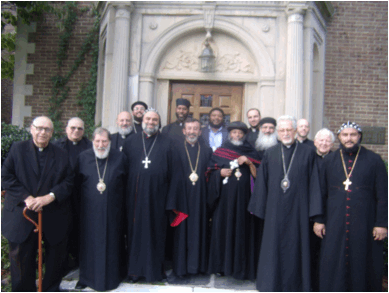
Attendees: Archbishop Mor Cyril Aphrem Karim, Archbishop Abune Zekarias, Archbishop Yeghishe Gizirian, Archbishop Mor Titus Yeldho, Archbishop Vicken Aykazian, Fr. John Meno, Fr. Daniel Findikyan, Fr. Anthony DeLuca, Fr. Kess Mahitama Selassie, Fr. Tateos Abdalian, Fr. Ambe Tsion, Fr. David Bebawy, Fr. John Rizkalla, Fr. Joseph Chamoun.
|
COMMUNITY ALERT: Turbans to Always be Searched at Nation’s Airports |
|
Sikh Organizations Coordinating Joint Action |
|
|
4 November 2010
Christian and Muslims want to mobilize joint crisis group
Geneva (ENInews). Global Christian and Muslim leaders meeting in Switzerland
have jointly called for the formation of a group that can be mobilized whenever
a crisis threatens to arise in which Christians and Muslims find themselves in
conflict. In a closing statement from their 1-4 November meeting at Geneva's
Ecumenical Center, the leaders of the two faiths said, "Religion is often
invoked in conflict creation, even when other factors, such as unfair resource
allocation, oppression, occupation and injustice, are the real roots of
conflict." The meeting at the Geneva center, which houses the World
Council of Churches and other Christian organizations, was convened by the WCC,
the Libyan-based World Islamic Call Society, the Jordanian-based Royal Aal al
Bayt Institute and the Consortium of "A Common Word", a group that
includes Muslim scholars from around the world.
German churches to bridge former iron curtain in merger
Trier, Germany (ENInews). Three regional Protestant churches in northern Germany
have cleared a key hurdle to forming one united church that will that will
stretch from the Danish border to Poland. A majority of 266 delegates from all
three churches voted overwhelmingly on Reformation day, 31 October, in favor of
a draft constitution and a church law that provides for the merger. The church
will be officially called the Evangelical Lutheran Church of Northern Germany
or in its shortened form the Nordkirche, the Northern church.
UN ENVIRONMENT CHIEF
CALLS ON G20 TO BUILD ON PREVIOUS PLEDGES OF GREEN GROWTH
New York, Nov 9 2010
As world leaders gather in the Republic of Korea for
the latest meeting of the Group of 20 (G20) major economies, the head of the
United Nations environmental agency is calling on them to build on their previous
pledge to move towards a green and more sustainable recovery from the financial
crisis with more concrete action.
“A year ago in London, G20 leaders articulated this vision as building an
‘inclusive, sustainable and green recovery,’” wrote the Executive Director of
the UN Environment Programme (UNEP), Achim Steiner, in an opinion piece
published today in the Korean JoongAng Daily newspaper.
“In Seoul, this vision needs to be evolved toward not only a green recovery,
but to inclusive, sustainable green growth underpinned by clean technologies
and the economic importance of maintaining nature's multi-trillion dollar
services.”
Features
More Iraqi Christians Consider Leaving Iraq After Attack on Baghdad Cathedral
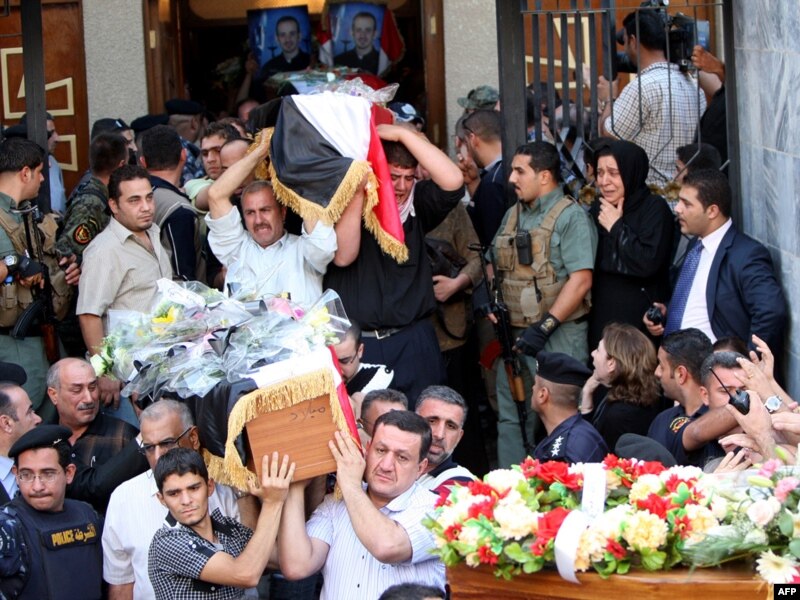
Christians carry coffins of their slain relatives during a funeral service at a church in Baghdad on November 2 for victims of the attack at the Assyrian Catholic Church of Our Lady of Salvation on the evening of October 31.
November 04, 2010
By Maysoon Abo al-Hab, Ron Synovitz
BAGHDAD -- Vian
Jabburi, a 22-year-old Roman Catholic, was celebrating Mass in Baghdad with her
father on October 31 when Al-Qaeda militants stormed the church.
Shot through her shoulder during the ensuing siege, Jabburi survived. Her
father was also shot and slowly bled to death, while she lay helpless at his
side in a pool of her own blood.
"Nothing resembles this experience. Nothing," Jabburi tells RFE/RL as
she breaks down in tears at her father's funeral. "The situation was very,
very difficult. I still don't know whether it was reality or just a nightmare.
I do not know. I really don't know.
"We were bleeding for four or five hours without receiving any help,"
she adds. "I will leave it to God. He is the only one who can take our
revenge."
Jabburi is among thousands of Iraqi Christians who suffered through years of
sectarian violence in Iraq but is now considering whether to stay any longer.
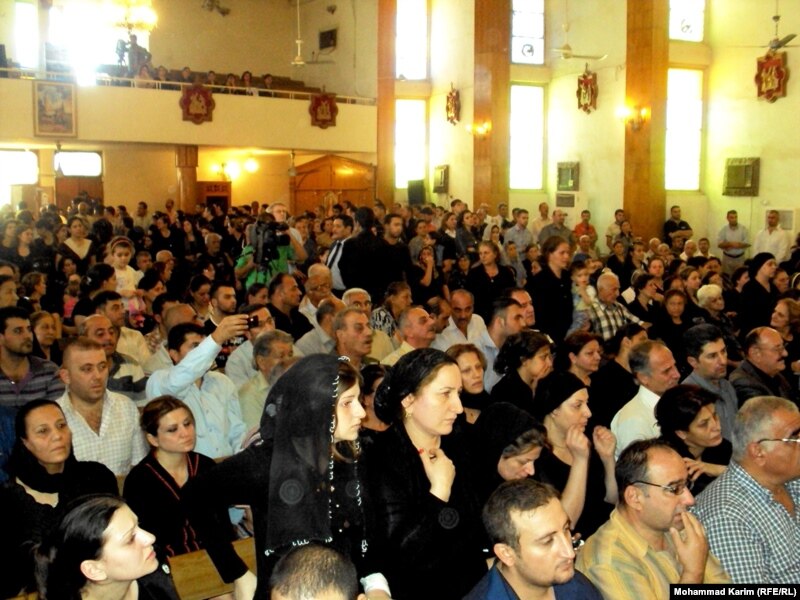
A funeral Mass for the victims of the attack was held at Baghdad's Mar Yusuf Church.
Raad Ammanuel, head of
the Office of Christian Endowment in Baghdad, says the attack has caused many
Iraqi Christians to rethink whether they have a long-term future in Iraq.
"Those who have an injured member of their family or lost a loved one,
they are talking about leaving the country," Ammanuel says. "We do
not want this to happen and we do not encourage it. But still, we can not stop
people from thinking this way. I have been discussing this with them. But what
can I say and how can I reply when they ask me if I am going to bring back the
ones they have lost?"
'This Is Our Country'
But other Iraqi Christians are adamant in their determination to stay. Among
them is the family of Hanan Fadhil, a math teacher in the Karrada district
whose cousin was killed in the October 31 assault.
"They want to destroy the country and create divisions and
conflicts," Fadhil says. "We've been living here all our lives and we
are not going to leave Iraq. We will stay. This is our country. I was born in
1956 and I'm now 54 years old. I've been here since then. How can I leave this
country?"
Baghdad's heavily fortified Karrada district has been an island of tolerance in
Baghdad, where Shi'ite and Sunni Muslims have continued to live alongside
Christians in relative harmony.
Luis al-Shabi, a Chaldean priest at the Mars Polis Church there, says most
residents blame criminals and extremist fanatics for violence that has targeted
Iraqis of all faiths.
"When a country is not stable, such things can happen. It happened many
times in mosques and it happened also in [Christian] churches many times,"
Shabi says. "One of them is this recent disaster.
"But I have to say that Muslims do not do such things," he continues.
"Those who commit such acts are not believers of Islam nor Christianity
and not even in God. When they have the chance, they come to kill and to
massacre people regardless of whether the victims are Muslims or
Christians."
Targets Of Al-Qaeda
Indeed, Iraqi Christians have faced the same pattern of beheadings,
kidnappings, rapes, and extortion that plagued Iraq's Shi'ite and Sunni
communities during the years of chaos after the 2003 U.S.-led invasion and
before the surge operations of 2007 brought relative stability.

An Iraqi Christian woman (right) holds a picture of her son who was killed in the attack.
That violence caused
many Muslims to leave their homes, along with the hundreds of thousands from
Iraq's Christian minority who have fled the country.
During the rule of Saddam Hussein, there were an estimated 1.4 million
Christians living in Iraq -- many of them Chaldean-Assyrians and Armenians, but
also a smaller number of Roman Catholics.
Exact figures are impossible to confirm, but some estimates say two-thirds of
Iraq's Christians have left the country since 2003 -- leaving fewer than
450,000 Iraqi Christians there today.
Al-Qaeda militants want the exodus to continue. On November 3 they threatened
to carry out more attacks against Iraqi Christians.
The Islamic State of Iraq, which claimed responsibility for the Baghdad
cathedral assault, linked its warning to allegations that Egypt's Coptic Church
is holding women captive if they convert to Islam.
The group -- an umbrella organization that includes Al-Qaeda in Iraq and other
allied Sunni insurgent factions -- is also demanding the release of Al-Qaeda
prisoners held in Iraq.
Inflaming Sectarian Strife
Abu Gaith, a 28-year-old Sunni Muslim from the Karrada neighborhood, thinks
Al-Qaeda has a deeper motive for targeting Christian churches.
"Everything is clear. The goal is to create problems and aggravate the
already tense situation," he says. "The attackers are trying to
create new opportunities and light a fire near a barrel of oil. They want the
situation to go back to how it was two or three years ago, when there were
sectarian conflicts between Sunnis, Shi'a or battles between Muslims and
Christians".
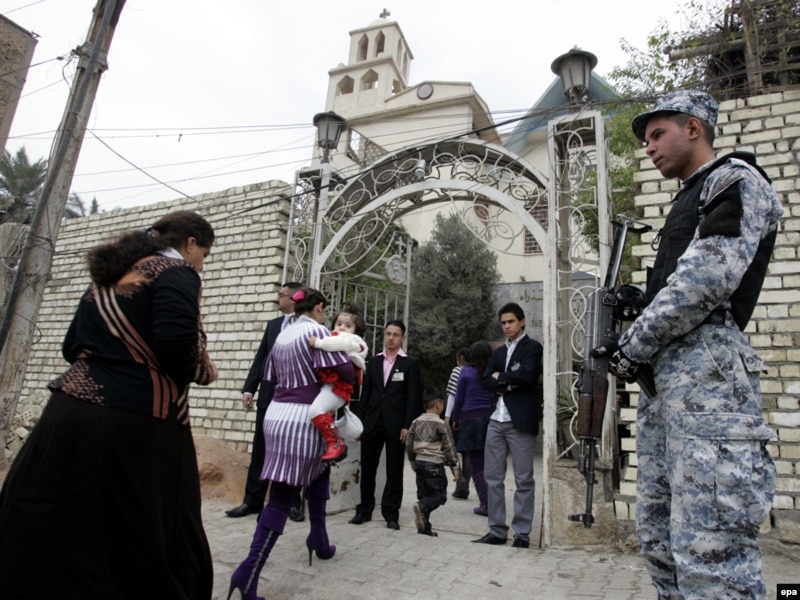
Are Iraqi security forces able to protect Christians, or any other Iraqis, from violence?
Western security
analysts have come to the same conclusion, saying a weakened Al-Qaeda in Iraq
is now trying to rebuild its reputation through high-profile terrorist attacks.
Jane's Security and Military Intelligence Consulting -- part of the
British-based Jane's Information Group -- says Al-Qaeda in Iraq is trying to
reignite large-scale and prolonged sectarian violence through focused attacks,
particularly in Baghdad. It also warns that a wave of attacks across the
country in late August suggests the withdrawal of U.S. combat troops from Iraqi
cities has given the terrorist organization the space it needs to rebuild.
The analysis from Jane's concludes that the inability of Iraqi politicians to
agree upon a new governing coalition has been detrimental to the abilities of
Iraqi forces to maintain security.
Residents of the Karrada district agree. "The only reason for what
happened, not only [at the cathedral] but for what is happening every day, is
the incompetence of [Iraqi] security forces, especially those deployed in the
Karrada district," says Ahmad Jassim, a 40-year-old Shi'ite Muslim who
owns a minimarket close to the cathedral in Karrada.
"We know there is a checkpoint or a police car in front of every
church," he continues. "Now, how did the gunmen enter the church?
Were there clashes before? We did not hear about clashes, which means [the
gunmen] entered very easily. Again, how did this happen, especially in Karrada,
which is almost like a military camp now?"
That sentiment reflects the concerns of many Baghdad residents -- whether
Shi'ite, Sunni, or Christian -- who say they have little confidence in the
protection provided by Iraqi security forces as the withdrawal of U.S. forces
from Iraq continues.
UN MARKS WORLD PHILOSOPHY DAY WITH CALL FOR GREATER USE OF REASON
AND DIALOGUE
New York, Nov 18 2010 12:10PM
The United Nations marked
<"http://www.unesco.org/new/en/social-and-human-sciences/themes/human-rights/philosophy/philosophy-day-at-unesco/philosophy-day-2010/">World
Philosophy Day today with a call for greater efforts to guard against the
politics of polarization and the rejection of stereotypes, ignorance and
hatred.
“Let us instead fortify our societies through reason and dialogue – the
lifeblood of philosophical debate,” said Secretary-General Ban Ki-moon, in a
video message for an event marking the Day at the Paris headquarters of the UN
Educational, Scientific and Cultural Organization (UNESCO). “And let us
recognize the critical role that the age-old tradition of philosophy can play
in our modern, interconnected world.”
World Philosophy Day is celebrated every third Thursday of November since 2002,
with the aim of making philosophical reflection accessible to all –
professors and students, scholars and the general public – thereby
enlarging the opportunities and spaces for the stimulation of critical thinking
and debate.
“Philosophy deals routinely in universals – in broadly shared questions
about human existence, beliefs and behavior. That gives it uncommon power to help build bridges between
people, and to open channels of communication among cultures,” Mr. Ban said.
“So let us use this essential expression of the human mind to change the minds
of men and women – for that is where, as UNESCO’s own Charter so
memorably states, true peace begins.”
Celebrations to mark the Day were organized by academics in more than 80
countries, in all regions of the world. A special event was held at UNESCO
Headquarters, interweaving philosophy, cultural diversity and the rapprochement
of cultures – with the latter tying in to the 2010 celebration of the
International Year for the Rapprochement of Cultures.
Since its creation, UNESCO has used philosophy to implement the ideals that
inspired its Constitution; these ideals stem from philosophical tradition.
UNESCO’s Director-General, Irina Bokova, inaugurated the Paris event, which
included an international forum on the topic “Philosophy, Cultural Diversity
and Rapprochement of Cultures,” with the participation of
internationally-renowned philosophers and eminent figures, in addition to a
series of symposia and round-table discussions.
“Philosophy actually teaches diversity lessons through its numerous schools of
thought in all eras and on all continents,” Ms. Bokova said in her
<"http://unesdoc.unesco.org/images/0018/001899/189970e.pdf">message
for the Day. “In view of the intricacies of current issues, we should tap into
that wealth in order to build our capacity to analyze reality.”
She also called for intensified efforts to provide everyone with quality
education and an enabling environment in which every man and woman can express
his or her ideas and enrich public debate in furtherance of justice and peace.
the Secretary-General
--
MESSAGE ON THE INTERNATIONAL DAY FOR THE
ELIMINATION OF VIOLENCE AGAINST WOMEN
25 November 2010
As we observe the 2010 International Day for the Elimination of Violence against Women, let us acknowledge the widespread and growing efforts to address this important issue. No longer are women’s organizations alone. From Latin America to the United States, from Asia to Africa, men and boys, young and old, musicians, celebrities and sports personalities, the media, public and private organizations, and ordinary citizens are doing more to protect women and girls and promote their empowerment and rights.
The social mobilization platform “Say NO-UNiTE” has recorded almost 1 million activities implemented by civil society and individuals worldwide. In August this year at the fifth World Youth Conference in Mexico, young activists from around the world were clear in their message: “It’s time to end violence against women and girls!” Member States, too, are engaged. As of November 2010, my database on the extent, nature and consequences of violence against women, which also logs policies and programmers for combating the pandemic, has registered more than 100 reports from governments.
This year’s observance highlights the role the business community can play – from developing projects to providing direct financial support to organizations working to end violence and embracing the principles of corporate social responsibility. The "Women’s Empowerment Principles", an initiative of the UN Global Compact and UNIFEM, recognize the costs to business of violence against women and are now supported by more 120 leading companies. A growing number of media outlets are bringing light to bear on so-called “honor-killings”, trafficking of girls and sexual violence in conflict, and are raising awareness about the benefits to society of empowering women. Yet much more needs to be done. In homes, schools and the office, in refugee camps and conflict situations, the corporate sector can help us to prevent the many forms of violence that women and girls continue to face.
My UNiTE to End Violence against Women campaign, and the Network of Men Leaders I launched last year, have generated welcome momentum and engagement. The word is spreading: violence against women and girls has no place in any society, and impunity for perpetrators must no longer be tolerated. On this International Day, I urge all – Governments, civil society, the corporate sector, individuals – to take responsibility for eradicating violence against women and girls.
22 November 2010
Pakistani minister denies release of Christian blasphemy accused
Thrissur, India (ENInews). There is confusion about the fate of a Christian
woman sentenced to death under Pakistan's draconian blasphemy law after a
minister in the country's government denied reports that President Asif Ali
Zardari has ordered her release. "This is not true," Shahbaz Bhatti,
the federal minister for minorities, told ENInews on 22 November from his
office in Islamabad regarding the release of Aasia Bibi, who was sentenced to
death on 9 November for blasphemy. The verdict had led to widespread
international criticism ranging from human rights groups to the churches, with
Pope Benedict XVI calling for her release.
Europeans feature in Pope's new list of cardinals
Rome (ENInews). In his selection of 24 new cardinals, Pope Benedict XVI has
ensured that half of the college that elects the pontiff will be Europeans,
although the number of Roman Catholics is growing in Africa and Asia, whilst
declining in Europe. Of the cardinals created on 20 November by the Pope, 15
are Europeans, of whom 10 are Italians, while nine come from the Americas,
Africa and Asia. One of the newly created cardinals is Kurt Koch, 60, who was
bishop of Basel in Switzerland until June, when he was named by Benedict as the
president of the Pontifical Council for Promoting Christian Unity. There are
now 203 cardinals, but only 121 of them are eligible to elect a pope, after
Pope Paul VI decided that only cardinals under the age of 80 have the right to
take part in the conclave.
Terrorists attack Christians too!!! It is worth knowing it and seeing it....
http://caritasveritas.blogspot.com/2010/11/baghdad-massacre-more-reports-from-iraq.html
Rivka
Bertisch Meir, Ph.D., MPH., LMHC
http://www.doctorrivka.com/
23 November 2010
UNAIDS says Pope's condom move makes HIV cooperation easier
Geneva/Rome (ENInews). The head of UNAIDS, Michel Sidib, says a statement by
Pope Benedict XVI that the use of condoms is justified when intended to reduce
"the risk of HIV infection" will make it easier for international
organizations to cooperate with faith-based organizations in the fight against
HIV and AIDS. Sidib? is the executive director of UNAIDS, the United Nations
programme on HIV and AIDS. He was answering a question about the Pope's
statement during a 23 November media conference in Geneva. "The
announcement will make cooperation easier with faith-based organizations, in
the fight against HIV and AIDS," said the head of UNAIDS. "This is an
important step forward." The Roman Catholic Church rejects condoms as a
means of birth control and had for many years said they are not a means of
preventing AIDS.
Police raid Sudan churches' offices during referendum build-up
Nairobi (ENInews). The head of the Sudan Council of Churches has been calling
for close scrutiny of out-of-country referendum registration processes in
Kenya, Uganda and Egypt, while also reporting that police recently stormed the
council offices breaking down doors, and conducted a search. The Rev. Ramadan
Chan Liol, the general secretary of the council, said police forced their way into
the council's offices in Amarat Khartoum on 14 November, a Sunday, as 200 men
who arrived in seven trucks cordoned off the building. The churches' leader
said one police officer had said the building was suspected of being a hideaway
for weapons. The raid came as Africa's biggest country is preparing for a
plebiscite on 9 January to determine if the north and south will split, Chan
noted.
German Protestant head says a European Islam needed for dialogue
Trier, Germany (ENInews). A European form of Islam needs to develop before a
meaningful interfaith dialogue can take place on the continent, the new leader
of Germany's 24 million Protestants has said. "We are only at the
beginning of a serious inter-religious discussion on a theologically high level
and that is because there are problems with finding counterparts," the
Rev. Nikolaus Schneider told ENInews in an interview in Trier. "The imams
who come from Turkey to Germany can hardly speak German and that means that we
need to train imams in Germany at our universities," said Schneider, who
was elected the new chairperson of the Evangelical Church in Germany (EKD) on 9
November during a meeting of its governing synod in Hanover. Schneider
said that one of his priorities in his new post is to set up as soon as
possible a meeting with representatives of Islam in Germany, which has about
four million Muslims.
Pope says he looks forward to meeting with Russian Patriarch
Rome (ENInews). Pope Benedict XVI has in comments made in a newly published
book says he hopes for a meeting "in the not too distant future" with
Patriarch Kirill I of the Russian Orthodox Church. The book, "Light of the
world", was presented on 23 November to international media at the
Vatican. It is the text of an extended interview with the pontiff conducted in
July by German journalist Peter Seewald. Benedict's predecessor, Pope John Paul
II, spoke repeatedly about his dream of visiting Russia, but met resistance
from the Moscow Patriarchate, which had accused the Vatican of aggressively
seeking converts among Russian Orthodox faithful.
WORLD HERITAGE SITES IN
CYPRUS AND ITALY GRANTED SPECIAL PROTECTION STATUS BY UN
New York, Nov 26 2010
A United Nations committee tasked with safeguarding the world’s valued cultural
heritage that might be threatened in times of armed conflict has granted
enhanced protection status to three sites in Cyprus and another one in Italy,
it was announced today.
The sites – Choirokoitia, Paphos and the Painted Churches of the Troodos
region in Cyprus, as well as the Castel del Monte in Italy – were
declared as being in need of enhanced protection by the Committee for the
Protection of Cultural Property in the Event of Armed Conflict of the UN
Educational, Scientific and Cultural Organisation (UNESCO) during a meeting in
Paris this week.
“We do not ever want a repeat of the destruction of cultural sites such as the
Mostar Bridge in Bosnia and Herzegovina, or attacks like those against the old
city of Dubrovnik in Croatia during the Balkans conflict,” said Committee
Chairman Nout van Woudenberg.
“Enhanced protection status reinforces the legal measures in place to prevent
such terrible losses to the world’s cultural heritage,” he added after the
status was granted, the first such decision by the Committee.
The “enhanced protection” status is one of the features of the 1999 Second
Protocol to the Hague Convention of 1954 for the Protection of Cultural
Property in the Event of Armed Conflict.
The granting of such protection by the Committee to sites in countries that are
party to the Second Protocol can be made under three conditions – that
the site be of the greatest importance to humanity; that it be protected by
adequate domestic legal and administrative measures recognizing its exceptional
cultural and historic value and ensuring the highest level of protection; and
that it not be used for military purposes or to shield military sites.
The protection means that States cannot fall back on the argument of
“imperative military necessity” for using or targeting cultural sites in times
of conflict. It also obligates States to make intentional attacks against
identified sites a criminal offence or to penalize use of such sites or their
immediate surroundings in support of military action.
Nov 26 2010
________________
Please also go to our website: http:IgnatiusU.com in order to
see our programs in theology, philosophy, psychology and diplomacy (at the
United Nations). In addition, there are programs leading to the
Certified Alcohol and Substance Abuse Counselor, CASAC and Licensed
Psychoanalyst, LP.