|
Holy Wisdom Peace: Showing that Others Matter! |
|
|
VOLUME XX I WINTER 2011 |
|
|
Publication of the Syrian Orthodox Church in America on United Nations Affairs. This publication is disseminated to the entire membership of the Church throughout the world on a quarterly basis. Please bring this information to the attention of your parishioners and all those under your care. The Earth is holy and a manifestation of God. Pray for peace and the UN. Anne Riccitelli, Litt, D. United
Nations Representative Kathryn Rahill, Asst. Editor, Youth
UN Representative Antoinette A. DeLuca, Psy.D.
President |
|
EDITOR’S NOTE: It is necessary through the collaboration of
NGOs to raise awareness among communities as we promote peace. If you will, the need for community
consciousness is a way we can connect parties and others. It is important at this time that all parties
begin to realize that they are a part of a larger picture, that they are in it
together and they have common concerns.
If there is a conflict all parties have contributed to the conflict and
they have the power to come together to develop a non-violent intervention to
result into a resolution. It is time for
us as people to acknowledge that there is something more that exceed our own
individual positions and needs. The
United Nations, religious institutions and NGO can be an avenue to promote
community consciousness to encourage global consciousness, clear and realistic
decisions as they promote non-violent solutions to conflicts!
Pope encourages talks with Oriental Orthodox
churches

 January 28, 2011
Pope Benedict XVI met on January 28 with members of a joint commission for dialogue between the Catholic Church and the Oriental Orthodox churches. The Pontiff expressed appreciation for their work and confidence for the future of the ecumenical dialogue.
The Oriental Orthodox churches are those Christian bodies that broke away with Rome in the wake of the Council of Chalcedon in 451, over disagreements on the christological doctrines affirmed by that council. The Oriental Orthodox churches include the Armenian Apostolic, Syrian, and Coptic Orthodox—but not the larger Russian, Greek, and other Orthodox churches of the Byzantine tradition.
Since the commission was established in 2003, the Holy Father observed, the group has reached a basis for agreement on the nature of the Church. The Pope observed: “We can only be grateful that after almost 1,500 years of separation we still find agreement about the sacramental nature of the Church, about apostolic succession in priestly service and about the impelling need to bear witness to the Gospel of our Lord and Savior Jesus Christ in the world.” The commission has now moved on to discussions on the communion among Christian churches prior to the Council of Chalcedon, and the role of monasticism in early Christianity.
In addressing the Orthodox members of the panel, Pope Benedict noted that many “come from regions where Christian individuals and communities face trials and difficulties that are a cause of deep concern for us all. “ He emphasized that all Christians have a moral obligation to work for justice and to support each other in such times of need.
World churches' leader to meet Pope in Rome
Geneva (ENInews). The general secretary of the World Council of Churches, the
Rev. Olav Fykse Tveit, says he hopes his upcoming audience in Rome with Pope
Benedict XVI will advance Christian unity. "It is important that we speak
honestly in this meeting about the challenges we have," Tveit said of the
4 December meeting at the Vatican. It will be Tveit's first meeting with
Pope Benedict since the Norwegian Lutheran theologian took up his WCC post in
January. "There are expectations for the ecumenical movement that have not
been fulfilled, and there are tensions arising in and between churches,"
Tveit said in a 2 December statement issued from the WCC's Geneva headquarters.
Some observers have suggested that the Vatican sees relations with Eastern
Orthodox churches as having a higher priority than contacts with Protestants.
Korean churches say global prayers needed after military clash
Tokyo (ENInews). The head of the Seoul-based National Council of Churches in
Korea has urged global prayers during Advent for peace on the peninsula
following a North Korean military attack on a South Korean island. The
council's newly-elected general secretary, the Rev. Kim Young-Ju, said he
wanted the "prayer and solidarity of the worldwide churches" to help
nurture peace. Advent marks the period of the church year before Christmas and
commemorates the coming of Jesus into the world. Kim made his appeal in a 1
December statement on the council's Web site, which also urged North and South
Korea to use only peaceful means to achieve reunification of the two countries
that were divided after the Second World War.
Swiss church group urges 'don't buy Zimbabwean diamonds'
Geneva, 2 December (ENInews)--The Swiss church-backed group Bread for All says
numerous human rights violations are being committed in certain Zimbabwe's
diamond mines by State security forces and the minerals should be labeled
"blood diamonds". Bread for All (Switzerland) is calling on the
government of Switzerland, as a member of the Kimberley Process, to demand the
exclusion of certain Zimbabwean diamonds tainted by links to human rights'
violation from international trade. Marlon Zakeyo, who heads the Zimbabwe
Advocacy Office in Geneva, told ENInews, "Switzerland is an important
jeweler centre, but it is also known as a country that is a centre for human
rights. The Swiss government is also a key partner in the Kimberley Process,
which deals with international diamond trading."
Muslims say respect is key to better relations
Washington DC (ENInews/RNS). Half of Muslims surveyed worldwide believe the
West does not respect them, according to a new Gallup report. "We also
found that this concept of respect ... now includes perceptions of fairness in
policies, not just culturally sensitive language," said Dalia Mogahed,
executive director of the Gallup Center for Muslim Studies, Religion News
Service reports. The findings are part of a report on "Measuring the State
of Muslim-West Relations", released on 1 December at Gallup's Washington
headquarters.
Another Iraqi Syrian
Orthodox Christian murdered in Mosul
Posted by: "SOCM News Bureau" SOCM
News Bureau
Thu
Dec 2, 2010 2:18 pm (PST)
Another Iraqi Syrian Orthodox Christian murdered in Mosul
December 02, 2010
The targeted murder of another Christian in Mosul has drawn a new protest from
Church leaders, who are demanding effective government action to ensure their
security.
Gunman who broke into his home seized Fadi Walid Gabriel, a Syrian Orthodox
layman; he was taken to a nearby empty shop where he was killed.
Eight Christians have now been murdered in Iraq-- all in execution-style
killings-- since the October 31 massacre at the parish of Our Lady of Salvation
in Baghdad.
6 December 2010
Pope gets gloves from ecumenical leader to warm relations
Rome (ENInews). The head of the World Council of Churches in his first official
meeting with Pope Benedict XVI has said he wants to strengthen cooperation with
the Roman Catholic Church, especially in the Middle East. No official statement
was released after the 4 December audience at the Vatican, but the WCC general
secretary, the Rev. Olav Fykse Tveit, told journalists in Rome there had been a
"a very open and friendly" conversation. He noted that at the
meeting, he and Pope Benedict had stressed that there are many levels at which
the WCC and Roman Catholic Church already cooperate.
Indian churches hail probe into pastor-led 'child trafficking'
Chennai, India (ENInews). Church officials and activists have welcomed an
investigation ordered by India's federal Supreme Court into trafficking in
children by pastors and exploitative Christians eyeing ways to pull in foreign
donations. "Such unscrupulous social work by some Christians is bringing
discredit to the entire Christian community. Such transplantation will not help
the growth of the children," Bishop G. Devakadasham, the Church of South
India's deputy moderator, told ENInews. Devakadasham heads the CSI diocese of
Kanyakumari in the southern Tamil Nadu state where the National Commission for
Protection of Child Rights has conducted raids on dubious orphanages at the
direction of the Supreme Court.
US clergy's professional reputation hovers in the middle
Washington DC (ENInews/RNS). What do nurses, soldiers, pharmacists,
elementary school teachers, doctors, and police officers have in common? U.S.
Americans say they are all more ethical and honest than members of the clergy,
according to a Gallup survey released on 3 December, Religion News Service
reports. Slightly more than half of Americans (53 percent) rate the moral
values of priests, ministers and other clerics as "very high" or
"high."
7 December 2010
Filipino sugar laborers' lives painful, church group finds
Tarlac, Philippines (ENInews). Life is not sweet for workers at a sugar estate
owned by the family of Philippines' President Benigno Aquino III, a visiting
church group has found. "I have been watching closely developments in the
Philippines since the late dictator (Ferdinand) Marcos was ousted in 1986 but
it looks like much remains to be desired in this so-called democratic
country," Tony Waworuntu, a former staff member of the Christian
Conference of Asia, told ENInews.
King James Bible still exerts influence, literary scholar argues
New York (ENInews). The King James Bible may not be the dominant cultural
reference point it once was in the United States, but it still influences
contemporary letters in the country, argues a new book. While "we no
longer have a culture pervaded by Scripture, where Bible reading is a daily
practice in parlor and pulpit," the King James Bible's influence remains
embedded in American culture, writes scholar Robert Alter in "Pen of Iron:
American Prose and the King James Bible". King James I of England
authorized the King James Version of the Christian Bible. Completed in 1611, it
became the standard Bible in the English-speaking world up through the 20th
century. Its cultural influence in Britain, and subsequently the American
colonies and later the United States, has long been noted.
Survey: Typical US atheist is white son of religious parents
Washington DC (ENInews/RNS). The typical member of a fast-growing U.S.
atheist association is a highly educated, married white male who grew up with
religious parents. The Freedom from Religion Foundation, which grew from 5500
In 2004 to about 16 000 members this year, announced results of a
survey of its members on 1 December, Religion News Service reports. Asked about
their primary reason for being "de-converted from religion to
free-thought," about a third of respondents said, "Religion doesn't
make sense." Seventeen percent said religious hypocrisy or bigotry was the
cause; 9 percent said reading skeptical authors; 5 percent cited reading the
Bible.
UNIVERSAL DECRIMINALIZATION OF HOMOSEXUALITY A HUMAN RIGHTS IMPERATIVE, BAN
SAYS
New York, Dec 10 2010
Noting that over 70 countries still consider homosexuality a crime,
Secretary-General Ban Ki-moon today appealed for its complete and universal
decriminalization, stressing that human rights must always trump cultural
attitudes and societal strictures.
In an event on sexual orientation at UN Headquarters in New York, held in
conjunction with Human Rights Day, Mr. Ban
<"http://www.un.org/apps/sg/sgstats.asp?nid=4992">deplored
discrimination against homosexuals and the violence of which they are often
victims, for which the perpetrators escape punishment.
“Together, we seek the repeal of laws that criminalize homosexuality, that
permit discrimination on the basis of sexual orientation or gender identity,
that encourage violence,” he said. “When individuals are attacked, abused or
imprisoned because of their sexual orientation, we must speak out. We cannot
stand by. We cannot be silent.
“This is all the more true in cases of violence. These are not merely assaults
on individuals. They are attacks on all of us. They devastate families. They
pit one group against another, dividing larger society. And when the
perpetrators of violence escape without penalty, they make a mockery of the
universal values we hold dear.”
Mr. Ban recognized that social attitudes run deep and social change often comes
only with time, but he highlighted the collective responsibility to stand
against discrimination, to defend fellow human beings and fundamental
principles.
“Let there be no confusion: where there is tension between cultural attitudes
and universal human rights, universal human rights must carry the day,” he
said. “Personal disapproval, even society’s disapproval, is no excuse to
arrest, detain, imprison, harass or torture anyone – ever.”
Mr. Ban noted that during his recent trips to Africa, he urged leaders to do
away with laws criminalizing homosexuality. He was particularly pleased that in
Malawi he was able to secure the release of a young gay couple sentenced to 14
years in prison, with President Bingu wa Mutharika freeing them on the very day
he asked him to.
Last night Mr. Ban
<"http://www.un.org/apps/sg/sgstats.asp?nid=4988">spoke to a
Human Rights Day event at the Ford Foundation in New York called ‘Speak Up,’ at
which one of his fellow speakers was a young activist from Uganda, Frank
Mugisha, who has been working with a variety of civil society groups to stop
legislation that institutionalizes discrimination against gay and lesbian
people.
“With extraordinary eloquence, he appealed to us, the United Nations, for
help,” Mr. Ban said today. “He asked us to rally support for the
decriminalization of homosexuality everywhere in the world. And that is what we
will do. We have been called upon, and we will answer.”
Pledging to “put myself on the line” in this struggle, he said he would
continue to speak out, at every opportunity, wherever he goes. “I will do so
because this is the right thing to do, because this cause is just,” he declared.
“That is why this day, this very special day, means so much to me. Human Rights
Day commemorates the Universal Declaration of Human Rights.
“It is not called the partial declaration of human rights. It is not the
sometimes declaration of human rights. It is the universal Declaration,
guaranteeing all human beings their basic human rights – without exception.
Violence will end only when we confront prejudice. Stigma and discrimination
will end only when we agree to speak out. That requires all of us to do our
part, to speak out – at home, at work, in our schools and communities – to
stand in solidarity.”
At an event in Geneva today, UN High Commissioner for Human Rights Navi Pillay
echoed Mr. Ban’s appeal, underscoring the need to protect the rights of
lesbian, gay, bisexual and transgender people through legislative reform and
education initiatives.
14 December 2010
Trade union founded for Bulgarian Orthodox clergy, lay employees
Sofia (ENInews). The founding of a trade union for Bulgarian Orthodox Church
priests and church employees has angered at least one member of the senior
hierarchy of the church, who denounced it as being against the church's canon
law. According to Bulgarian-language media reports on 13 December, the union
will be part of Podkrepa, one of the southeastern European country's two
national trade union federations. In the northwestern town of Vratsa, priests
said that they had not been paid on time for a long time and their statutory
health and retirement insurance had not been paid, the Standart daily newspaper
reported. The Vratsa Metropolitan Kipriyan said, however, it is
"absurd" for priests to have a trade union and that this is against
the church's own law.
Japanese Baptist leader says statistics hide impact of homelessness
Tokyo (ENInews). Being homeless cuts people off from the rest of humanity, says
a Japanese pastor who heads an award-winning non-profit organization for those
without a roof over their heads. "We need to support those homeless people
in both physical and relational poverty by providing them with their material
needs and helping to restore their human ties," said the Rev. Tomoshi
Okuda, who chairs the board of directors of the Kitakyushu Organization to
Support the Homeless in Fukuoka, southwestern Japan. He said government
statistics do not reveal the true cost of homelessness.
Presbyterian theologian takes helm at Indian church council
Bangalore, India (ENInews). A Presbyterian theologian, the Rev. Roger Gaikwad,
has been installed as the new general secretary of the National Council of
Churches in India, which groups 30 Orthodox and Protestant churches. "My
aim is to strengthen ecumenical relations at the grass roots. This will bring
out greater unity among the churches," Gaikwad told ENInews on 14 December
following his installation five days earlier at the NCCI's Nagpur headquarters
in central India. Fifty-seven-year old Gaikwad had been principal of the Aizwal
Theological College of the Presbyterian Church of India and was chosen
unanimously for the post in August.
SECURITY COUNCIL STEPS UP FIGHT AGAINST SEXUAL VIOLENCE IN
CONFLICT
New York, Dec 16 2010
The United Nations stepped up its battle against sexual violence in conflicts
around the world today with the Security Council calling for perpetrators to be
publicly listed and punished with sanctions.
“Even as we take this step here, catastrophe is unfolding for communities
caught in the chaos of conflicts,” Secretary-General Ban Ki-moon
<"http://www.un.org/apps/sg/sgstats.asp?nid=5003">told the
15-member body as the meeting today where it unanimously adopted the
resolution. 60 countries, including somewhere the worst cases of recent abuse
have been perpetrated, had sponsored it.
The Council resolution – voicing deep concern at the slow progress in combating
the scourge and the limited number of perpetrators brought to justice –
stresses the need to end impunity and vowed to take “appropriate steps to
address widespread or systematic sexual violence in situation of armed
conflict” in accordance with procedures of relevant sanctions committees.
It also asks Mr. Ban to include detailed lists of those credibly suspected of
committing or being responsible for rape and other forms of sexual violence in
his
Regular reports to the Council on the issue
“Armed elements are targeting civilians, raping women and men, and terrorizing
entire populations,” Mr. Ban said. “Pre-meditated campaigns are being waged
with the most sinister goals: to silence women leaders, to empty areas that are
filled with rich minerals but poor people, to recruit others and perpetuate the
cycle of abuse.”
UN, RELIGIOUS LEADERS PROMOTE EXCLUSIVE BREASTFEEDING IN INDONESIA
New York, Dec 21 2010
Faced with a marked decrease in exclusive breastfeeding in Indonesia, the
United Nations has teamed up with Government and religious leaders to promote a
practice that is proven to protect newborns and infants from disease, illness
and impaired development.
As Indonesia, the world’s fourth most populous country, commemorates national
Mothers’ Day this week, Muslim, Christian, Buddhist and Hindu leaders pledged
at a conference led by the Ministries of Health and Religious Affairs to
develop an action plan with their clerics to spread key information about the
benefits of exclusive breastfeeding for the first six months.
“Religious leaders have the power to persuade their followers about the
importance of breastfeeding, a simple life-saving practice that is referred to
in all the Holy Scripts including the Quran, the Bible, the Vedas and the Tripitaka,”
UN Children’s Fund (UNICEF) Representative Angela Kearney
<"http://www.unicef.org/media/media_57284.html">said.
“The health of the nation is dependent upon a shared vision and shared action
that can only come through practical partnerships… Every religion accepts a
responsibility to guide its followers, to show wisdom and foresight in enabling
people to make the right choices in life. Today, we are focusing on a critical
health issue, where our collective voices can offer life-saving guidance to
families.”
THE DPI NGO COMMUNITY
|
Through the
cooperation and collaboration of the NGO Community, United Nations Department
of Public Information Cluster, Government of Australia, Australian Convener,
Planning Committees in Melbourne and New York, and donors who enabled
delegates and speakers from developing nations to attend, we planned and
implemented a very successful conference. The Conference
Vision Statement provided a philosophical approach to foster global health
which emphasized the multidisciplinary, multifaceted issues in fostering
global health; not just managing disease. It helped us set goals and
priorities in planning and implementing the conference that included: disease
prevention, identification of skills and resources needed to design and
implement programs, and measures to evaluate their quality and
sustainability. Topics and discussions also included human rights, human
dignity and security, climate change, nuclear disarmament and their roles in
fostering global health and achieving the MDGs. We had the
largest number of delegates at any DPI/NGO Conference. Workshops discussed
issues and possible solutions to underlying social determinants of health
such as education, poor nutrition, substandard housing, contaminated water and
lack of sanitation, and gender inequalities. Exhibits amplified the work
being done in these areas by the NGO community and roundtables brought
together world experts who shared best practices in fostering health and
achieving the MDGs. A highlight of
the conference was the sensitive and beautiful indigenous welcome. Another
memorable moment was the introduction of a statement on "Strengthening
humanitarian response to severe floods in Pakistan," written by several
NGOs and unanimously approved by the delegates. Under-Secretary-General
delivered it to the Secretary-General for Communications and Public
Information Kiyo Akasaka. The most
significant document to emerge from the three-day meeting was the Conference
Declaration. The Declaration is based on the values of social justice, equity
and quality health care for all people and calls on all governments,
agencies, corporations and individuals to deliver on their human rights
obligations and provide the financial and political will necessary to achieve
the MDGs; as a moral imperative. The Declaration, forwarded by the Australian
Government to the President of the General Assembly, was circulated on 22
October. (The official UN symbol is A/65/525.) In closing, I
want to "thank" all who made this conference possible and
successful. I extend a special note of appreciation to my colleagues of the
NGO Community for providing me with this extraordinary opportunity to serve,
you, as Chair of the Conference. Together we helped educate the world
community that health is more than managing disease and remind them we have
the ability, and skill, to eliminate the social determinants that are the
root causes of illness and disease. Dr. Mary E.
Norton |
|
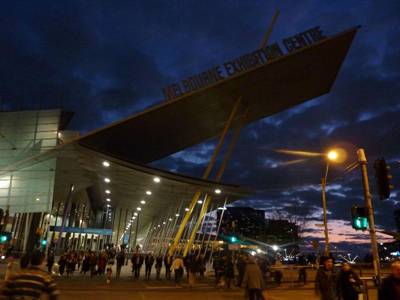
IN MELBOURNE, WE ARE ALL CONNECTED |
|
|
|
Over 45 exhibits
from NGOs working on global health and poverty eradication filled the foyer
of the Convention Centre. During breaks the foyer became an animated hub of
activity with delegates able to browse the colorful exhibits, or simply
engage likeminded individuals in conversation while enjoying the lunch and
refreshments provided. The participation
of youth in all aspects of the conference added another layer to the overall
experience. Each morning around 100 youth delegates gathered for breakfast at
the Centre. The breakfasts quickly became a time for youth to deepen their
engagement with the conference, swap ideas and to network. The Conference
brought the multicultural fabric of Melbourne to life. Highlights included a
symphony orchestra featuring musicians from over 20 different cultural
backgrounds, a sand animation artist, a traditional indigenous welcome and a
closing ceremony with hundreds of children performing on stage. All the elements
of the Conference were accessible to the general public, thanks to an
impressive social networking and outreach program. Live feeds of conference
proceedings, real time commentary on twitter and in-depth analyses were
available through the website www.makinghealthglobal.com.au. The conference
was well covered by local and international media The conference
Declaration was adopted with overwhelming support from the delegates. It
serves as a strong call to individuals, non-government organizations and
governments to unite in their efforts to improve global health and alleviate
poverty. Subsequently the Australian Ambassador to the UN transmitted the
Declaration to the President of the General Assembly who circulated it to the
representatives of all member states. It is
unacceptable that so many children and adults in low-income countries
continue to suffer preventable illness, disability and premature deaths each
year. The world knows how to prevent and treat most of the causes and has
shown that well-focused efforts can significantly reduce levels of suffering.
The MDGs can be, indeed must be, achieved by 2015! Philip
Batterham |
|
THE MELBOURNE CONFERENCE |
|
|
|
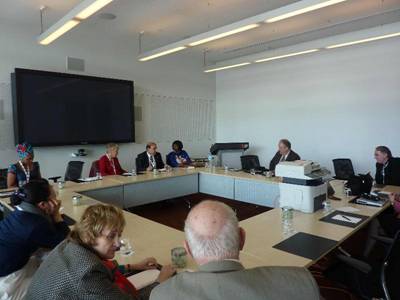
The three-day event
was a true example of successful partnership between the United Nations and
civil society to raise awareness about global health and the MDGs, and a
tribute to the important role of civil society in the United Nations system.
It featured experts in global health addressing the Opening and Closing
ceremonies, four Roundtables on how NGOs can participate in achieving the
MDGS, more than 50 NGO-organized workshops, and 50 NGO exhibits, including a
Youth MDG Village. The participants were also treated to several displays of
Aboriginal art and culture. In his remarks at
the Opening Ceremony, Kiyo Akasaka, Under-Secretary-General for
Communications and Public Information, said: "We have come to Australia
in recognition of this country's strong support and rich and varied
contributions to the United Nations since its very founding in 1945. And we
have come to the beautiful city of Melbourne in recognition of its history,
culture and care for its citizens, as well as for its embrace of those from
around the world". Describing global health as "the most important
and most pressing issue in the world", Mr. Akasaka noted that "The
fate of nations is inextricably linked to the health of their people." The enthusiastic
participation of numerous NGO youth representatives was a welcome development
at the Conference. This was acknowledged in speakers' remarks, as well as by
Mr. Akasaka, who said: "I have also been thrilled by the energy and
enthusiasm of all the participants and speakers, in particular the young people,
who have joined us and actively participated in our conference. We are all
heartened by your strong desire to become involved in improving the lives of
millions of children, mothers and people in need." The Conference
was accompanied by several public events linked to the themes of global
health and poverty. They were organized across Melbourne by civil society to
raise awareness of health issues. Also, NGO delegates were treated to several
demonstrations of Aboriginal and multicultural song and dance. The Conference
stage was adorned with Indigenous interpretations of the eight MDGs that were
carved into rock-like formations. The Conference
Declaration recognizes the relationship between the MDGs and human rights. It
notes that billions of people around the world still lack access to adequate
and appropriate food, improved sanitation and safe drinking water. It
underscores that almost 9 million children die before the age of five; while
several hundred thousands of women continue to die each year of pregnancy-related
causes. These are just a few examples in the Declaration, which also notes
that many more people die of insufficient access to health care, health care
professionals, and medicines or of non-communicable diseases; or face
discrimination and poverty as a result of their disabilities. My deepest
appreciation and thanks go to the Federal Government of Australia, the
Victorian State Government, and the Melbourne City Council for the enthusiasm
with which they embraced this Conference and the unwavering and generous
support they extended to it. Without their contributions, and dedicated
commitment, the convening of this event in Australia would have been
impossible. I would be remiss
if I did not express a word of thanks to the members of the Conference
Planning Committee in New York and Australia - as well as to NGOs worldwide -
for their selfless dedication and efforts to make this Conference a success. With warm regards
to all, |

UN AUTHORIZES NEW BODY TO STEM LOSS OF ECOSYSTEMS VITAL TO LIFE
New York, Dec 21 2010
A new international body aimed at reversing the unprecedented loss of species
and ecosystems vital to life on Earth due to human activity has passed its
final hurdle with
<"http://www.un.org/News/Press/docs//2010/ga11040.doc.htm">approval
by the United Nations General Assembly.
In a resolution adopted by consensus, the Assembly yesterday called on the UN
Environment Programme (UNEP) to take the necessary steps to set up the
Intergovernmental Science Platform on Biodiversity and Ecosystem Services
(IPBES), the final approval needed for the body for which the groundwork had
been laid at UNEP-sponsored meetings earlier this year.
“IPBES represents a major breakthrough in terms of organizing a global response
to the loss of living organisms and forests, freshwaters, coral reefs and other
ecosystems that underpin all life, including economic life, on Earth,” UNEP
Executive Director Achim Steiner said today.
It caps 2010 as the International Year of Biodiversity, launched in January to
raise awareness and generate public pressure for action by global leaders on
the vital link between biodiversity, ecosystems and survival, based on the
premise that the world's diverse ecosystems purify the air and the water that
are the basis of life, stabilize and moderate the Earth's climate, renew soil
fertility, cycle nutrients and pollinate plants.
IPBES, which in many ways mirrors the UN-backed Intergovernmental Panel on
Climate Change (IPCC) that has helped to catalyze government action on global
warming, will foster the search for government action needed to reverse the
accelerating degradation of the natural world and its species, which some
experts put at 1,000 times the natural progression.
COPTIC PRAYER SERVICE HELD AT ST. VARTAN CATHEDRAL NEW YORK
December 14, 2010
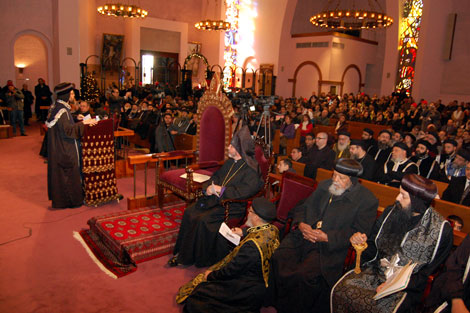
In light of a recent spate of violence and persecution against Christians in Egypt, members of the Coptic Orthodox Church of America gathered at New York’s St. Vartan Armenian Cathedral for a special prayer service.
Some 1,000 people took part in the service, which was organized by
the Coptic Orthodox Bishops in the United States.
The morning of worship and remarks included an address by Bishop
David, the Coptic General Bishop of North America, and other Coptic bishops, as
well as Archbishop Khajag Barsamian, Primate of the Eastern Diocese of the
Armenian Church of America.
Other speakers and participants included Archbishop Francis Assisi
Chullikatt, the Vatican’s permanent observer to the United Nations; Bishop
Serapion, of the Coptic Diocese of Los Angeles; Bishop Souriel, the Coptic
Bishop of Sidney, Australia; Bishop Youssef, the Coptic Diocese of Southern
United States; Bishop Marcarius, the Coptic General Bishop of North America;
and Bishop Michael, the Coptic General Bishop of Virginia. Others from the Eastern Diocese included
Archbishop Yeghishe Gizirian and the Rev. Fr. Madiros Chevian, dean of St.
Vartan Armenian Cathedral, the Rev. Fr. Tateos Abdalian, and the Rev. Fr.
Bedros Kadehjian, a representative of the Syrian Catholic Church also attended.
Egypt and the Destruction of Churches: Strategic
Implications
Over the past few days, Christian churches have been attacked in
at least two countries — Nigeria and Egypt — while small packages containing
improvised explosive devices were placed on the doorsteps of Christian families
in Iraq. Attacks against Christians are not uncommon in the Islamic world, driven
by local issues and groups, and it is unclear whether these latest attacks were
simply coincidental and do not raise the threat to a new level or whether they
indicate the existence of a new, coordinated, international initiative. There
is a strong case to be made for the idea that there is nothing new in all of
this.
Yet I am struck by the close timing of events in three distant and
dispersed countries. Certainly, Egyptian intelligence services are looking for
any regional connections (e.g., whether Iraqi operatives recruited the Egyptian
bomber). While there have been previous bombings in Egypt, they have focused on
tourists, not churches. What is important is this: If the recent attacks are
not coincidental, then a coordinated campaign is being conducted against
Christian churches that spans at least these countries. And it is a network
that has evaded detection by intelligence services.
UN LAUNCHES FIRST WORLD INTERFAITH HARMONY WEEK
New York, Feb 1 2011
The United Nations launched the first World Interfaith Harmony Week today
with a broad range of activities around the world, including interfaith
breakfasts, film screenings and talks featuring the active participation
of civil society, UN entities and other intergovernmental organizations.
The UN General Assembly in November resolved that the first week of
February be devoted to spreading “the message of interfaith harmony and
goodwill in the world’s churches, mosques, synagogues, temples and other
places of worship... based on love of God and love of one’s neighbor or on
love of the good and love of one’s neighbor, each according to their own
religious traditions or convictions.”
“The first World Interfaith Harmony Week is an opportunity to focus global
attention on the efforts of religious leaders, interfaith movements and
individuals around the world to promote mutual respect and understanding
between followers of different faiths and beliefs,” Secretary-General Ban
Ki-moon <"http://www.un.org/News/Press/docs//2011/sgsm13382.doc.htm">said
in a message. “These partners play an indispensable role in supporting
United Nations efforts for peace.
“Respect for diversity and peaceful dialogue are essential if the human
family is to cooperate globally to face shared threats and seize common
opportunities,” said Mr. Ban.
“That is why efforts by States, civil society and other actors to build
trust among communities and individuals lie at the heart of so many United
Nations initiatives, from the Alliance of Civilizations to our
wide-ranging work to protect human rights, promote social cohesion
and build a culture of peace.”
The Alliance of Civilizations is an initiative launched in 2005 by
Spain and Turkey under UN auspices to promote better cross-cultural
relations worldwide.
>From Jerusalem to Malappuram in India, from Amman in Jordan to
Pietermaritzburg in South Africa, from Sedona in the United States to
Newcastle in Australia, and a myriad of other places special events are
being held to shine the spotlight on the need for interfaith understanding.
Feb 1 2011
The Committee of Religious NGOs at the
United Nations
The Committee of Religious NGOs at the
United Nations voted to officially endorse World Interfaith Harmony Week, as
proclaimed by the UN General Assembly for 1-7 February annually.
This year, the RNGOs will host an interfaith breakfast to celebrate the Week on
Thursday, February 3rd from 8:30-9:45, prior to the DPI NGO briefing. The
location will be announced shortly, since it depends on the briefing location,
which has not yet been determined. If you would like to serve on the task force
for this event, please contact Monica Willard
<MBWillard@aol.com>.
INTERFAITH BREAKFAST
The Committee of Religious NGOs Helps Launch the First Annual
WORLD INTERFAITH HARMONY WEEK
3 February 2011
The Committee of Religious NGOs at the United Nations, working with the UN Department of Public Information, hosted an Interfaith Breakfast on 3 February 2011 to help launch World Interfaith Harmony Week. World Interfaith Harmony Week was proclaimed by UN General Assembly Resolution A/65/PV.34 to fall on the first week of February of every year. It was proposed in 2010 by HM King Abdullah II and HRH Prince Ghazi bin Muhammad of the Hashemite Kingdom of Jordan, and was warmly supported by Secretary-General Ban Ki-moon.
Monica Willard, President of the Committee of Religious NGOs, saw the Week as an excellent project for RNGOs to demonstrate their commitment to interfaith solidarity and support of the goals of the United Nations. The RNGOs enlisted the partnership of the NGO Section of the UN Department of Public Information, organizing the breakfast for 8:30-9:45 a.m., preceding the weekly DPI NGO briefing. The NGO Section sent the invitation to the entire list of affiliated NGOs, greatly helping to publicize World Interfaith Harmony Week. The Salvation Army, itself an NGO, kindly offered the use of its space on East 52nd Street, where many of the DPI NGO briefings have been held during the current period of UN reconstruction.
Despite the early hour and the ice storm the day before, nearly 100 people attended the event. They were greeted by a lovely continental breakfast buffet set up by volunteers from the New Seminary for Interfaith Studies. Along with their refreshments, they enjoyed quotes on harmony from various traditions that were posted on the walls, such as:” All human beings regardless of religion, race, national origin, color, creed, or gender are living icons of God, innately worthy of such respect and dignity.” (Ecumenical Patriarch Bartholomew)
Monica opened the brief formal part of the gathering by inviting Commissioner Christine MacMillian, Director of the Salvation Army Social Justice Commission, to welcome everyone, which she did with great warmth. Rev. Deborah Moldow of the Committee of Religious NGOs expressed gratitude to the Kingdom of Jordan for initiating World Interfaith Harmony Week. She set the tone with an opening Minute of Silence and invited everyone to say together, “May Peace Prevail on Earth.” Monica then introduced the very distinguished speakers.
UN
Under Secretary-General Kiyotaka Akasaka shared some of the Secretary-General’s
message for World Interfaith Harmony Week and mentioned the importance of human
rights in interfaith harmony and how interfaith harmony helps build a culture
of peace.
HRH Prince Zeid Ra'ad Zeid Al Hussein, Permanent Representative of the
Hashemite Kingdom of Jordan to the UN, began his remarks by joking about the
length of his name. He went on to say that the real purpose of the GA
Resolution is to go beyond social gatherings and reach out to congregations and
encourage them to site passages from their own traditions to acknowledge the
"others," as a way of breaking down stereotypes. He shared that the
Resolution emphasizes the terms "love of God and love of neighbour or love
of the good and love of neighbour."Since February already has Valentine's
Day, it was a good month for a Week that encourages love!
Marc Scheuer, Director of the UN Alliance of Civilizations, shared how
the Alliance supports interfaith cooperation and that President Jorge Sampaio,
UN High Representative for the Alliance, supports World Interfaith Harmony
Week.
Stephen
Hanmer,
Civil Society Partnerships, UNICEF shared the importance of faith-based
organizations in meeting the Millennium Development Goals. He also shared that
spiritual well-being is mentioned four times in the Convention on the Rights of
the Child.
Dr. Azza Karam, Senior Technical Advisor, UNFPA ended the program of speakers.
She spoke about the importance of UNFPA’s work with faith-based organizations
and made special mention of the rights of the disabled. She was also grateful
to be with us as a past President of the Committee of Religious NGOs and as a
person from Egypt during this moment of turbulence in her country.
Monica shared a story she saw through the United Religions Initiative list
serve about how Christians were protecting Muslims at prayer during the
demonstrations in Egypt. She encouraged communities of faith to recognize what
they are already doing to build interfaith harmony.
Everyone
in the extremely diverse crowd enjoyed the spirit of the event and agreed that
more must be done next year to promote and implement World Interfaith Harmony
Week.
As one of the signs on the wall said:
"May Peace Prevail Among Religions. May Peace Prevail on Earth."
Thursday, 20 January 2011
”After
Cancun: Where Do We Stand on Climate Change?
(A Follow-Up to Cancun Conference
29 November – 10 December 2010)”
193 countries gathered at The
UN Climate Change Conference in Cancún, Mexico where they produced a balanced
package of decisions that set all governments more firmly on the path towards a
low-emissions future and support enhanced action on climate change in the
developing world. The United Nations Climate Change Conferences in
Cancun and in Copenhagen were further steps on the way to a balanced life of
human and nature. The Conference in Cancun took place from 29 November to 10
December of 2010 created a new "Cancun Adaptation Framework”. This
framework established an improved planning and implementation of adaptation
projects in developing countries through increased financial and technical
support, including a clear process for continuing work on loss and damage.
As climate change is one of
the greatest challenges of our time, attendees of the Cancun Conference
concluded Conventions based on concerns made at the Cancun Conference.
Their vision addresses mitigation, adaptation, finance, technology
development and transfer, and capacity-building in a balanced, integrated and comprehensive
manner to enhance and achieve the full, effective and sustained implementation
of the United Nations Framework Convention on Climate Change, now, up to and
beyond 2012. “The outcomes in Cancun have given us important tools. Now
we must use them, and strengthen our efforts in line with the scientific
imperative for action,” stated Mr. Ban.
21 January 2011
Sentencing is significant for Egypt's Christians
Jerusalem (ENInews) The sentencing to death of a Muslim man in connection with
an attack in 2010 that killed six Coptic Christians and a Muslim police officer
is seen as being particularly significant for Egypt's Christians and a marked
difference from previous responses to attacks on Copts.
Indigenous traditions infuse theological gathering
Toronto, Canada (ENInews) Indigenous Christian theologians from around the
world will gather in La Paz, Bolivia in the coming week to share their
experiences and reflections. Sponsored by the World Council of Churches (WCC),
in partnership with local ecumenical organizations, the 23-27 January gathering
is a follow-up to previous indigenous consultations in the Philippines in 2008
and Switzerland in 2009.
Minority Christians cling to tenuous position in Pakistan
Lahore, Pakistan (ENInews)--As Pakistan's main churches held special prayers in
memory of Salman Taseer, the Punjab governor assassinated for his opposition to
a law that punishes insult to Islam by death, Christians in Pakistan spoke of
their feelings that they are in a precarious position in their own country.
INDIA’S HUMAN RIGHTS
DEFENDERS NEED BETTER PROTECTION, SAYS UN EXPERT
New York, Jan 21 2011
An independent United Nations human rights expert today called on Indian
authorities to do much more to ensure a safe and conducive environment for
human rights defenders working in the country.
The visit by Ms. Sekaggya,
the UN Special Reporter on the situation of human rights defenders, began on 10
January and included discussions with State officials, a broad segment of civil
society and the press, representatives of UN agencies and the diplomatic corps,
as well as visits to five states.
She underscored the testimonies she received about human rights defenders and
their families, who have been killed, tortured, ill-treated, disappeared, threatened,
arbitrarily arrested and detained, falsely charged and under surveillance
because of their legitimate work in upholding human rights and fundamental
freedoms.
Ms. Sekaggya said the
Government should enact a law on the protection of human rights defenders “in
full and meaningful consultation with civil society,” and review the
functioning of the National Human Rights Commission with a view to
strengthening it.
RECORD-SETTING 2010
HIGHLIGHTS GLOBAL WARMING TREND, SAYS UN WEATHER AGENCY
New York, Jan 20 2011
The year 2010 ranked as
the warmest on record – together with 2005 and 1998 –
<"http://www.wmo.int/pages/mediacentre/press_releases/pr_906_en.html">according
to the United Nations World Meteorological Organization (WMO), which added that
last year also witnessed a large number of extreme weather events, including
the heat wave in Russia and the devastating floods in Pakistan.
In 2010, the global average temperature was 0.53 degrees Celsius (0.95 degrees
Fahrenheit) above the mean for the period from 1961 to 1990, the reference
period for the Geneva-based WMO.
In addition, Arctic sea-ice cover in December 2010 was the lowest on record,
with an average monthly extent of 12 million square kilometers, 1.35 million
square kilometers below the 1979-2000 average for December.
The agency also
highlighted a number of major weather events in late 2010 and early 2011,
including the January floods that have affected more than 800,000 people in Sri
Lanka, the flash floods that have resulted in over 700 deaths near the
Brazilian city of Rio de Janeiro, and the severe flooding in eastern Australia
which is expected to be the most costly natural disaster in that country’s
history.
UN AGENCY CALLS ON UGANDA
TO ENSURE SECURITY OF GAYS AFTER ACTIVIST'S MURDER
New York, Jan 27 2011
The United Nations today condemned the murder of a prominent gay activist and
human rights defender in Uganda and called on the Government to ensure the
security of gays in a country where homosexuality is a crime under existing
laws.
According to media reports, David Kato, a primary school teacher and a leading
voice against Uganda's Anti-Homosexuality Bill, was beaten to death with a
hammer yesterday.
The bill would prohibit homosexual relations and contains provisions for
punishing people alleged to be lesbian, gay, bisexual or transgendered. It
could also lead to a prison sentence of up to three years for anyone who fails
to report within 24 hours the identities of any such people they know,
including members of their own family, or who overtly supports their human
rights.
"I urge the Government of Uganda to conduct a thorough investigation into
his death, as well as to
ensure adequate security for its lesbian, gay, bisexual and transgender
citizens," Joint UN Programme on HIV/AIDS (UNAIDS) Executive Director
Michel Sidibé said in a
<http://www.unaids.org/en/resources/presscentre/pressreleaseandstatementarchive/2011/january/20110127uganda/>statement,
voicing deep sadness at Mr. Kato's death.
The UN, including UNAIDS and many development partners, have called on the
Ugandan Parliament to drop the bill and to decriminalize same-sex behavior.
Last month Secretary-General Ban Ki-moon appealed for the complete and
universal decriminalization of homosexuality, still a criminal offence in some
80 countries, stressing that human rights must always trump cultural attitudes
and societal strictures.
A year ago UN High Commissioner for Human Rights Navi Pillay warned that the
"draconian" bill would bring Uganda into a "direct
collision" with established international human rights standards aimed at
preventing discrimination.
Mr. Kato's death comes days after
the High Court of Uganda ruled that the constitution protects the right to
dignity and privacy for all Ugandans regardless of their sexual orientation.
Specifically, it ruled that inciting violence against people based on their
sexual orientation threatens their right to human dignity.
This ruling came from a case against a local publication that had published a
photograph of Mr. Kato and others, urging citizens "to hang them because
of their sexual orientation.
"UNAIDS denounces homophobia and actions that incite violence against
individuals and communities... [And] believes that such laws are discriminatory
and create obstacles for people accessing HIV services," today's statement
said.
ALARMED AT RISE IN
KILLINGS, UN RIGHTS CHIEF URGES IRAN TO HALT EXECUTIONS
New York, Feb 2 2011
Voicing alarm at reports
that at least 66 people have been executed in Iran in January alone,
including several political activists, the United Nations human rights
chief today once again called on the Government to halt the use of the
death penalty.
“We have urged Iran, time
and again, to halt executions,” said High Commissioner Navi Pillay. “I am very
dismayed that instead of heeding our calls, the Iranian authorities appear to
have stepped up the use of the death penalty.”
There are at least three
known cases in which political activists were executed. Jafar Kazemi, Mohammad
Ali Haj Aqaei and another man whose name was not disclosed were affiliated
with banned political parties. Mr. Kazemi and Mr. Aqaei were arrested in
September 2009 during protests. All three individuals were convicted of
mohareb or “enmity against God,” and hanged last month.
“Dissent is not a crime,” Ms. Pillay stressed, recalling that Iran is party to
the International Covenant on Civil and Political Rights, which guarantees the
right to free expression and to free association.
“It is absolutely unacceptable for individuals to be imprisoned for
association with opposition groups, let alone be executed for their political
views or affiliations.”
“As Iran is no doubt
aware, the international community as a whole is moving towards abolition of
the death penalty in law or in practice. I call upon Iran to establish a
moratorium on executions with a view to abolishing the death penalty,” stated
the High Commissioner.
“At a minimum, I call upon them to respect international standards guaranteeing
due process and the protection of the rights of those facing the death penalty,
to progressively restrict its use and reduce the number of offences for which
it may be imposed.”
UN WORLD HERITAGE AGENCY
APPOINTS SPECIAL ENVOY FOR PREAH VIHEAR TEMPLE
New York, Feb 11 2011
The head of the United Nations Educational, Scientific and Cultural
Organization (UNESCO) today named Koïchiro Matsuura as Special Envoy to address
the issue of Preah Vihear, a Hindu temple inscribed on the World Heritage List
that has been damaged owing to recent border clashes between Cambodia and
Thailand.
8 February 2011
Russian Orthodox Clergy May Run for Office
Moscow (ENInews)--The Russian Orthodox Church has ruled that hierarchs (church
leaders) and clergy can run for office in exceptional cases when their presence
is needed to fight "forces striving to use electoral power to fight the
Orthodox Church."
10 February 2011
New Nepal PM urged to ensure Christians' rights
Kathmandu, Nepal (ENInews)--With the former Hindu kingdom of Nepal ending a
seven-month political deadlock by electing a new prime minister, Christian
organisations are asking the new government to finalize a new constitution by
May and guarantee the rights of Christians, including allowing an official
burial site.
Sudanese churches seek action on Ugandan rebel group
Juba, Southern Sudan (ENInews)--Church leaders in Southern Sudan have called
for urgent strategies to end threats caused by northern Uganda's rebel group,
the Lord's Resistance Army (LRA). The leaders said attacks are escalating,
threatening a fragile peace in a region that will celebrate independence on 9
July.
Church of Scotland to discuss sustainable farming
Canterbury, England (ENInews)--Ways and means of improving food production in
Britain and overseas against the background of high fuel prices and a growing
demand for all land-based commodities will be discussed in Edinburgh on 10
February at a one-day conference organized by the Church of Scotland.
10 February 2011
Kandhamal Christians struggling after carnage
Borimunda, India (ENInews)--Junos Nayak's family owns more than ten acres of
land in Gadaguda, a village in the Kandhamal district in eastern India, but his
turmeric and rice fields have remained barren for the last two years. [706
words, ENI-11-0060 Note: story was re-sent to incorporate a correction; use the
second version.]
In the watery Netherlands, a modern Noah builds an ark
Utrecht, Netherlands (ENInews)--If there was ever a country that understands
floods, it is the Netherlands, where one-quarter of the land is below sea
level, and it is there that a modern Noah is constructing an ark.
Indonesia urged to repeal
blasphemy laws
London (ENInews)--Indonesia has been urged to repeal its blasphemy laws and
provide greater protection to religious minorities? Including Christians and
the Muslim Ahmadiyya sect - in order to safeguard its reputation as one of the
world's most progressive and tolerant Muslim-majority countries.
14 February 2011
Anti-Semitic incidents last year in Britain were second-highest
London (ENInews)--Anti-Semitic incidents in Britain last year fell by 31
percent from the all-time high of 926 in 2009, but were the second-highest ever
amid a generally increasing trend, according to a report by a Jewish community
organization.
Ugandan faith leaders welcome pledges for peaceful election
Nairobi (ENInews)--Religious leaders in Uganda have welcomed pledges from
presidential candidates for a violence-free election, due to take place 18
February. The candidates made the commitment at national prayer rally held at
the Kololo independence grounds in Kampala on 13 February.
Membership trends for U.S. churches reported to be "stable"
New York (ENInews)--Trends in church membership in the United States remain
stable, with churches that have grown in recent years showing continued growth
and those with declining memberships experiencing continued drops, according to
an annual publication that tracks church membership.
Russian Orthodox Christians debate Valentine's Day, but others celebrate
Moscow (ENInews)--As shoppers snapped up heart-shaped goods, restaurants
advertised romantic dinners and many Russians planned to celebrate Valentine's
Day, Russian Orthodox Christians debated the morality of the holiday, which
some denounce as a commercial imposition from the West.
Episcopalians, Moravians inaugurate full communion relationship
Bethlehem, Pennsylvania, 14 February (ENInews)--Representatives of the
Episcopal Church and the two provinces of the Moravian Church in North America
on 10 February formally inaugurated a full-communion relationship with a
service that blended elements of the liturgical and musical practices of both
traditions.
18 February 2011
Pope, Russian president vow to strengthen relationship
Rome (ENInews)--In their first meeting after the establishment of full
diplomatic relations between the Vatican and Russia, Pope Benedict XVI and
President Dmitry Medvedev expressed their desire to strengthen bilateral
relations.
Are American clothing donations really needed?
Washington, D.C., 17 February (ENInews)--On a recent family trip to Africa,
spotting locals wearing T-shirts and baseball caps bearing American brands or
slogans became something of a parlor game -- a way to pass long hours in the
Land Rover driving from place to place.
Georgia's Showdown Between Church And State
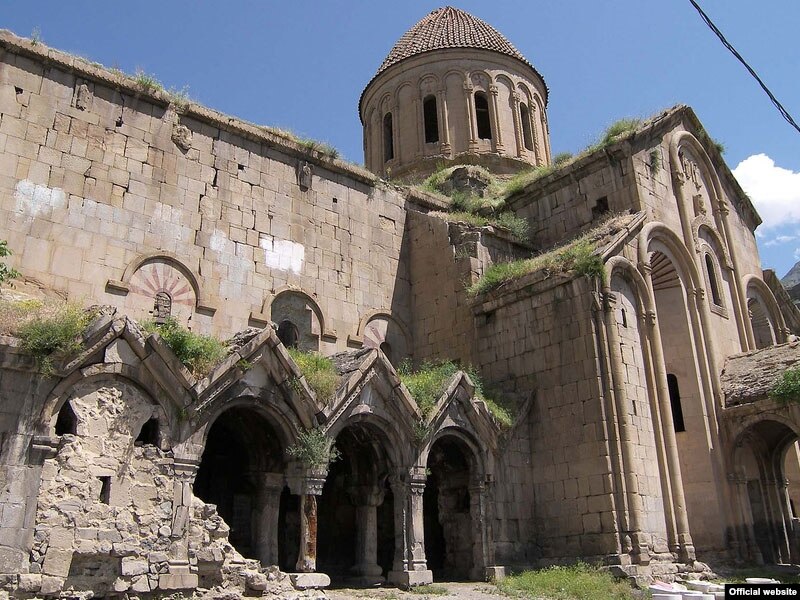
Efforts to restore churches like the Oshki Cathedral in Turkey have exposed a growing rift between the Georgian government and the church.
February
20, 2011
By Ghia
Nodia
The
authority of the Orthodox Church is perceived as unshakeable in Georgia.
Opinion polls consistently show trust in the church at over 90 percent, a
rating politicians can only dream of. The personal popularity of Patriarch Ilia
II, who has led the Georgian Orthodox Church since 1977, is particularly high.
As a result, it has become a taboo for politicians to criticize the church. In
fact, they regularly compete with each other to demonstrate their personal
religiosity and close relations to the patriarch.
For its part, the church is increasingly trying to play an independent
political role. Many church figures view the "liberal West" as an
enemy, so they are naturally upset by the pro-Western orientation of President
Mikheil Saakashvili.
Some clerics have openly encouraged congregations to oppose the authorities.
The patriarch himself has been more cautious, but he occasionally makes
comments that are viewed as unpleasant by the government.
The political opposition sees the church as a potential ally. This bothers the
government, although officials have refrained from engaging church figures in
public and continue to subsidize the Orthodox Church from the state budget.
Agreement With Turkey A
Flashpoint
But it appears this simmering discord is becoming more difficult to contain. A
proposed agreement between Georgia and Turkey on the issue of preserving
religious monuments in the two countries is becoming an important divisive
issue.
There are several medieval Christian churches in Turkey that are considered
important examples of Georgian culture. If they are not renovated in time, they
may be lost forever.
In exchange, the Turkish government is seeking the right to restore three
mosques and to build a fourth to replace a mosque in Batumi that was destroyed
during the Soviet period.
A similar agreement was drawn up three years ago, but a last-minute veto from
the patriarch scuttled the signing. At that time, the government, frightened by
a wave of opposition-led mass demonstrations, didn't dare to go against the
church's wishes. In fact, the scrapped agreement was not even discussed in
public.
21 February 2011
WCC pressed to develop new policy statement on gender justice
Geneva (ENInews)--Members of the World Council of Churches (WCC) Central
Committee, at their meeting here, took a fresh look at the ecumenical
movement's progress on gender justice issues and many members didn't like what
they saw.
Churches in India challenged to support indigenous people
New Delhi (ENInews)--Churches in India have been urged to stand up for
indigenous peoples who have been affected by such development projects as dams
and mines.
In Southern Sudan, ecumenical movement turns to nation-building
Geneva (ENInews)--Having successfully brokered a historic and peaceful
referendum in southern Sudan -- on 9 July the Republic of South Sudan will be
born -- ecumenical organizations in Africa and around the world are focusing on
the equally challenging task of helping to build the new nation.
February 22, 2011
Hopes are Mounting for Meeting between the Pope and the Patriarch
Patriarch Cyril confirmed a great harmony with Benedict XVI in the report he
presented Feb. 2, 2010, to his bishops on the occasion of the first anniversary
of his enthronement. In regard to the various questions that are at the heart
of Catholics and Orthodox, "Benedict took positions very close to those of
the Orthodox," said Cyril.
ROME, Italy (Zenit.org) - "Welcome, Mr. President, this meeting of ours is
very important," Benedict XVI, told Russian President Dmitry Medvedev last
Thursday when the president visited the Pope in the Vatican.
These words underscore something of the visit's significance, Medvedev's first
after the establishment of full diplomatic relations between the Holy See and
Russia. It was at their first meeting in December 2009 that the president and
Pope agreed to upgrade existing ties to the level of full diplomatic relations.
"The broad-ranging
collaboration," the note continues, "between the Holy See and the Russian
Federation was recognized, both in the promotion of specifically human and
Christian values, and in the cultural and social field. Subsequently, emphasis
was given to the positive contribution antireligious dialogue can make to
society."
Changing tides
a first positive change occurred with the election of Benedict XVI to the
Throne of Peter, under whose leadership there has been no more talk of a new
Patriarchate. In an interview published at the end of April 2008 in the daily
Russian newspaper "Kommersant," Alexy II praised the new German
Pontiff for his "powerful intellect."
"The whole Christian world," he said, "including the Orthodox
world, respects him. Without a doubt there are theological differences. But in
what regards the view of modern society, of secularization and moral
relativism, of the dangerous erosion of Christian doctrine and on many
contemporary problems our perspectives are very close."
After the death of Alexy II in December 2008, the election of the metropolitan
of Smolensk and Kaliningrad, Cyril, as patriarch of Moscow, was a second turn.
As the chairman of the Moscow patriarchate's foreign relations department,
Cyril already had met Benedict XVI in the Vatican on three occasions. The last
time was that same December during the patronal feast of the Russian Orthodox
parish of St. Catherine of Alexandria in Rome.
Interviewed by L'Osservatore Romano after that meeting, Cyril described as
"very positive" the state of relations between the Patriarchate of
Moscow and the Catholic Church. "There were so many important topics on
our agenda," he said. "I am thinking of the promotion of fundamental
values for the life of the person, which today concerns the whole of humanity
and not just Russia."
"We need one another," he continued. "We must not forget that
Jesus Christ called for the unity of his disciples. We are one family. In fact,
we share the same values."
Allies
These are very significant words. Just as the Kremlin recognizes in the
Orthodox Church a partner to re-launch post-Soviet Russia, faced with phenomena
such as a fall in the birth rate and the scourge of alcoholism, this statement
illustrates how in turn the Patriarchate sees the Catholic Church as an ally in
the battle against the crisis of values.
Cyril confirmed a great harmony with Benedict XVI in the report he presented
Feb. 2, 2010, to his bishops on the occasion of the first anniversary of his
enthronement. In regard to the various questions that are at the heart of
Catholics and Orthodox, "Benedict took positions very close to those of
the Orthodox," said Cyril. "And this is demonstrated in his
addresses, in his messages as well as in the opinions of other representatives
of the Roman Catholic Church with whom we have contacts" (L'Osservatore Romano,
Feb. 4, 2010).
23 February 2011
Number of Catholics worldwide edged up, Vatican says
Vatican City (ENInews/RNS)--The number of Catholics in the world edged up by
one percent in 2009, the Vatican said, bringing to 1.18 billion the number of
adherents of the world's largest church.
Libyan Christian clergy vow to stay on amid violence
Nairobi (ENInews)--Christian clergy in Libya said they have no intention of
leaving the country, where several days of protests and retaliation by
government armed forces have left hundreds of people dead.
WCC criticizes U.S. veto of UN resolution on Israeli settlements
Geneva (ENInews)--With one U.S. delegate dissenting, the World Council of
Churches (WCC) Central Committee on 21 February criticized the U.S. veto on 18
February of a UN Security Council resolution condemning continued settlement
construction by Israel in the Palestinian Territories.
Churches in India protest inquiry into church attacks
Bangalore, India (ENInews)--More than 15,000 Christians took part in a rally here
on 21 February to protest what they said was a biased inquiry report into
attacks on churches in the troubled Karnataka state.
Rescuers search for quake survivors in Christchurch, New Zealand
New York (ENInews)--Rescue teams in Christchurch, New Zealand were digging
through rubble on 23 February, searching for survivors of the 6.3-magnitude
earthquake that killed at least 75 people and destroyed and damaged many
buildings in the city on 21 February, among them a number of historic churches.
Ambassador Al-Bayadi
(Iraq), Antoinette DeLuca, Psy.D, at UN Reception on Women's Issues
2 March 2011
Harvard minister Peter J. Gomes remembered as "an original"
New York (ENInews)--The Rev. Peter J. Gomes, best known as an imposing but
beloved figure on the campus of Harvard University, where for many years he
served as the minister of the university's Memorial Church, is being remembered
as one of the era's great preachers. Gomes, 68, died 28 February in Boston of
complications from a stroke he suffered in December.
Pakistan's minister for religious minorities assassinated
Islamabad, Pakistan (ENInews)--Pakistan's Minister for Religious Minorities and
the only Christian cabinet member, Shahbaz Bhatti, was assassinated on 2 March
outside his home in Islamabad. He was the second high-ranking Pakistan
government official murdered this year after expressing opposition to the
country's law that makes criticism of the Prophet Muhammad a capital crime.
British banks must address social responsibility, says report
London (ENInews)--A report calling on British banks to address a broad
range of social, ethical and environmental concerns following the financial
crisis of the last three years was published on 1 March by the Ecumenical
Council for Corporate Responsibility (ECCR) a charity which works with Churches
Together in Britain and Ireland.
Israel revokes Anglican bishop's residency permit
Jerusalem (ENInews)--Israel has declined to renew a residency permit for the
Anglican Bishop in Jerusalem, Suheil Dawani, according to Yusef Daher,
executive secretary of the Jerusalem Inter-Church Centre (ICC).
New Yorkers gather for prayer and hope in the aftermath of Japan's earthquake and Tsunami
On Friday, March 18th, marking one week since Japan was devastated by the
massive earthquake and tsunami, New Yorkers came together to pay respect to the
victims of this tragedy and send solidarity to all those affected.
The “Gathering for Prayer and Hope,” coordinated by Rev. T.K. Nakagaki, Vice
President of the Interfaith Center of New York, began at 5:30 pm at The Church
Center for the United Nations, 777 First Ave. at 44th St., New York City.
Buddhist, Shinto and Christian Priests from Japan chanted and prayed for the
victims.
"This will be a chance for the Japanese community here in New York, and
all New Yorkers, to come together for healing and comfort," said Reverend
Nakagaki. "I hope the event can provide us with the spiritual
encouragement and strength to overcome this time of suffering together."
The “Candlelight Vigil for the People of Japan” followed the prayer service at
7:00 pm, which took place nearby at the Dag Hammarskjold Plaza, (47th St.
between 1st and 2nd Ave.).
"We wish to send love and hope, safety and well-being to the people of
Japan,” said Emiko Nagano, one of the event organizers. "This is a time
that we need to be together.”
19 Mar 2011
Please
Play the next files:
Two files ( per the below web link) about monk ordination…
http://www.youtube.com/watch?v=94a5DILXteA&feature=player_embedded
http://www.youtube.com/watch?v=61zJwQQFFPI&feature=related
UN
Department of Public Information Continues to Mobilize Non-Governmental
Organizations
Worldwide, Associating 11 More with Its Work
The Department of Public Information has associated
11 new non-governmental organizations (NGOs), bringing the total number of
such organizations that work with the Department to 1,597. This was done
after the 16 March first biannual meeting of its Non-Governmental
Organizations Committee, which approves the applications for association.
The newly appointed Director
of the Department of Public Information Outreach Division, Maher Nasser,
expressed his pleasure at chairing his first Committee meeting and welcomed the
new diverse group of non-governmental organizations. He expressed the
hope that this group would ably demonstrate their commitment to supporting
important criteria of association, namely their “commitment to promote the work
of the UN”.
The newly associated NGOs
represent organizations based in Australia, Brazil, Mexico, Nigeria, United
Kingdom, and the United States. They work with a wide range of issues,
including autism awareness, health, global sustainable development and youth.
The list of the newly
associated non-governmental organizations is as follows: American Cancer
Society (ACS) (United States); Autism Awareness Ltd (Australia); Congregations
of Sons of the Immaculate Heart of the Eastern Province, Inc./Claretian
Missionaries (United States); International Society of Nurses in Cancer Care
(ISNCC) (United Kingdom);Institute of Research, Formation and Diffusion in
Public and Social Politics (IPFD/Obore) (Brazil); Mother Helpage UK (United
Kingdom); Peace Dividend Trust (PDT) (United States); Patronato Pro Zona
Mazahua A.C. (Mexico); Stakeholder Forum for a Sustainable Future (United
Kingdom); Women’s Freedom Forum, Inc. (WFF) (United States); and Youth
Enhancement Organization (YEO) (Nigeria).
Among the recent Department
of Public Information-associated organizations, four NGOs also hold
consultative status with the United Nations Economic and Social Council.
The Non-Governmental
Organizations Committee also reviewed a list of NGOs, which no longer met the
criteria for association. Consequently, the following such organizations
have been disassociated: Orphans International America; Orphans International
Worldwide; and International Film and TV Exchange.
The Department of Public
Information is also pleased to announce that its sixty-fourth Annual United
Nations Department of Public Information (DPI)/Non-Governmental Organizations
(NGOs) Conference, entitled “Sustainable Societies; Responsive Citizens”, will
be held in Bonn, Germany, from 3 to 5 September. This will be
the fourth time the Conference will be held outside United Nations Headquarters
in New York, and the second time the Conference has been held in Europe.
The objective of taking the
Conference “on the road” is to diversify and strengthen the geographical
representation of non-governmental organizations associated with the Department
of Public Information, as well as broaden its reach to NGOs in that region.
To assist with this new initiative, the Department revised its
association policy, giving priority for affiliation to non-governmental
organizations based in the region hosting the annual Conference. This
revised policy has proven to be an effective way to reach out to those NGOs and
members of civil society, who, otherwise, would be unable to attend the
Conference, or become involved with the UN DPI/NGO community.
In 2009, as a result of the sixty-second DPI/NGO
Conference in Mexico City, 43 non-governmental organizations based in
Mexico were newly associated, and more than three quarters of the attendees at
the Conference hailed from the region. In 2010, 62 NGOs from the
Asia and Pacific region were associated with the Department of Public
Information as a result of the sixty-third DPI/NGO Conference in Melbourne,
Australia.
As this year’s Annual United
Nations DPI/NGO Conference heads to Bonn, prospective non-governmental
organizations in Eastern, Central and Western Europe interested in association
with the Public Information Department are encouraged to apply by contacting
their nearest United Nations Information Centre (UNIC) or United Nations
Regional Information Centre (UNRIC) for information on the association process.
This does not preclude any other interested non-governmental organization
from other regions of the world from applying for association.
SYRIA: UN HUMAN RIGHTS
OFFICE VOICES CONCERNS ABOUT SITUATION
New York, Mar 25 2011
The United Nations human rights office today spoke out over the worsening
situation in Syria, saying it will be closely monitoring the pledge of the
country’s Government to introduce political and economic reforms.
Rupert Colville, a spokesperson for the Office of the UN High Commissioner for
Human Rights (OHCHR), told reporters in Geneva that the office was concerned by
the use of live ammunition and tear gas by authorities against peaceful
protesters in Syria.
At least 37 people were killed in the southern town of Deraa, including two
children, and media reports today indicate that more protesters have been shot
dead by security forces.
“We welcome the decision to investigate the killings and reiterate our call for
this investigation to be independent and impartial; those responsible for the
killings must be held accountable,” Mr. Colville said.
“We also welcome the release of those associated with the protests in Deraa,
and hope that all human rights defenders and political activists throughout
Syria, who have also reportedly been arrested, will also be released without
delay.”
The demonstrations in Syria are part of a broader protest movement that has
swept the Middle East and North Africa since the start of the year, toppling
long-standing regimes in Tunisia and Egypt and leading to fierce fighting in
Libya.
Secretary-General Ban Ki-moon spoke by telephone earlier today with Syrian
President Bashar al-Assad, and earlier this week he urged authorities to
refrain from violence and to abide by their international human rights commitments.
The Syrian Government announced yesterday that it would introduce a series of
political and economic reforms, including holding consultations aimed at ending
the state of emergency that has been in existence within the country since
1963.
Mr. Colville welcomed the news and said OHCHR “will be closely monitoring the
speedy and effective implementation of such reforms.”
Damascus, Syria – March
22, 2011
Dr. Martin Harrich, staff of UN, new graduate of the Ignatius /Sofia universities program at the United Nations brings the greetings of Father Rector Anthony DeLuca of Ignatius [of Antioch] University to the Patriarch of Antioch and All The East, His Holiness Ignatius Zakka I Iwas, Damascus, Syria on March 22, 2011.
Ignatius and Sofia
Universities offer master and doctoral programs in Peace Studies and Diplomacy
to diplomats, secretariat staff and NGO representatives at the United
Nations. http://IgnatiusU.com
UN CHIEF MARKS AUTISM
AWARENESS DAY WITH CALL FOR GREATER SUPPORT TO THOSE AFFECTED
New York, Apr 1 2011
Secretary-General Ban Ki-moon has called for increased support for children and
adults with autism and their families, saying public awareness about the
condition remains low, with those affected suffering discrimination, abuse,
isolation and violation of their fundamental rights.
“Children and persons with autistic conditions face major challenges associated
with stigma and discrimination, as well as a lack of access to support.
Many struggle with multiple barriers in their daily lives,” Mr. Ban said in a
message to mark the World Autism Awareness Day, which will be observed
tomorrow.
The United Nations chief executive said that the number of children and people
with autistic conditions continues to rise in all countries and racial, ethnic
and social groups, but awareness remained low despite the recognition of
autistic conditions among the scientific, health and care communities.
Mr. Ban described the annual observance of World Autism Awareness Day as an
“opportunity to mobilize for action and assistance.”
“Autism is a complex disorder. But in many cases the right treatment early on
can bring improvements. That is why it is so important to raise awareness about
the signs of autism and provide services as soon as possible,” added Mr. Ban.
He spoke of the need to support parents, create jobs for individuals with
autism based on their skills and strengths, and improve public education to
better meet the needs of students with autism. Such steps can benefit society
and enrich the lives of people with autism and their loved ones.
Mr. Ban highlighted a remark by a mother of a child with autism who said:
“Although my daughter has walked a long way, I have walked a longer way.”
“Together, let us travel this road toward a more caring and inclusive world,”
the Secretary-General added.
Rev. Ambassador Anthony
DeLuca also attended this meeting.
St. Mark’s Syrian Orthodox
Cathedral, Teaneck N.J.
His Eminence, Mor Cyril
Aphrem Karim celebrates his 15-year of consecration.
Guest at celebration MOR POLYCARPUS EUGENE AYDIN of the Netherlands
Archbishop
Eugene with Fr. George McBride, Editor of Holy Wisdom.
Fr. Kamil Ishak visits St. Mark’s Cathedral
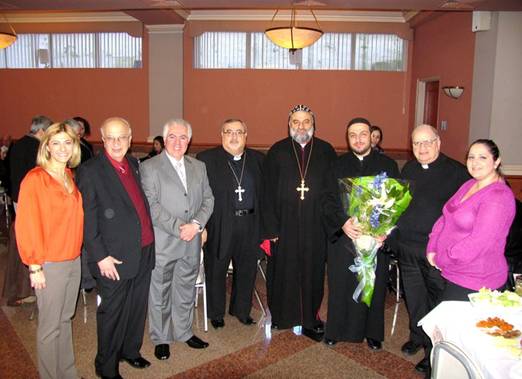
Fr. Joseph Chamoun celebrates birthday
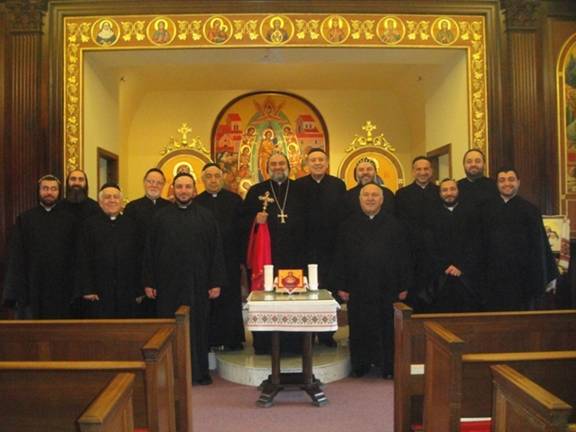
The Archdiocese of the
Syriac Orthodox Church in Eastern United States held its Annual Clergy Retreat
on March 21-24 2011, in St. Mary’s Villa Convent, Sloatsburg, New York. His
Eminence Mor Cyril Aphrem Karim presided over the Retreat, which was attended by
the clergy from all the parishes of the Archdiocese.
His Eminence Mor Cyril Aphrem
Karim meets with the Turkish Speaker of the Parliament Mehmet Ali Şahin
The Turkish Council General
Mehmet Samsar of New York invited His Eminence Mor Cyril Aphrem Karim to meet
with the Turkish Secretary of State Mehmet Ali Şahin on Wednesday, March
23rd. Fr. Aziz H. Hadodo, Sait Samuel, Gabriel Akyon, Aziz Akyon, Lahdo Yildiz
and Sami Gelin accompanied his Eminence. Speaker Şahin was accompanied by
delegates from Turkey, including Congressman Suat
Kınıklıoğlu, Ambassador Namık Tan of Washıngton
D.C., Council General Mehmet Samsar, and Assistant Council General Ayşe
Üzer. Turkish media organizations TRT and Anatolia News
Agency also were present at the meeting.
The main topic of discussion
was Mor Gabriel Monastery’s land issues in Turkey. The discussion covered also
a guesthouse built in the town of Hazakh (Idil) next to a local church, as well
as a land grant to build a new church in Istanbul. The questions His Eminence
posed were friendly but firm. Mr. Şahin’s answers were sincere and
affirming. The speaker’s dedication to working with our community was evident
when phone calls were made to resolve the Hazakh guesthouse issue. We were
assured that the building would not be demolished, as previously decided, and
that the community there would be satisfied with the outcome.
Mor Gabriel’s Monastery is
currently in litigation with the Supreme Court of Turkey. If Mor Gabriel were
denied any land rights in the lawsuits, Mr. Şahin assured His Eminence and
the attendees that the Turkish Government would do their utmost to help Mor
Gabriel. When discussing the Istanbul land grant, Mr. Şahin said he would
look into the case and try to find property suitable for our church needs.
His Eminence Karim and
Speaker Şahin had a fruitful dialogue with positive outcomes to look
forward to. Mr. Gabriel Akyon, one of the attendees, presented a short speech
on the issues at hand. Fr. Aziz H. Hadodo also mentioned that all of the monasteries
are part of a national heritage; they attract tourists to the country built in;
and tens of thousands of saints are buried within our sacred and holy
monasteries. The meeting was an excellent opportunity to raise some of the
difficulties faced by our Syriac people in Turkey with the highest Turkish
authorities.
International School for Mental Health Practitioners, chartered by the Regents of the University of the State of New York, registered with the New York State Office of the Professions offers a program leading to NYS licensure for the independent practice of psychoanalysis. Further information may be obtained at http://IgnatiusU.com or calling the Dean, Anthony DeLuca, Ph.D., L.P., (718) 698-0700.
American Institute for Creative Living is approved by the NYS Office of Alcohol and Substance Abuse Services to offer the educational components of the Credentialled Alcohol and Substance Abuse Counselor (CASAC) and other credentials in the field. See above web; (718) 698-0300.