12 August 2005 – Marking another step
forward for persons with disabilities, the United Nations panel negotiating an
international treaty codifying their rights has wrapped up its sixth session
having agreed on draft articles on such issues as education and children’s
disabilities, as well as accessibility and personal mobility.
The rights
to health and rehabilitation, the right to work, social security and adequate
standards of living, as well as participation in political, public and cultural
life and in recreation, leisure and sport, were among the other articles
negotiated during the current session of the Ad Hoc Committee on a
Comprehensive and Integral Convention to Promote and Protect the Rights and
Dignity of Persons with Disabilities, which has been meeting at UN Headquarters
in New York since August 1.
Briefing
the press on the work of the session, the Chairman of the Committee, Don MacKay
of New Zealand,
spotlighted the importance of disabilities, but also for the UN, which had an
opportunity to show, once again, that it could come up with a convention that
would have a direct impact on people’s lives.
In its
present state, the draft convention contained about 25 articles, he said. What the authors of the draft convention
tried to do was to strengthen the rights of people with disabilities and to set
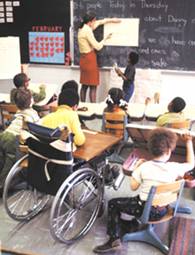
out a more detailed code for their implementation. “For example, persons with disabilities had
freedom of movement, but that right was not of much use to the people confined
in wheelchairs if no accommodations were made for accessibility,” he said.
The
convention also sought “a paradigm shift” away from the tendency to segregate
people with disabilities and towards social inclusion. “People with disabilities actually perform,
live and contribute much better if they are included in the community – be it
by way of inclusive education, inclusive health, participation in political
life, or measures to improve accessibility,” he said.
Mr. MacKay
also stressed the active involvement of civic groups in the Committee’s
work. Some 400 civil society
representatives had registered for the meeting – the largest number ever, he
added. This has given the drafting
process “a very unusual flavor.” The
participants had been very focused on the issues and there had been genuine
interaction on the text and proposals, he said, adding: “This was not one of the United Nations
meetings where people are sitting there reading prepared statements at each
other.”
The last
two weeks had “gone pretty well” for the negotiations on the draft instrument,
he said. The Committee had conducted “a
detailed read-through” of the draft and identified the areas of differences and
convergence.
With
appreciation to US News Centre, Key Articles in Draft Disability Treaty
Approved at UN Meeting, August,
12,2005 at http://www.un.org/apps/news
With appreciation to http://www.un.org/Pubs/chronicle
WASHINGTON/DARFUR
– July 26 - A recent
study conducted in South Darfur by Dr. Lynn Lawry
(formerly Amowitz), Director of Evidence-Based Research for International
Medical Corps (IMC), warns that while some of the displaced population’s basic
needs are being met by humanitarian organizations, significant gaps persist in
general health services, mental health, and women’s health needs.
The current
international aid response is not fully meeting these needs. The study calls for immediate steps be taken
to address the poor state of mental and women’s health.
Approximately
2.3 million people in Darfur rely on aid to
survive. United Nations officials have
called this the worst humanitarian crisis in the world. Insecurity for aid workers and poor
infrastructure continues to hinder relief efforts, particularly in South
Darfur. Although health
assessments of internally displaced persons (IDPs) in Darfur
have been previously reported, mental health and women’s health burdens in this
population remained largely unknown.
To assess
these needs, IMC surveyed a random sample of 1,293 displaced women living in
camps in Nyala district South Darfur. The results represent over 220,000 IDPs in
Nyala and revealed the significant unmet women’s and mental health burden among
these people.
Urgent women’s
health needs
Women make
up the majority of refugee and IDP populations.
This study reflects a poor state of reproductive health among IDP women
in South Darfur.
Family planning and provisions for safe motherhood (prenatal, delivery,
and postpartum care) are inadequate.
Overall, 12% of respondents (152/153 were pregnant at the time of the
study. The average number of pregnancies
was 6 + 0.09
(range 0-20) while the average number of pregnancies receiving pre-natal care
was 1.4+ 0.06.
Thirty percent
of respondents (380/1/1,262) were breastfeeding at the time of the study and
50% (177/353) of these reported difficulties or an inability to
breastfeed. Fifty-six percent of
respondents (709/1,274) reported gynecological symptoms and 67% of respondents
(853/1,269) reported they must ask permission of a family member to access
health care all or most of the time.
The
findings also indicate limited sexual and reproductive rights including rights
to marriage, spacing and timing of children, movement, education, consensual
sex, unattended deliveries or attendance with untrained birth attendants and
access to health care. This may
negatively impact health and the already high maternal mortality rate.
Depression
and suicide
The
prevalence of depression and suicide rates presents a considerable challenge
for humanitarian agencies in Sudan. This reflects a more general need to address
mental health needs in populations affected by conflict as the priority is
usually given to physical health. Nearly
a third of women interviewed (31 390//11,253) met criteria for Major Depressive
Disorder (MDD) and another 63% of women reported symptoms of depression
including feeling down, depressed, and hopeless. Suicide attempts among women and household
suicide prevalence were alarmingly high in contrast to general rates
worldwide. Over the prior year, 5% of
respondents reported suicidal ideation (66/1,257) and 2% reported personal
suicide attempts (28/1,260) Two percent of households had a household member
that committed suicide during the prior year (21/124.)
With appreciation to www.unicef.org/emerg/darfur
Historically,
provisions for mental health programs in Sudan
have been minimal. To IMC’s knowledge,
there are no mental health services available for IDPs beyond services provided
by a few non-governmental organizations.
“Women make
up the majority of refugees and their needs cannot be neglected. These women are not just helpless victims,
they are resilient and determined to cope and adjust to their situation. Mental health is important in building this
coping ability. We as an aid community
must address these unmet needs,” Lawry said.
Call to
Action
The study
proposed the following steps to address some of the unmet needs:
Increasingly
culturally appropriate mental health support, further mental health
assessments, and multidisciplinary programs are needed. It is noteworthy that 98% (381/390) of women
meeting criteria for MDD felt that counseling facilitated by international
agencies might be helpful. To
effectively promote women’s mental health in Sudan,
gender-and-rights-based models (i.e. provision basic needs) including health
needs will be necessary.
Reducing
deaths from maternal and neonatal tetanus Tetanus toxoid immunizations for
women of child-bearing age are a fundamental component of antenatal care for
pregnant mothers to prevent maternal and neonatal tetanus. Given limited antenatal services and lack of
skilled traditional birth attendants (TBAs) in this population, a high-risk
strategy (vaccination of at least 90% of all women of child-bearing age with
three, properly spaced doses of tetanus toxoid) may be necessary per UNICEF,
WHO and UNFPA recommendations. It is
also essential to train TBAs or midwives to address the most common causes of
maternal death such as hemorrhage and to make appropriate referrals to health
facilities that can care for women with complications of pregnancy.
Addressing breastfeeding difficulties. Nearly half of women surveyed reported
difficulties breastfeeding, which emphasizes the need for infant feeding
counseling and education programs.
Displaced women in emergency situations are at increased risk of
breastfeeding problems. In emergency
settings, breast milk is a hygienic, economical food source that is important
for conferral of immunity, nutrition, fertility regulation, and psychological
well being of mother and child. It is an
essential preventive measure against diarrheal diseases.
Reducing the risk of sexual violence. Given the predominance of women and children
foragers found in this study, and the reports of sexual violence in Darfur,
particularly among women and girls foraging for wood beyond camp borders, there
is a need to find alternative provision for assuring fuel for households in IDP
camps.
Managing the health consequences of female circumcision. The 84% prevalence of female circumcision was
consistent with previous estimates of 89% in Sudan. Health consequences include hemorrhage and
infection, urology and sexual dysfunction, difficulties with childbirth, and
psychological complications. A
predominance of infibulation (an extreme type of female genital mutilation) has
been reported in Sudan
and surgical defibulation may be necessary for safe deliveries. The high prevalence of this traditional
practice emphasizes the need for national policies, culturally-sensitive
educational programs, and appropriate health care including obstetric and
gynecological services.
The crisis
in Darfur has displaced over 200,000 refugees into Chad
and 1.85 million people within the greater Darfur
region. Up to 3 million could be
displaced in Darfur by the end of the year. The death toll from disease and violence is
unknown with estimates ranging from 180,000-300,000.
With
appreciation to www.unicefusa.org/site/pp.asp
?
In Chad and Darfur, IMC is supporting
the needs of more than 250,000 people who have been affected by the ongoing
violence through emergency medial assistance, primary health care with a focus
on maternal and child health, nutritional screening for children 0-5 years of
age, health education and hygiene promotion and immunizations and mental health
programs. In addition, IMC is recruiting
and training volunteer community health workers from within the camps to
provide health education, identify community members who are in need of
treatment and encourage pregnant women to access antenatal care.
With appreciation to Common Dreams News Center, Darfur Study, 2005:
Basic Needs, Mental Health, and Women’s Health Among
IDPs, July 26 at http://www.commondreams.org
UN Launches Large Scale Food Distribution in Niger
9 August – With funding finally coming in for Niger’s hungry
millions after initial appeals fell on deaf ears, the United Nations World Food
Programme (WFP) today reported the start of large-scale distribution that will
feed 2.5 million people in the next two months.
Yesterday, the first free food distribution at
village level took place in the small village of Tolkobey, 90
kilometres from Niamey, the capital
and WFP is finalizing field level agreements with non-governmental organization
(NGO partners.
With
appreciation to www.un.org/news
The agency last week tripled the funds it had
requested to deal with crisis arising from drought and the worst invasion of
crop-devouring locusts in 15 years in the world’s second poorest country. So far it has received 40 percent of the new
total of $57.6 million, leaving the current shortfall at $34.4 million.
WFP aims to get food assistance to all critical and
at-risk areas to avoid an increase in hunger among the 2.5 million people most
at risk. More than 1 million more have
been affected by the crisis, UN agencies say.
The UN Children’s Fund (UNICEF) reported that, more
than a week after pictures of starving children shocked the world into action,
relief supplies are reaching their destination, but more need to be done to get
children out of danger.
“While its initial appeals for money to avert the
disaster fell on deaf ears, UNICEF programmes in Niger are now almost “fully funded”
the agency said, noting that it had received nearly $15 million to help care
for nearly 200,000 children, 32,000 of them severely undernourished, and some
160,000 are moderately undernourished.
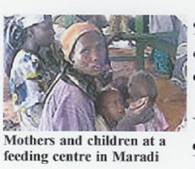
UNICEF Deputy Executive Director Rima Salah recently
toured emergency feeding centers in Maradi, epicenter of the crisis, to see the
suffering first-hand. “We were at the
hospital of (NGO) Medecins Sans Frontieres where they receive the severely
malnourished children and we saw a child die in front of us…I think we should
all feel guilty because children cannot die now at this time and age when we
have technology and resources,” a shocked Ms. Salah told reporters before
leaving Niger at the weekend. Working
closely with its partners on the ground, UNICEF Niger has provide 41 tons of
therapeutic milk, 6.7 tons of food and 190 tons of UNIMIX- a life-saving
porridge easy for undernourished children to digest. In collaboration with WFP, 187 tons of
corn-soy blend and 614 tons of cereals have been
deliver3ed to 62 affected villages, benefiting an estimated 200,000 people,
including 40,000 children under five.
In addition, about 900 tons of cereals are being
delivered to another 90 villages, and approximately six tons of seed (corn,
wheat, potato) have also been provided.
As famine threatens to spread through the region,
neighboring countries including Nigeria, Mali, and Burkina
Faso are also at risk of serious food
shortages.
“We need to fight poverty, we need to
build an early warning system, and we