Winter –
2005 – Human trafficking is one of today’s most egregious human rights
violations. Traffickers prey on the most
vulnerable members of society: people
burdened with poverty, disabilities and discrimination. Trafficking in persons refers to the illegal
trade or “sale” of human beings for sexual exploitation or forced labor through
abduction, the use or threat of force, deception and fraud. It knows no gender, race, age, or even
boundaries (due to globalization.)
According
to the Trafficking in Persons Report of the United State Department,
600,000 to 800,000 are traded annually across international borders; most of
the victims are women and girls. The
number is even more horrific after factoring in domestic trafficking, that is,
trading within country borders. However,
despite its massive scale, human trafficking will remains unknown to many. This increasingly lucrative industry is often
associated with organized crime, hence in 2000 the International community
created the United Nations Convention against Transnational Organized Crime and
the Protocol to Prevent, Suppress and Punish Trafficking in persons, Especially
Women and Children, which supplements the Convention.
For the
first time in a legal document, the Protocol specifically defines and
criminalizes trafficking in persons. It
also urges States to assist and protect victims of trafficking, for example, by
stopping their deportation and allowing their repatriation, strengthening
border controls and improving the integrity and security of identification
documents. Furthermore, States are also
urged to try to prevent such trafficking by pursuing research, public awareness
campaigns, as well as social and economic initiatives that decrease the vulnerability
of victims. In addition to the Protocol,
individual countries also have passed anti-trafficking legislation or revised
existing immigration and criminal laws since the mid-1990s in an effort to
counter this modern-day slavery.
Although
many people are unfamiliar with this issue, the anti-trafficking movement is
growing, thanks to non-governmental organizations (NGOs) that conduct local,
national, and international lobbying and advocacy. From grass-roots organizations which identify
victims and provide direct services to advocacy organizations that lobby for
anti-trafficking laws and build civil society capacity through networking,
training, information-sharing and public awareness campaigns, NGOs are driving
the global anti-trafficking movement.
Generally,
there are two types of anti-trafficking NGOs: those that work directly with
victims, so-called service providers; and the advocacy groups, which do not
directly work with the victims, but instead interact regularly with government
officials and legislators to promote strong anti-trafficking laws and policies,
and monitor the enforcement and implementation of these policies. They also engage in civil society through
active networking with other organizations and individuals, thus building
stronger alliances in the NGO community and strengthening their advocacy
work. As an international NHO that
promotes women’s rights worldwide, Vital Voices Global Partnership pursues
three strategies in its anti-trafficking advocacy work:
Raising
public awareness
Public
awareness is a key to the success of the anti-trafficking movement. Victims are frequently kept in isolation and
their rescue often depends on good Samaritans who report trafficking cases to
law endorsement. Vulnerable individuals,
such as the poverty-stricken, who seek employment abroad, also need to
understand the process of human trafficking in order to avoid becoming
victims.
Vital
Voices raises public awareness first through an electronic newsletter, Trafficking
Alert, which covers human trafficking issues. Readers include government officials, NGO
workers, international organization employees, and scholars from all over the
world. The newsletter encourages
discussions and debates on the best approaches and practices to counter human
trafficking worldwide. Vital Voices also
produces in eight languages an anti-trafficking tool-kit for use throughout the
United States. The kit contains information on identifying
victims in local communities, a summary of United
States anti-trafficking laws, a list of
national complaint lines to report potential victims, and a fact sheet for
health professionals outlining the effects of trafficking on victims’
health. Another component of its
campaign involves working with the United Nations Office on Drugs and Crime to
distribute public service announcements to national and regional television
stations. It also conducts active
outreach by speaking to different communities, such as at universities,
seminars and conferences, about issues related to human trafficking.
Promoting
effective partnerships between Governments and NGOs
Although
NGOs are driving the global anti-trafficking movement, Governments remain vital
because they are the ones that establish anti-trafficking policies, strengthen
law enforcement and fund support for victims.
Conversely, effective government policies cannot be made without
information from the NGO community, especially those that have direct
experience with trafficking victims.
Unfortunately, mutual trust or confidence between Governments and NGOs
in many countries and channels for both to discuss human trafficking issues are
either rare or simply do not exist. In
this regard, Vital Voices promotes and facilitates these discussions by
identifying and bringing together NGOs and policy makers to create sound
anti-trafficking policy.
Training
and building NGO capacity to counter human trafficking
Recognizing
the vital contribution of NGOs, but Governments and financiers worldwide pursue
strategies to develop civil society and build the capacity of these
organizations. Government offices
frequently partner with NGOs in various anti-trafficking activities, such as
training about victim protection prosecuting cases and developing methods to
prevent trafficking. Vital Voices works
with an extensive network of NGOs and uses leadership training to connect with
emerging women leaders. The issue of
human trafficking is incorporated into such training to encourage
anti-trafficking efforts within the network.
It also provides training to encourage strategizing about the way that
law endorsement; legislators, government officials and NGO workers can best
stop human trafficking.

With appreciation to
www.undoc.org//undoc/en/trafficking
In addition
to advocacy NGOs, other anti-trafficking organizations work directly with
victims, and their focus is identifying victims and helping in their
recovery. Because these NGOs concentrate
more on service provision, they often collaborate with advocacy groups if they
want to work on anti-trafficking policy and generally provide social services
and legal assistance. Counselors,
psychologists and social workers administer counseling and care to help trafficking
victims recover from physical and psychological abuse. Medical attention is often needed, especially
for victims of sex trafficking, to determine if they have contracted HIV/AIDS
or other sexually transmitted diseases.
Safe housing is another immediate necessity. These urgent and basic needs are often
arranged by non-profit service providers in the community.
Depending
on the extent of trauma, recovery may take years, this in addition to emergency
assistance, long-term rehabilitation plans are necessary Service providers also
facilitate the reintegration of trafficking victims into society. They provide vocational training, language
classes, or basic education in cases where the victims are minors with incomplete
schooling. Victims frequently require
legal assistance in areas such as immigration law, family law or civil
rights. As they often cannot afford to
pay legal fees, service providers can refer them to legal professionals who
provide pro bono or low-fee counsel and serve as their advocates before
government authorities and the court to ensure the full protection of victim’s
rights.
NGOs are
vital in the fight against human trafficking; they have the autonomy and
expertise to being the issue to the public eye, promote policy change and care
for victims. Despite differences in
strategies or ideologies, the goal of NGOs remains the same: to end human trafficking. Only by collaborating at the level of policy
and legislation, as well as the level of direct service provision, can there be
comprehensive and lasting solutions to this horrific humans
rights violation. Human traffickers are
organized, and to counter them we need to be united and organized as well.
With
appreciation to Wenchi Yu Perkins, UN Chronicle, Vital Voices:
Advocacy and Service Work of NGOs in the Fight Against
Human Trafficking, Winter, 2005 at www.un.org/Pubs/chronicle/2005/issue1/0105p54.html
European
Commission Calls for a Sustained Effort to Help People Affected By the Tidal
Waves
January 3, 2005 – European
Commissioner for Development and Humanitarian Aid, Louis Michel expressed today
to the Sri Lankan people the firm commitment of the European Commission to help
them to recover from the unprecedented devastation caused by the tidal
wave. During the past two days Louis
Michel has visited some of the most affected coastal areas of the island, as
well as hospitals and relief camps in Galle
(South). Commissioner Michel underlined that “the European
Commission was the first donor to provide 3 million euros on the day of the
disaster, another 20 million (8 M for Sri Lanka,
2 M for the Maldives
and 10 M for Indonesia)
by 30 December, 2004. Together with the EU Member States we are
committed to spending every single euro that we pledge. Up to now, the European Commission and Member
States have committed at least 240
million euros and this figure is likely to be increased in the coming
days”. Furthermore, it contributes with
civil protection means, under the co-ordination of the Civil Protection
Community Co-ordination Mechanism for which Commissioner Stavros Dimas is in
charge.

With appreciation t0 www.unicef.org
Commissioner
Michel declared: “I was struck by the dimension of the devastation but also by
the determination of the Sri Lanka
population to stand up and rebuild their country. I told them that they can rely on the
European solidarity for this huge task.”
In Sri
Lanka alone, more than 40,000 people died,
almost 6,000 are still missing and 860,000 are displaced. Damage is running into millions of
euros. The human toll could be a lot
worse if epidemics occur and aid is not delivered to the victims as rapidly as
possible. Louis Michel pointed out that
“international aid is being mobilized as quickly as possible, both by
international humanitarian agencies and by donors, and the co-ordination is
improving day by day, under an ad-hoc Secretariat set up by the Government”.
Mr. Michel
and Minister for Development of Luxembourg, who holds the rotation presidency
of the EU, Jean Louis Schlitz, met also the representatives of major
stakeholders involved in the relief effort in Colombo
and in Galle (South
Coast), who receive funding from
the European Commission via its humanitarian aid department, ECHO.
Commissioner
Michel and Minister Schiltz met also the President of Sri Lanka, Ms. Chandrika
Bandanaraike Kumaratunga, and noticed with satisfaction her commitment to
restart the reconstruction in the shortest delay.
Mr. Michel
underlined that “the European Commission participates fully in coordination
activities in the field. We have ECHO
experts in India,
Sri Lanka, Indonesia
and Thailand
working closely with the United Nations and other donors to ensure the
coordination of the humanitarian aid effort on the ground. But it is essential that the United Nations
is allowed to fulfill its key role as coordinator of international efforts in
the field.”
He stressed
that “there must be no gap between the initial emergency aid phase and the
rehabilitation and reconstruction phase that will follow. From the commission’s side, I am working
closely with my colleagues in charge of the External Relations, Benita
Ferrero-Waldner, who will deal with the reconstruction aid, and President of
the European Commission Jose Manuel durao Barroso, to build a comprehensive
strategy to avoid this risk. We will
submit our ideas to the Member States in Brussels
on 7 January, when I will report on my trip to the region and all our
international partners, in a meeting taking place in Geneva
on 11 January.
He will
travel tomorrow to Indonesia
(Aceh and Jakarta) to complete his
assessment of the immediate and longer term needs. On the 6th, he and President
Barroso will meet the main donors at the conference organized by the ASEAN and
submit a comprehensive report to the EU Development Ministers meeting in Brussels
on the 7 January.
Key
Articles in Draft Disability Treaty approved at UN Meeting
6 – February
2005 – In a major step forward for persons with disabilities and
humanity as a whole, a United Nations negotiating panel has reached agreement
on key provisions in a treaty codifying their rights.
The General
Assembly committee on a convention on the rights of persons with disabilities
forged accord on draft articles addressing access to justice, privacy,
independent living, full inclusion in the community and other individual
rights.
“This major
human right convention represents a shift in the way governments interact with
persons with disabilities,” the Coordinator of the talks, Ambassador Don MacKay
of New Zealand,
said at a press conference on Friday at the close of the two-week session. “Many have said that the rights of persons
with disabilities are already guaranteed in existing human rights treaties, but
the reality is that persons with disabilities have been deprived of those
rights.”
“Many
conventions say that such and such people should not be treated differently
from others – but people with disabilities are treated differently from
others,” Mr. MacKay observed, adding that existing treaties had prescribed
equal rights, but had not set out in detail what those rights were.
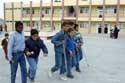
With appreciation to www.un.org/photos/disabled.htm
The
Convention would say not only that persons with disabilities had the same
rights as those without, but would spell out in detail what those rights were,
he said. “We’re setting up a new regime,
a new way of thinking and a new sort of paradigm.”
The
Committee Chair, Ambassador Luis Gallegos Chiriboga of Eduador, told reporters
that the negotiations were part of an historic process aimed at integrating 600
million people into society.
“The owners
of the convention are the people with disabilities; they are the actors who are
moving forward the convention,” he said.
“They are the ones who tell us what their problems are, and how to
address them.”
The
Committee on a Comprehensive and Integral International Convention on the
Protection and Promotion of the Rights of Persons with Disabilities agreed on a
text providing that States parties should take all measures to ensure that
persons with disabilities can exercise their right to freedom of expression and
opinion, including the right to seek, receive and impart information on an
equal basis with others.
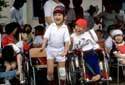
With appreciation to www.un.org/photos/disabled.htm
That
provision calls on States parties to facilitate the use of sign language,
Braille, and augmentative alternative communication.
The agreed
draft text also stipulates that persons with disabilities shall not be
subjected to arbitrary or unlawful interference with their privacy and
correspondence.
There was
broad support for committing States parties to take measures to enable persons
with disabilities to live independently and as full participants in the
community, including the right to choose one’s place of residence and living
arrangements.
A separate
draft article was proposed on protection of the home and family, which would
ensure the rights of persons with disabilities to decide freely and responsibly
on the number and spacing of their children on an equal basis with other
persons.
With
appreciation to UN News Centre, Key Articles in Draft Disability Treaty
Approved at UN Meeting at www.un.org
International
Call to Action for Improved ADHD Care Launched
The World
Federation for Mental Health has opened a new stage of its campaign to improve
the diagnosis and treatment of children with attention deficit/hyperactivity
disorder. Research has shown that the
prevalence of ADHD is consistent across countries, affecting 3%-&% of
school-aged children.
With appreciation to
images.google.com/images
The
initiative coincides with publication of a report by WFMH,
that presents results from a survey of 938 parents of children with the
disorder in Australia,
Canada, Germany,
Italy, Mexico,
the Netherlands,
Spain, the United
Kingdom and the United
States.
The survey
showed that on average children with ADHD wait just under
two years for diagnosis (although there are significant discrepancies among the
countries surveyed). Among parents, 88%
said they experienced stress or worry about their children’s disorder, and 57%
of the parents said their children had been excluded from activities by peers. Two-thirds (69%) of the parents surveyed
recognized the symptoms in themselves.
Research shows that ADHS is a highly hereditary disorder.
Professor
Russell Barkley, Professor of Psychiatry at the Medical University of South
Carolina, US, who has been closely involved in the development of the report,
commented: “ADHD can have a pervasive, adverse impact on major life activities,
affecting every facet of a child’s life at home, at school and at play, If not diagnosed
and treated effectively it can limit an individual’s potential into adulthood.”
According to
recent research, individuals with ADHD are more likely to hold less skilled
jobs, with 75%-95% never completing college.
Evidence shows that they are also involved in 3-to-4 times more car
crashes than those who do not have the disorder. Research also shows that many adolescents
with ADHD are involved in teen pregnancy.

With appreciation to
images.google.com/images
The
cornerstone of the Federation’s new initiative is a pledge campaign to bring
parents and physicians together in a unified approach to increase education
about the disorder and knowledge about treatment. “We ask all parents and physicians who are
concerned about the potentially serious consequences of ADHD, for both children
and their families, to make a pledge to take a few simple actions to address
some unmet needs of ADHD diagnosis, as identified in the parent survey,” urged
Preston J. Garrison, WFMH’s Secretary General and Chief Executive Officer. They are asked to learn all they can about
ADHD to support their children, meet regularly with child’s physician and
teachers, recognize that there are places they can go to for support, and to
become advocates for their children and for other families diagnosed with ADHD.
WFMH hopes
that the pledge initiative, together with the new report, will encourage
physicians educators, the media and parent support organizations to work
together to ensure that the necessary assistance is in place for children with
ADHD and their families.
Details of
the pledge initiative and copies of the full report are available on the WFMH
website at www.wfmh.org, and results of the
initiative will be released later this year.
With
appreciation to World Federation for Mental Health, International Call to
Action for Improved ADHD Care Launched, Winter, 2005
at www.wfmh.org
The
President of Chile
and the WHO Director-General Launch Global Commission to Tackle the “Causes Behind the Causes of Ill-Health”
March 18 – Today
the President of the Republic of Chile,
His Excellency Mr. Ricardo Escobar and World Health Organization
Director-General, Dr. LEE Jong-wook launched the Commission on Social
Determinants of Health, a new body to spearhead on the social causes behind
ill-health.
The new
Commission includes leading global experts on health, education, housing and
economics. Commissioners will work to
recommend the best ways to address health’s social determinants and safeguard
the health of poor and marginalized populations, and to break the \poverty
equals ill health’ cycle.
“Social
standing plays a big part in whether people will live to be 40 or 80, whether
they will be treated for a curable disease, and whether their children survive
their fifth birthday. People should not
die young because they are poor. This
commission, will assist, countries, no matter how rich or poor, to implement
strategies that will help people who are poor and marginalized live longer,
healthier lives. “ said Dr. Lee at the official launch
in Santiago, Chile. “This effectively places the needs of the
disadvantaged first on the health agenda in the 21st century.”
Social
determinants are the conditions in which people live and work. They are the “causes behind the causes” of
ill-health. They include poverty, social
exclusion, inappropriate housing, and shortcomings in safeguarding early
childhood development, unsafe employment conditions, and lack of quality health
systems.
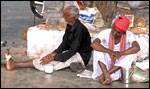
With appreciation to
www.who.int/mediacentre/news/releases/2005
The core of
the Commission’s work will be to identify, evaluate, adapt and distribute
effective strategies to address social determinants, with the aim of supporting
governments to scale-up interventions.
The Commission will operate for three years from this month.
“A great
share of health problems is attributable to social conditions, and this is why
the poor carry the greatest burden of ill-health. On a global scale, we must ensure that health
policies move beyond exclusively disease-focused solutions and include the
social environment,” said Commission chair Michael
Marmot. “I am honored to be working with
Commissioners of such high caliber. We
will arm policymakers with the best evidence to ensure that poverty does not
sentence a person to a shorter, unhealthy life.”
Social
determinants are intrinsically linked to inequities in health. They help to explain why poor and
marginalized people get sick and die sooner than people in better social
positions. There are significant
reasons behind the world’s vast difference in average life expectancy, which
ranges from 34 years in Sierra Leone
to 81.9 in Japan. Social determinants also account for the
majority of health inequities within countries.
In Indonesia,
under-five mortality is nearly four times higher in the poorest fifth of the
population than in the richest fifth. In
England and Wales,
the latest data shows a 7.4year gap in life expectancy between men in
professional occupations and men in unskilled manual occupations.
Some
countries- such as Chile,
Sweden, and the
United Kingdom
– are already advancing innovative health programs that address social
determinants through a comprehensive inter-sectoral approach. For instance, social welfare programs with
benefits conditional on children’s school attendance, regular medical
check-ups, and other health-promoting actions are helping to reverse the
“poverty equal ill-health”
trend. Health inequity
assessments resulting in the declaration of “health action zones” and health
promotion campaigns targeting disadvantaged people are also safeguarding the
health of vulnerable groups.
The
Commission will identify successful strategies now underway in countries. It will work with national authorities to
determine ways to replicate success in other countries and settings. Whereas, to date, the greatest progress in
tackling social determinants has occurred in high-income countries, the
Commission will focus especially on identifying and promoting policies
applicable in developing countries, where the adverse health effects of social
determinants are greatest. Overcoming
these social barriers represents a prime opportunity to reduce global health
inequalities and ensure that health gains are sustainable over time.
The
Commission will focus the attention of the world’s top experts and researchers
on specific social determinants such as urban settings, social exclusion, and
employment conditions. These “Knowledge Networks”
will push the limits of current information to better define the links between
social determinants and health, particularly in developing countries.
The
Commission on Social Determinants of Health will work with national authorities
to incorporate social determinants approaches into efforts to meet the
Millennium Development Goals (MDGs). The
MDGs recognize the interdependence of health and other social conditions, and
present an opportunity to promote health policies that tackle the social roots
of unfair and avoidable human suffering.
With
appreciation to World Health Organization, The
President of Chile
and the WHO Director-General Launch Global Commission to Tackle the “Causes
Behind the Causes of Ill-Health”, March
18, 2005 at www.who.int/mediacentre/news/releases/2005/pr13/en/print.html