|
Ignatius University School of Psychology |
|||
|
|
|||
|
Mental Health/ Counseling/ Peace Studies/ Dispute Resolution Programs |
|||
|
Peace Studies / Conflict Management; Organizational Management / Diplomacy |
|||
|
|
|||
Susan Kavaler Adler, Ph.D,
Adelphi University
John R. Braun, Ph.D., University of California (Berkeley)
Sherry L. BLakey, Ph.D., Wayne State University
V. Rev. Anthony J. DeLuca, Ph.D., Fordham University
Steven A. Diamond, Ph.D., Psychological Studies Institute
Miriam Ehrenberg, Ph.D, New School for Social
Research
Otto Ehrenberg, Ph.D., New York University
Rev. A. P. George, Ph.D., University of Kerala
Lee R. Greene, Ph.D., Yale University
Susanne Iasenza, Ph.D., New York University
Richard A. Klein, Ph.D., Kent State University
Marcel Lebrun, Ph.D., University of San Jose
Mary E. Loomis, Ph.D., Wayne State University
Rachel M. MacNair, Ph.D., University of Missouri at
Kansas City
Mary Joy McMachen, Ph.D., University of Detroit
Janet Piedilato, Ph.D., New York University, Ph.D., Saybrook Graduate School
Mary Powell, M.S.W., Ph.D.(c)
Gloria Rich, Ph.D., Union Graduate School, M.S.W., New York University
Linda Richter, Ph.D., University of Maryland
Antonio Santonastasi, Ph.D., Walden University
Joel Schmidt, Ph.D., University of Arkansas
Bertram Schaffner, M.D., Johns Hopkins Medical School
Jean Tracy, Ph.D., Texas Christian University
William Weichun, Ph.D., Fordham University
K. H. Wong, Ph.D., Oklahoma State University
Joanne Zager, Ph.D., Indiana University
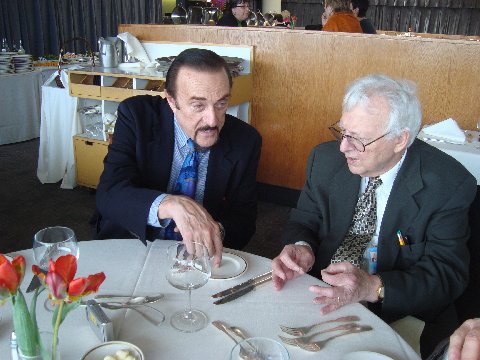
Doctors Philip Zimbardo and Anthony DeLuca at United Nations (3/4/2010) engaged in discussing Dr. Zimbardo's new work, The Heroic Imagination Project.
UNDERGRADUATE PROGRAMS:
Back
Students may earn a Bachelor of Arts degree (120 credits) in Psychology (30
credits) by following the standard undergraduate program of Ignatius University
and using Psychology as the major. All courses are 3 credits unless otherwise
indicated. It is necessary to include the following courses in the 30 credit
major: Psychology 100A&B General Psychology (4 credits each); Psychology
150/399 Statistics; Psychology 151/399 Research Methods; Psychology 103
Psychopathology; two courses from: Psychology 152/404 Physiological Psychology;
Psychology 153/513 Conditioning and Learning; Psychology 154/511 Sensation and
Perception; Psychology 155/514 Cognition and Memory; and one course from
Psychology 156/510 Social Psychology;
Psychology 157/515 Theories of Personality; Psychology 158/516 History of
Psychology. The remaining courses may be selected from any undergraduate
psychology courses.
An Associate in Arts may be applied after 60 credits are completed in the appropriate areas.
Psychology Programs:
Back
The School of Psychology of IGNATIUS UNIVERSITY offers five doctoral programs leading to the degree of Doctor of Psychology (Psy.D.) or Doctor of Philosophy (Ph.D.) in psychology: combined Clinical and Counseling Psychology (with pastoral counseling psychology option); combined Industrial and Organizational Psychology; combined Conflict Management and Mediation Psychology; combined Personality and Social Psychology; Political Psychology. Students may opt for either the Psy.D. or Ph.D. Requirements are the same including experimental research. Upon completion of the doctorate, a candidate may receive the second doctorate by defending a meta-analysis dissertation in the same field as the first doctorate. All programs detailed in the School of Psychology may also be pursued simultaneously but separately through Sofia University, Bulgaria.
In addition, the School offers a Doctor of Philosophy (Ph.D.) or Doctor of Education (Ed.D.) in Mental Health Studies / Counseling (with pastoral counseling option). These fields include Mental Health Counseling, Marriage and Family Counseling and Art Therapy. In place is also the Doctor of Psychoanalysis (Psa.D.) or Doctor of Philosophy (Ph.D.) in Psychoanalysis. The Ph.D., Ed.D., Psa.D., in this paragraph are not psychology degrees.The Master of Science in psychology is not a terminal degree but is awarded to all who are accepted into the Psy.D., Ph.D. program and complete all the requirements for the master's degree.
The psychology programs are designed to develop in psychologists strong theoretical background in psychology, an ability to transform theory into practice and the expertise to design and implement research.
The psychology programs are designed in such a way that on the master's level (first two years), the student takes a series of courses which are basic and necessary for any psychologist regardless of specialization. The remaining master's courses provide a survey of the field of specialization while the thesis enables the student to do a literature research of an area which may be an eventual topic for the student's own experimental research.
In the third and fourth years, there are intensive studies in statistics, research methods, and design, measurement and scaling as well as further courses in the area of specialization. The student is also engaged in the internship where the theoretical meets the practical. These experiences are designed to enhance awareness of the needs and problems encountered in various settings and to stimulate the student to think of research in these areas. In the fifth year, work on the dissertation commences.
Distance Learning Program with Part-time Doctoral Residence
Ignatius University allows its Graduate Program in the above five areas of
psychology to be taught through a combination of Distance Learning and Doctoral
Residential Learning. From the outset, the student should understand that
Distance Learning is no less, and perhaps more
demanding than the traditional classroom experience. The rigor of the Distance
Learning far exceeds the demands of Residential Learning. Further, all Distance
Learning courses in the School of Psychology entail "hands on"
experience through the use of local resources in proximity to where the student
resides.
Students in the psychology program are required to join the national psychological association in their own country and to attend each year its annual convention e.g. American Psychological Association in the United States.
The Graduate Psychology Program at Sofia University is independent and autonomous from any other outside institution. The regular faculty of Ignatius University conducts its own graduate program. The curriculum of IU and SU are the same. However, in order to consider the current and necessary trend toward globalization, additional adjunct faculty from all over the world are also involved.
The master's degree in psychology (69 credits which includes a 15 credit thesis) may be completed soley by Distance Learning. However, some psychology licensing boards require that some time be spent in residential learning. Depending upon the rigor of the licensing requirement, IU may not be able to accomodate all residential requirements.
In addition to a satisfactory, intensely supervised one year internship (12 credits) with a licensed psychologist for the Psy.D., or Ph.D., there is required a successful dissertation defense (12 credits) and a minimum 3.0 overall average in course work. Those in Ph.D., Ed.D in Mental Health have a one year internship supervised by a licensed mental health practitioner with doctorate.Students for the Ph.d, Ed.D. in Peace Studies have various practice supervised by those holding the doctorate in a related field.
An integral part of the program involves supervised field internships and practice. All students are expected to know the Code of Ethics of the American Psychological Association and to abide by it. All students are required to purchase American Psychological Association sponsored Professional Liability Insurance or the equivalent. This will provide coverage for the professional duties of a psychologist in training. This insurance information may be obtained through APA, Washington, D.C., USA.
Research topics for the dissertation may be selected through a review of the varied research interests of the faculty.
Mental Health / Counseling
Studies: Mental Health Counselor, Marriage and Family Therapist, Creative Arts
Therapist, Psychoanalyst
Back
The master and doctoral degrees in Mental Health / Counseling Studies are not psychology degrees.
For the doctoral degree in Mental Health / Counseling Studies, students with extensive post master's formal studies and experience, may be granted advanced standing in the doctoral program. A one year supervised internship is required.
Licensure/Certification
and the like.
Back
IGNATIUS UNIVERSITY offers the student a standard, reputable and highly demanding course of studies in psychology and related fields, directed by an outstanding faculty and leading to master and doctoral degrees in the respective discipline. Based upon our research, our programs are modeled after the most rigorous and comprehensive programs being offered world-wide.
Since there are over 200 countries in the world with many having numerous different jurisdictions ( as many as 50, many without reciprocity within the same country) and all having different requirements which regulate the practice of the professions through licensure/certification and the like, it is impossible for Ignatius University to guarantee/contract/promise that any student, upon completion of these programs will be eligible to be licensed/certified etc. in that particular jurisdiction.
Accordingly, at the time of application, all students are required to sign and present an original notarized Disclaimer acknowledging that the above information is fully understood. (See, Graduate Studies, Application).
We advise the student to obtain the licensing requirements from his/her respective licensing board and to include in his/her graduate program the specific requirements demanded by the board. If there are additional requirements beyond our program, these may be added to our program and, where possible, they may be substituted as electives. The student is advised to request in writing from the respective board confirmation of licensure acceptability of the program to be undertaken.
Admission Requirements
Back
1. Successful completion of the baccalaureate degree at an accredited institution.
2. A total minimum score of 2500 on the Graduate Record Exam (GRE), including Verbal, Quantitative, Analytical, Language Proficiency (score x 100), and Subject Exam in Psychology ( Psy. D., Ph.D.; and Ph.D., Ed.D. in Mental Health Studies/Counseling). Subject Exam in Psychology, while required, will not be factored into the score for those applying to the Mental Health Studies program.
3. A cumulative grade-point average of 3.0 or better.
4. Three excellent letters of recommendation from faculty.
5. A personal interview locally arranged.
6. TOEFL of 550 for non-native English speaking students.
DEGREE REQUIREMENTS
Specific requirements are listed under each degree for separate psychology
disciplines and for the mental health / counseling studies programs.
P R O G R A M S :
CLINICAL AND COUNSELING
PSYCHOLOGY
Back
The goal of the Clinical and Counseling psychology program is to educate the student in the general discipline of psychology with an emphasis on training competent practitioners and researchers in the area of diagnosis and treatment of maladaptive mental behavior. The program prepares clinicians to work with behavioral problems in community facilities, centers and hospitals as well as independent practice. Students are instructed in diagnostic methods including the full range of psychological testing, individual and group psychotherapy and group relations. The training involves the combining of practicum experiences, academic courses and research with infants, children, adolescents and adults as well as personal insight derived from the group dynamics courses and other experiences.
MASTER OF SCIENCE (M.S.) in Clinical and Counseling Psychology
I. GENERAL LIST OF ALL COURSES
* MASTER'S program on the way to DOCTORATE in Psychology.
54 credits for courses + 15 credits for thesis = 69 credits
* These courses are all part of the doctorate.
* M.A. courses should go first and be completed in two years.
* "L" means these are specifically required and there are no
substitutes.
* All courses are 3 credits unless otherwise indicated.
BASIC COURSES - 54 CREDITS
1. Psychology 516 History and Systems of Psychology
2. Psychology 404 Physiological Psychology
3. Psychology 514 Cognitive-Affective Basis of
Behavior
4. Psychology 320 Psychology of Individual Differences
5. Psychology 510 Social Psychology
6. Psychology 321 Psychology, Cultural and
Ethnic Diversity
7. Psychology 302 Infant and Child Development
8. Psychology 304 Adolescent and Adult Development
9. Psychology 303 Psychopathology- with practicum ( 4
credits )
10. Psychology 299 Psychology of Religion ( 4 credits
)
11. Psychology 301 Interviewing Skills- with practicum (4 credits)
12. Psychology 305 Approaches to Counseling- with practicum (4 credits)
13. Psychology 403A Intelligence Testing 1 ( Child)-
with practicum (4 credits)
14. Psychology 403B Intelligence Testing 2 ( Adolescent/Adult)-
with practicum (4 credits)
15. Psychology 406 Projective Techniques 1- with practicum (4 credits)
16. Psychology 409 Projective Techniques 2 ( Rorschach)-
with practicum (4 credits)
Thesis (15 credits) This may be a literature search or empirical research in the area which the student plans to write the doctoral dissertation.
2. GENERAL LIST OF COURSES DIVIDED INTO 4 SEMESTERS
First Semester
History and Systems of Psychology
Physiological Psychology
Cognitive-Affective Basis of Behavior
Psychology of Individual Differences
Second Semester
Social Psychology
Psychology, Cultural and Ethnic Diversity
Infant and Child Development
Adolescent and Adult Development
Psychopathology- with practicum
Third Semester
Intelligence Testing 1- with practicum
Intelligence Testing 2- with practicum
Projective Techniques 1- with practicum
Projective Techniques 2- with practicum
Psychology of Religion
Fourth Semester
Interviewing Skills- with practicum
Approaches to Counseling- with practicum
Thesis (15 credits) - with practicum
DOCTOR OF PSYCHOLOGY (Psy.D.), DOCTOR OF PHILOSOPHY (Ph.D.) in Clinical and Counseling Psychology
1. GENERAL LIST OF ALL COURSES
In addition to the 69 credits from the M.S., the
following is required for the Doctorate.
* 42 credits in course work + 12 credits Internship + 12 credits Dissertation =
66 credits
* Grand total for doctorate = 69 + 66 = 135 credits
* Each course is three credits unless otherwise
indicated.
A. BASIC COURSES 42 CREDITS
1. Psychology 311 Graduate Statistics 1 L
2. Psychology 401 Graduate Statistics 2 L
3. Psychology 601 Multivariate Statistics in
Psychological Research L
4. Psychology 602 Research methods and Design 1 L
5. Psychology 603 Research Methods and Design 2 L
6. Psychology 322 Psychological Measurements and Scaling L
7. Psychology 323 Ethics and Professional Practice in
Psychology L
8. Counseling Course- with practicum
9. Counseling Course- with practicum
10. Counseling Course- with practicum
11. Counseling Course- with practicum
12. Counseling Course- with practicum
13.Psychology 306 Group Dynamics 1- with practicum
14. Psychology 309 Group Dynamics 2 -with practicum
B. COUNSELING COURSES
Select any 5 of the following courses to meet the
counseling course requirement.
1. Psychology 407 Counseling the Child- with practicum
2. Psychology 410 Counseling the Adolescent- with practicum
3. Psychology 310 Counseling the Addictive Person-
with practicum
4. Psychology 408 Counseling the Couple- with
practicum
5. Psychology 307 Counseling the Family- with
practicum
6. Psychology 411 Counseling the Elderly- with
practicum
7. Psychology 412 Career Counseling- with practicum
8. Psychology 308 Rehabilitation Counseling- with practicum
9. Psychology 402 Advanced Group Dynamics 1- with practicum
10. Psychology 405 Advanced Group Dynamics 2 - with practicum
C. INTERNSHIP - 12 CREDITS
* The internship is done through 4 courses over two years i.e. 875 hours ( per
year/ part time) or one year full time (1750 hours).
* Supervision is conducted by a licensed psychologist in the jurisdiction of
the internship site.
* Part time requires one supervisory session per week; full time requires two
supervisory sessions per week.
1. Psychology 501A&B Internship 1
2. Psychology 502A&B Internship 2
D. DISSERTATION
* This is accomplished through 4 courses over two
years.
* The dissertation must be experimental and scientific dealing with human
subjects and approved by the Institutional Review Board of the University in
the planning stage.
* Beyond the 4 courses, each additional course is called Extended Dissertation
Advisement; additional fees are charged for each extended course (See fees).
1. Psychology 503A&B Dissertation 1
2. Psychology 504A&B Dissertation 2
2. GENERAL LIST OF COURSES DIVIDED INTO 6 SEMESTERS
First Semester
Graduate Statistics 1 L
Research Methods and Design 1 L
Psychological Measurements and Scaling L
Ethics and Professional Practice of Psychology L
Group Dynamics 1 with practicum
Second Semester
Counseling Course- with practicum
Counseling Course- with practicum
Counseling Course- with practicum
Counseling Course- with practicum
Internship (3 of 12 credits)
Third Semester
Graduate Statistics 2 L
Multivariate Statistics in Psychological Research L
Research Methods and Design 2 L
Group Dynamics 2 - with practicum
Dissertation Seminar (3 of 12 credits)
Fourth Semester
Counseling Course - with practicum
Internship (3 of 12 credits)
Dissertation Seminar (3 of 12 credits)
Fifth Semester
Internship (3 of 12 credits)
Dissertation Seminar (3 of 12 credits)
Sixth Semester
Internship (3 of 12 credits)
Dissertation Seminar (3 of 12 credits)
INDUSTRIAL AND
ORGANIZATIONAL PSYCHOLOGY
Back
The goal of the Industrial and Organizational psychology program is to educate students in the general discipline of psychology, with emphasis on training competent researchers and practitioners in the area of human behavior at work and in organizations. There is extensive training in the basic areas of psychology, research design, statistics and the areas of industrial and organizational psychology. The program follows the lead of the American Psychological Association's guidelines for the Delivery of Services by I / O Psychologists.
MASTER OF SCIENCE (M.S.) in Industrial / Organizational Psychology
1. GENERAL LIST OF ALL COURSES
MASTER'S program on the way to the DOCTORATE in Psychology
54 credits for courses + 15 credits for thesis = 69 credits
These courses are all part of the doctorate.
Master's courses should go first and be completed in 2 years.
All are 3 credits unless otherwise indicated.
A. BASIC COURSES - 48 CREDITS
1. Psychology 516 History and Systems of Psychology
2. Psychology 404 Physiological Psychology
3. Psychology 514 Cognitive-Affective Basis of
Behavior
4. Psychology 320 Psychology of Individual Differences
5. Psychology 510 Social Psychology
6. Psychology 321 Psychology, Cultural and
Ethnic Diversity
7. Psychology 299 Psychology of Religion
8. Psychology 324 Foundations of Industrial /
Organizational Psychology 1- with practicum
9. Psychology 325 Foundations of Industrial / Organizational Psychology
2- with practicum (4 credits)
10. Psychology 326 Work Motivation- with practicum (4 credits)
11. Psychology 327 Organizational Development - with practicum (4 credits)
12. Psychology 328 Human Resources Management - with practicum (4 credits)
13. Psychology 329 Consumer Behavior- with practicum (4 credits)
14. Psychology 330 Organizational Consultation - with practicum (4 credits)
B. ELECTIVE COURSES - 6 CREDITS
Any 2 of the following courses:
1. Psychology 331 Organizational Culture- with practicum
2. Psychology 332 Applied Behavior Analysis in Industry- with practicum
3. Psychology 333 Organizational Effectiveness- with practicum
4. Psychology 334 Leadership in Organizations- with practicum
5. Psychology 335 Attitude and Attitude Change- with
practicum
6. Psychology 301 Interviewing Skills- with practicum
THESIS ( 15 credits) - this may be a literature search of the area the student plans to write the doctoral dissertation.
2. GENERAL LIST OF COURSES, DIVIDED INTO 4 SEMESTERS.
First Semester
History and Systems of Psychology
Physiological Psychology
Cognitive-Affective Basis of Behavior L
Psychology of Individual Differences L
Second Semester
Social Psychology L
Psychology, Cultural and Ethnic Diversity L
Psychology of Religion
Foundations of Industrial / Organizational Psychology 1 - with practicum
Third Semester
Foundations of Industrial / Organizational Psychology 2 - with practicum
Work Motivation- with practicum
Organizational Development- with practicum
Human Resources Management- with practicum
Consumer Behavior - with practicum
Fourth Semester
Organizational Consultation- with practicum
Elective Course- with practicum
Elective Course- with practicum
Thesis- with practicum
DOCTOR OF PSYCHOLOGY (Psy. D.), DOCTOR OF PHILOSOPHY (Ph.D.) in Industrial and Organizational Psychology
1. GENERAL LIST OF ALL COURSES
In addition to the 69 credits from the Master's degree, the following is
required for the Doctorate:
39 credits in course work + 12 credits Internship + 12 credits dissertation =
63 credits
Grand total for doctorate = 69 + 63 = 132 credits
Each course is 3 credits unless otherwise indicated.
A. BASIC COURSES - 39 CREDITS
1. Psychology 311 Graduate Statistics 1
2. Psychology 401 Graduate Statistics 2
3. Psychology 601 Multivariate Statistics in Psychological
Research
4. Psychology 602 Research Methods and Design 1
5. Psychology 603 Research Methods and Design 2
6. Psychology 322 Psychological Measurements and
Scaling
7. Psychology 323 Ethics and Professional Practice of
Psychology
8. Psychology 336 Organizational and Small Group
Theory - with practicum
9. Psychology 337 Task Analysis and Performance
Appraisal- with practicum
10. Psychology 338 Organizational Diagnosis and
Intervention - with practicum
11. Psychology 339 Strategic Planning - with practicum
12. Psychology 306 Group Dynamics 1- with practicum
13. Psychology 309 Group Dynamics 2 - with practicum
B. INTERNSHIP- 12 CREDITS
This is accomplished through 4 courses over 2 years i.e. 875 hours (per
year/ part time) or one year full time (1750 hours).
Supervision is conducted by a licensed psychologist in the jurisdiction of the
internship site.
The part time internship requires one supervisory session per week; full time
requires two supervisory sessions per week.
C. DISSERTATION - 12 CREDITS
This is carried out through 4 courses over two years.
The dissertation must be experimental and scientific with human subjects
approved by the Institutional Review Board of the University.
Beyond the 4 courses each additional course is called Extended Dissertation
Advisement and additional fees are charged for each extended course.
2. GENERAL LIST OF COURSES, DIVIDED INTO 6 SEMESTERS
First Semester
Graduate Statistics 1 L
Research Methods and Design 1 L
Psychological Measurements and Scaling L
Ethics and Professional Practice of Psychology L
Group Dynamics 1- with practicum
Second Semester
Organizational and Small Group Theory - with practicum
Task Analysis and Performance Appraisal - with practicum
Organizational Diagnosis and Intervention- with practicum
Strategic Planning - with practicum
Internship (3 of 12 credits)
Third Semester
Graduate Statistics 2 L
Multivariate Statistics in Psychological Research L
Research Methods and Design 2 L
Group Dynamics 2 - with practicum
Dissertation Seminar ( 3 of 12 credits)
Fourth Semester
Internship (3 of 12 credits )
Dissertation Seminar (3 of 12 credits)
Fifth Semester
Internship (3 of 12 credits)
Dissertation Seminar ( 3 of 12 credits)
Sixth Semester
Internship (3 of 12 credits)
Dissertation Seminar (3 of 12 credits)
SOCIAL PSYCHOLOGY
Back
The goal of the program in Social Psychology is to educate students in the general discipline of psychology with an emphasis on training competent researchers and practitioners in the areas of social issues and the development of social policy. Courses and research draw on theories, models, and concepts of social psychology in such areas as attitudes and attitude change; community based intervention; evaluation and policy research; gender; health psychology; social identity processes and structures; race and ethnicity; social injustice and various social problems (substance abuse); school and social reform. Multiple methodological strategies are considered ( survey research, ethnographical field research, interviews, case studies, experimental and partial experimental studies).
MASTER OF SCIENCE (M.S). in SOCIAL PSYCHOLOGY
1. GENERAL LIST OF ALL COURSES
The master's program on way to the doctorate in Psychology:
54 credits for courses + 15 credits for thesis = 69 credits
These courses are all part of the doctorate.
Master's courses should be taken first and be completed in two years.
"L" means these are specifically required and must be taken by all
and there are not substitutes.
All are 3 credits, unless otherwise indicated.
A. BASIC COURSES - 48 CREDITS
1. Psychology 516 History and Systems of Psychology
2. Psychology 404 Physiological Psychology
3. Psychology 514 Cognitive Affective Basis of
Behavior
4. Psychology 320 Psychology of Individual Differences
5. Psychology 510 Social Psychology
6. Psychology 321 Psychology, Cultural and
Ethnic Diversity
7. Psychology 299 Psychology of Religion
8. Psychology 362 Research Methods in Social
Psychology - with practicum
9. Psychology 510 Experimental Studies in Social Psychology - with
practicum (4 credits)
10. Psychology 351 Interpersonal and Inter-group Relations - with practicum (4
credits)
11. Psychology 352 Social Cognition- with practicum (4 credits)
12. Psychology 353 Psychology of Mass Behavior - with practicum (4 credits)
13. Psychology 402 Advanced Group Dynamics 1 - with practicum ( Group Dynamics 1 & 2 are not prerequisites ) (4
credits)
14. Psychology 405 Advanced Group Dynamics 2- with practicum
(4 credits)
B. ELECTIVE COURSES- 6 CREDITS
Any 2 of the following courses:
1. Psychology 354 Social Psychology and Personality- with practicum
2. Psychology 355 Theories of Social Injustice- with
practicum
3. Psychology 356 Group Effectiveness- with practicum
4. Psychology 357 Leaders and Leadership- with
practicum
5. Psychology 301 Interviewing Skills- with practicum
6. Psychology 335 Attitude and Attitude Change - with practicum
Thesis (15 credits) : this may be a literature search or empirical research of the area student plans to write doctoral dissertation.
2. GENERAL LIST OF COURSES, DIVIDED INTO 4 SEMESTERS.
First Semester
History and Systems of Psychology
Physiological Psychology
Cognitive-Affective Basis of Behavior
Psychology of Individual Differences
Second Semester
Social Psychology
Psychology, Cultural and Ethnic Diversity
Psychology of Religion
Research Methods in Social Psychology- with practicum
Third Semester
Experimental Studies in Social Psychology- with practicum
Interpersonal and Inter-group Relations - with practicum
Social Cognition- with practicum
Psychology of Mass Behavior- with practicum
Advanced Group Dynamics 1- with practicum
Fourth Semester
Advanced Group Dynamics 2- with practicum
Elective Course- with practicum
Elective Course- with practicum
Thesis- with practicum
DOCTOR OF PSYCHOLOGY (Psy.D.), DOCTOR OF PHILOSOPHY (Ph.D.) in Social Psychology.
1.GENERAL LIST OF ALL COURSES
In addition to the 69 credits for the M.A., the following is required for
the doctorate:
39 credits in course work + 12 credits Internship + 12 credits Dissertation =
63 credits
Grand total for doctorate = 69 + 63 = 132 credits.
Each course is 3 credits, unless otherwise indicated.
A. BASIC COURSES - 39 CREDITS
1. Psychology 311 Graduate Statistics 1
2. Psychology 401 Graduate Statistics 2
3. Psychology 601 Multivariate Statistics
4. Psychology 602 Research Methods and Design 1
5. Psychology 603 Research Methods and Design 2
6. Psychology 322 Psychological Measurements and
Scaling
7. Psychology 323 Ethics and Professional Practice in
Psychology
8. Psychology 358 Human Motivation- with practicum
9. Psychology 359 Social and Personal Identity - with
practicum
10. Psychology 360 Prejudices and Gender Issues - with
practicum
11. Psychology 361 Social Influence and Social Support
- with practicum
12. Psychology 306 Group Dynamics 1- with practicum
13. Psychology 309 Group Dynamics 2 - with practicum
B. INTERNSHIP- 12 CREDITS
The internship is accomplished through 4 courses over two years i.e. 875
hours ( per year part time) or one year full time (1750 hours),
Supervision is to be conducted by a licensed psychologist in the jurisdiction
of the internship site.
Part time requires one supervisory session per week; full time requires two
supervisory sessions per week.
C. DISSERTATION - 12 CREDITS
Dissertation is carried out through 4 courses over two years.
Dissertation must be experimental and scientific with human subjects.
Beyond the 4 courses, each additional course is called Extended Dissertation
Advisement and additional fees are charged for each extended course.
2. GENERAL LIST OF COURSES DIVIDED INTO 6 SEMESTERS
First Semester
Graduate Statistics 1
Research Methods and Design 1
Psychological Measurements and Scaling
Ethics and Professional practice of Psychology
Group Dynamics 1 - with practicum
Second Semester
Human Motivation - with practicum
Social and Personal Identity - with practicum
Prejudices and Gender Issues - with practicum
Social Influence and Social Support- with practicum
Internship ( 3 of 12 credits )
Third Semester
Graduate Statistics 2
Multivariate Statistics in Psychological Research
Research Methods and Design 2
Group Dynamics 2 - with practicum
Dissertation Seminar ( 3 of 12 credits )
Fourth Semester
Internship (3 of 12 credits)
Dissertation Seminar (3 of 12 credits)
Fifth Semester
Internship ( 3 of 12 credits)
Dissertation Seminar (3 of 12 credits)
Sixth Semester
Internship (3 of 12 credits)
Dissertation Seminar (3 of 12 credits).
POLITICAL PSYCHOLOGY
Back
The goal of the Political Psychology program is to educate students in the general discipline of psychology and to train them in the application of contemporary psychological theories, concepts, and models to the study of political behavior. There is great reliance on social psychology, particularly, attitudes, emotion and affect, and group process; memory, decision and cognition. Attention is given to the content and structure of political information and the factors that influence political judgments and decisions. There are lab and field experiments in addition to survey research.
MASTER OF SCIENCE (M.S.) in Political Psychology
1. GENERAL LIST OF ALL COURSES:
Master's program on the way to doctorate in Psychology:
54 credits of course work + 15 credits for thesis = 69 credits
These courses are all part of the doctorate.
M.S. courses should go first and be completed in two years.
"L " means these are specifically required
and must be taken by all and there are no substitutes.
All are 3 credits unless otherwise indicated.
A. BASIC COURSES - 42 CREDITS
1. Psychology 516 History and Systems of Psychology
2. Psychology 404 Physiological Psychology
3. Psychology 514 Cognitive-Affective Basis of
Behavior
4. Psychology 320 Psychology of Individual Differences
5. Psychology 510 Social Psychology
6. Psychology 321 Psychology, Cultural and
Ethnic Diversity
7. Psychology 299 Psychology of Religion / Political Conflict and Religion ( 4 credits)
8. Psychology 370 Political Philosophy
9. Psychology 371 Fundamentals of Political Psychology - with practicum
(4 credits)
10. Psychology 372 Social Influence and Political Socialization - with
practicum (4 credits)
11. Psychology 373 Public Opinion and Electoral Behavior - with practicum (4
credits)
12. Psychology 374 Psychology of Political Leadership and Decision Making -
with practicum (4 credits)
13. Psychology 402 Advanced Group Dynamics 1 with practicum (
May be taken before Group Dynamics 1 & 2 ) (4 credits)
14. Psychology 405 Advanced Group Dynamics 2 -with practicum (4 credits)
B. ELECTIVE COURSES- 6 CREDITS
Any 2 of the following courses:
1. Psychology 353 Psychology of Mass Behavior - with practicum
2. Psychology 376 War, Violence, and Conflict Resolution -
with practicum
3. Psychology 377 Theory and Practice of International
Negotiations - with practicum
4. Psychology 378 Political Conflict and "isms:" nationalism,
racism, sexism, ageism, and classism - with practicum
5. Psychology 335 Attitude and Attitude Change - with
practicum
6. Psychology 201 Interviewing Skills - with practicum
Thesis ( 15 credits). This may be accomplished by a literature search or empirical research in the area which the student plans to write the doctoral dissertation.
2. GENERAL LIST OF COURSES, DIVIDED INTO 4 SEMESTERS
First Semester
History and Systems of Psychology L
Physiological Psychology L
Cognitive-Affective Basis of Behavior L
Psychology of Individual Differences L
Second Semester
Social Psychology L
Psychology, Cultural and Ethnic Diversity L
Psychology of Religion/ Political Conflict and Religion
Political Philosophy
Third Semester
Fundamentals of Political Psychology - with practicum
Social Influence and Political Socialization - with practicum
Public Opinion and Electoral Behavior - with practicum
Psychology pf Political Leadership and Decision
Making - with practicum
Advanced Group Dynamics 1 - with practicum
Fourth Semester
Advanced Group Dynamics 2 - with practicum
Elective Course - with practicum
Elective Course - with practicum
Thesis - with practicum
DOCTOR OF PSYCHOLOGY (Psy. D.), DOCTOR OF PHILOSOPHY (Ph.D.) in Political Psychology
1. GENERAL LIST OF ALL COURSES
In addition to the 50 credits from M.S., the following is required for the
doctorate:
39 credits of course work + 12 credits Internship + 12 credits Dissertation =
63 credits
Grand total for doctorate = 69 + 63 = 132 credits
Each course is 3 credits unless otherwise indicated.
A. BASIC COURSES - 39 CREDITS
1. Psychology 311 Graduate Statistics 1 L
2. Psychology 401 Graduate Statistics 2 L
3. Psychology 601 Multivariate Statistics in
Psychological Research L
4. Psychology 602 Research Methods and Design 1 L
5. Psychology 603 Research Methods and Design 2 L
6. Psychology 322 Psychological Measurements and Scaling L
7. Psychology 323 Ethics and Professional Practice in
Psychology L
8. Psychology 379 Political and Social Change -with
practicum
9. Psychology 380 Nationalism and Ethnicity- with
practicum
10. Psychology 381 Political Violence and Terrorism -
with practicum
11. Psychology 382 Mediating Policy Conflict- with practicum
12. Psychology 306 Group Dynamics 1- with practicum
13. Psychology 309 Group Dynamics 2 - with practicum
B. INTERNSHIP - 12 CREDITS
This is done through 4 courses over two years i.e. 875 hours ( per year part time ) or one year full time ( 1750 hours).
C. DISSERTATION - 12 CREDITS
This is done through 4 course over two years.
Dissertation must be experimental and scientific with human subjects.
Beyond the 4 courses, each additional course is called Extended Dissertation
Advisement and additional fees are charged for each extended course.
2. GENERAL LIST OF COURSES, DIVIDED INTO 6 SEMESTERS
First Semester
Graduate Statistics 1 L
Research Methods and Design 1 L
Psychological Measurements and Scaling L
Ethics and Professional Practice of Psychology L
Group Dynamics 1 - with practicum
Second Semester
Political and Social Change - with practicum
Nationalism and Ethnicity - with practicum
Political Violence and Terrorism - with practicum
Mediating Policy Conflict - with practicum
Internship (3 of 12 credits)
Third Semester
Graduate Statistics 2 L
Multivariate Statistics in Psychological Research L
Research Methods and Design 2 L
Group Dynamics 2 - with practicum
Dissertation Seminar (3 of 12 credits)
Fourth Semester
Internship (3 of 12 credits)
Dissertation Seminar (3 of 12 credits)
Fifth Semester
Internship (3 of 12 credits)
Dissertation Seminar ( 3 of 12 credits)
Sixth Semester
Internship (3 of 12 credits)
Dissertation Seminar (3 of 12 credits)
CONFLICT MANAGEMENT PSYCHOLOGY AND
MEDIATION PSYCHOLOGY
Back
The goal of the Conflict Management Psychology and Mediation Psychology program is to educate the student in the general discipline of psychology and to understand the psychological principles and models underlying both conflict management and mediation. In this program, these latter areas are placed within the matrix of psychology as distinguished from other similar programs which are not essentially psychological. Students are trained in the understanding and resolution of significant and persistent human conflicts among individuals, small groups, communities, ethnic groups, and nations. There is consideration to deep rooted conflicts and their resolution, underlying conditions bringing parties to the table; third parties in dispute resolution; testing of conflict intervention methods in community, national and international settings; in depth view of the mediation process. It should become obvious to the student that these areas are not sufficiently grasped without an understanding of certain models in social psychology, personality theory, psychological developmental process, psychopathology, and other psychological disciplines.
MASTER OF SCIENCE (M.S.) in Conflict Management Psychology and Mediation Psychology
1. GENERAL LIST OF ALL COURSES:
Master's program on the way to the doctorate in Psychology:
54 credits in course work + 15 credits for thesis = 69 credits
These courses should be taken first and be completed in two years.
All are 3 credits, unless otherwise indicated.
A. BASIC COURSES - 48 CREDITS
1. Psychology 516 History and Systems of Psychology
2. Psychology 404 Physiological Psychology
3. Psychology 514 Cognitive-Affective Basis of
Behavior
4. Psychology 320 Psychology of Individual Differences
5. Psychology 510 Social Psychology
6. Psychology 321 Psychology, Cultural and
Ethnic Diversity
7. Psychology 385 Psychology of Conflict - with practicum
8. Psychology 299 Psychology of Religion / Conflict and Religion ( 4 credits )
9. Psychology 386 Interpersonal and Group Conflict - with practicum (4 credits)
10. Psychology 387 Community and Organizational Conflict - with practicum (4
credits)
11. Psychology 388 Conflict in Development and Personality Crisis - with
practicum (4 credits)
12. Psychology 389 Conflict Resolution: Theory and Practice - with practicum (4 credits)
13. Psychology 390 Mediation and Negotiation: Theory and Practice- with
practicum (4 credits)
14. Psychology 391 Business Mediation and Commercial Negotiation - with
practicum (4 credits)
B. ELECTIVE COURSES - 6 CREDITS
Any 2 of the following:
1. Psychology 376 War, Violence, and Conflict Resolution - with practicum
2. Psychology 392 Ethnic and Cultural Factors in Conflict
Resolution- with practicum
3. Psychology 393 Family Mediation - with practicum
4. Psychology 394 Leadership Roles in Conflict and
Business Communication -with practicum
5. Psychology 201 Interviewing Skills - with practicum
6. Psychology 378 Conflict and "isms:" nationalism, racism,
sexism, ageism, and classism - with practicum
2. GENERAL LIST OF COURSES, DIVIDED INTO 4 SEMESTERS
First Semester
History and Systems of Psychology L
Physiological Psychology L
Cognitive-Affective Basis of Behavior L
Psychology of Individual Differences L
Second Semester
Social Psychology L
Psychology, Cultural and Ethnic Diversity L
Psychology of Conflict - with practicum
Psychology of Religion / Conflict and Religion
Third Semester
Interpersonal and Group Conflict - with practicum
Community and Organizational Conflict- with practicum
Conflict in Development and Personality Crisis- with practicum
Conflict Resolution: Theory and Practice- with practicum
Mediation and Negotiation: Theory and Practice - with practicum
Fourth Semester
Business Mediation and Commercial Negotiation- with practicum
Elective Course- with practicum
Elective Course- with practicum
Thesis - with practicum
DOCTOR OF PSYCHOLOGY ( Psy.D.), DOCTOR OF PHILOSOPHY (Ph.D.) in Conflict Management Psychology and Mediation Psychology
1. GENERAL LIST OF ALL COURSES
In addition to the 69 credits from the master's, the following is required
for the doctorate:
39 credits in course work + 12 credits Internship + 12 credits Dissertation =
63 credits.
Grand total for doctorate = 69 + 63 = 132 credits.
Each course is 3 credits, unless otherwise indicated.
A. BASIC COURSES - 39 CREDITS
1. Psychology 311 Graduate Statistics 1 L
2. Psychology 401 Graduate Statistics 2 L
3. Psychology 601 Multivariate Statistics in
Psychological Research L
4. Psychology 602 Research Methods and Design 1 L
5. Psychology 603 Research Methods and Design 2 L
6. Psychology 322 Psychological Measurements and Scaling L
7. Psychology 323 Ethics and Professional Practice in
Psychology L
8. Psychology 395 Global Context of Conflict - with
practicum
9. Psychology 382 Mediating Policy Conflict - with practicum
10. Psychology 397 Negotiation and Mediation in Ethnic
Conflict - with practicum
11. Psychology 398 Special Topics in Conflict: Race, Gender, and Health-
with practicum
12. Psychology 306 Group Dynamics 1- with practicum
13. Psychology 309 Group Dynamics 2- with practicum
B. INTERNSHIP 12 CREDITS
The Internship is carried out through 4 courses over two years i.e. 875
hours /per year/ part time or one year full time ( 1750 hours).
Supervision is conducted by a licensed psychologist in the jurisdiction of the
internship site. Part time requires one supervisory session per week; full time
requires two supervisory sessions per week.
C. DISSERTATION 12 CREDITS
The dissertation is accomplished through 4 courses over two years.
The dissertation must be experimental and scientific with human subjects.
Beyond the 4 courses, each additional course is called Extended Dissertation
Advisement and additional fees are charged for each extended course.
2. GENERAL LIST OF COURSES, DIVIDED INTO 6 SEMESTERS
First Semester
Graduate Statistics 1
Research Methods and Design 1
Psychological Measurements and Scaling
Ethics and Professional Practice of Psychology
Group Dynamics 1 - with practicum
Second Semester
Global Context of Conflict - with practicum
Mediating Policy Conflict - with practicum
Negotiation and Mediation in Ethnic Conflict - with practicum
Special Topics in Conflict : Race, Gender, Health -
with practicum
Internship (3 of 12 credits)
Third Semester
Graduate Statistics 2
Multivariate Statistics in Psychological Research
Research Methods and Design 2
Group Dynamics 2 - with practicum
Dissertation Seminar ( 3 of 12 credits )
Fourth Semester
Internship ( 3 of 12 credits )
Dissertation Seminar (3 of 12 credits)
Fifth Semester
Internship ( 3 of 12 credits)
Dissertation Seminar (3 of 12 credits)
Sixth Semester
Internship ( 3 of 12 credits)
Dissertation Seminar ( 3 of 12 credits)
MENTAL HEALTH STUDIES : Mental Health Counseling. Marriage
and Family Therapy. Creative Arts Therapy.
Psychoanalysis.
Back
The goal of the Mental Health Studies : Mental Health Counseling, Marriage
and Family Therapist, Creative Arts Therapy, Psychoanalysis programs is to
provide the student with an overall view of the mental health field from a
global perspective and specifically to train the student to make assessments of
various emotional problems and to remediate them through various counseling
skills. Under the Counseling Program, there are four separate programs, Mental
Health Counseling, Marriage and Family Therapy, Creative Arts Therapy, and
Psychoanalysis. The student is provided a wide range of treatment modalities
and is given the option, in view of the Mission of the University, to include
other techniques, e.g. pastoral and spiritual. The emphasis of this program is
to prepare the student to practice in various counseling situations:
specifically, individual, couple and group, with all age ranges and varying
disorders in different settings. The program is so designed that the student,
new to the field, may obtain significant expertise in the above skills at the
master's level. It also provides a doctoral program for those completing the
University master program and those entering with a master's degree from
another institution. Those master-level seasoned clinicians with many years of experience, practice and significant post-master's
continuing education may be admitted to advanced standing in the doctoral
program. This is not a degree program in psychology but in counseling. For the
dissertation, original experimental research is required for the Ph.D. and a
literature study is required for the Ed.D., and Psa.D.
With the Ed.D.. and Psa.D., the student may use
studies carried out by other researchers in writing the dissertations and
specific cases treated by the clinician may become the springboard for the
dissertation research.
Master of Psychoanalysis ( M.Psa.) in Mental Health Studies / Psychoanalysis
1. GENERAL LIST OF ALL COURSES
* Master's program on the way to the doctorate in Mental Health Studies /
Mental Health Counseling.
54 credits of course work + 15 for thesis = 69 credits.
* These courses are all part of the doctorate.
* M.A. courses should go first and be completed in 2 years.
* All courses are 4 credits, unless otherwise indicated.
A. BASIC COURSES - 54 CREDITS
1. Psychology 302 Infant and Child Development
2. Psychology 304 Adolescent and Adult Development
3. Psychology 303 Psychopathology - with practicum
4. Psychology 299 Psychology of Religion
5. Psychology 301 Interviewing Skills - with practicum * +
6. Psychology 305 Approaches to Counseling - with practicum * +
7. Psychology 306 Group Dynamics 1- with practicum
8. Psychology 309 Group Dynamics 2 - with practicum
9. Psychology 412 Career Counseling with practicum
10. Psychology 408 Counseling the Couple with practicum
11. Psychology 307 Counseling the Family with
practicum
12. Psychology 399 Research Methods
13. Psychology 501 Internship: Mental Health Counseling I
14. Psychology 502 Internship Mental Health Counseling II
* For those in the Pastoral Counseling option, take instead Theology 1137
Orientation to Pastoral Counseling and 2 other Pastoral Counseling courses ( all are 3 credits each).
+ For those in the Spiritual Counseling option, take instead Theology 1157
Orientation to Spiritual Counseling and 2 other Spiritual Counseling courses
(all are 3 credits each).
* + Those using the Pastoral and Spiritual Counseling
option, may not take Advanced Group Dynamics 1 & 2. The above courses are
cross referenced as follows: Psy 407/ Theology 1143; Psy 410/ Theology 1145; Psy 310/
Theology 1142; Psy 408/ Theology 1144;
Psy 307/ Theology 1140; Psy
411/ Theology 1146; Psy 412/ Theology 1147; Psy 308/ Theology 1141.
Thesis (15 credits) : this may be a literature search or empirical research for the area the student plans to write the doctoral dissertation.
2. GENERAL LIST OF COURSES DIVIDED INTO 4 SEMESTERS
First Semester
Infant and Child Development
Interviewing Skills - with practicum * +
Group Dynamics 1 - with practicum
Second Semester
Adolescent and Adult Development
Psychopathology - with practicum
Approaches to Counseling - with practicum *+
Group Dynamics 2 - with practicum
Third Semester
Psychology of Religion
Counseling the Couple with practicum
Career Counseling with practicum
Research Methods
Internship: Mental Health Counseling I
Fourth Semester
Counseling the Family with practicum
Internship : Mental Health Counseling II
Doctor of Philosophy (Ph.D.), Doctor of Education (Ed.D.) in Mental Health Studies / Mental Health Counseling
* Ed.D. is a 66 credit
program.
* Students must enter with an accredited master's degree in the field of at
least 69 credits.
* Where these 69 are lacking, the deficit may be made up through counseling
courses at Ignatius University.
* Toward the 66 credits of the Ed.D. program in Mental Health Studies / Mental Health Counseling,
the University may evaluate and accept up to 15
credits for fully documented work experience in the field; no more than 3
credits are granted per year of related work.
The University may accept up to 30 credits for post master's graduate courses
in the field and post graduate training programs from
training institutes, seminars, workshops and the like. All of these studies
must be from documented accredited programs. One credit
may be awarded for 15 classroom contact hours. A contact hour is 60 minutes. No
more than a total of 30 credits may be granted from
previous studies/work toward the total of 66 credits.
* 36 additional credits must be completed through Ignatius University.
* Grand total for doctorate = 69 + 66 = 135 credits.
* All courses are 4 credits unless otherwise indicated.
1. GENERAL LIST OF ALL COURSES
A. BASIC COURSES- 36 CREDITS
1. Psychology 299 Psychology of Religion (4 credits) (requirement waived, if
previously taken; counseling course must be substituted). * +
2. MHS/Psychology 501 Doctoral Internship 1, (6 credits)
3. MHS/Psychology 502 Doctoral Internship 2, (6 credits)
4. MHS/Psychology 505 Dissertation Seminar 1, (6 credits)
5. MHS/Psychology 506 Dissertation Seminar 2, (6 credits)
6. MHS/Psychology 503 Current Literature in Mental Health 1
(4 credits)* +
7. MHS/Psychology 504 Current Literature in Mental Health 2
(4 credits)* +
* For those in the Pastoral Counseling option, these courses are replaced
with Advanced Group Dynamics 1 & 2 and 2 didactic courses in Pastoral
Counseling ( all four courses are 3 credits each).
+ For those in the Spiritual Counseling option, these courses are replaced with
Advanced Group Dynamics 1 & 2 and 2 didactic courses in Spiritual
Counseling (all four courses are 3 credits each).
B. COUNSELING COURSES
The following courses are available to those students who have been accepted
into the doctoral program but lack the total 54 credits in the master's program
and for those students who were not granted full advanced standing in the
doctoral program.
Those students who have selected either the Pastoral Counseling option or the
Spiritual Counseling option and have insufficient courses (as the above
students) may take a combination of both didactic and practical courses in
their specific option area.
1. Psychology 407 Counseling the Child - with practicum
2. Psychology 410 Counseling the Adolescent - with practicum
3. Psychology 310 Counseling the Addictive Person-
with practicum
4. Psychology 408 Counseling the Couple - with
practicum
5. Psychology 307 Counseling the Family - with
practicum
6. Psychology 411 Counseling the Elderly - with
practicum
7. Psychology 412 Career Counseling - with practicum
8. Psychology 308 Rehabilitation Counseling - with
practicum
9. Psychology 402 Advanced Group Dynamics 1- with
practicum
10. Psychology 405 Advanced Group Dynamics 2 - with practicum
In cases where the above courses are insufficient in number to make up the deficiency, additional courses may be selected in consultation with the studetn adviser.
C. INTERNSHIP - 12 CREDITS
* The Internship is accomplished through 4 courses over two years i.e. for
part time employment (875 hours); or 2 courses in one year which is full time
employment (1750).
* Supervision must be conducted once a week by one holding a doctorate in a
mental health discipline and licensed.
* Part time employment requires one supervisory session on alternate weeks;
full time employment requires one supervisory session per week.
D. DISSERTATION - 12 CREDITS
* Dissertation is conducted through 4 courses over two years.
* Dissertation does require an experimental study but may be a literature
research in a particular area of mental health.
* Beyond the 4 courses, each additional course is called Extended Dissertation
Advisement and additional fees are charged for each extended course.
2. GENERAL LIST OF COURSES, DIVIDED INTO 6 SEMESTERS
Semester One
Psychology of Religion ,* +
Current Literature in Mental Health 1, * +
Doctoral Internship
Semester Two
Current Literature in Mental Health 2, * +
Doctoral Internship
Semester Three
Dissertation Seminar
Doctoral Internship
Semester Four
Dissertation Seminar
Doctoral Internship
Semester Five
Dissertation Seminar
Semester Six
Dissertation Seminar
MASTER OF SCIENCE (M.S.) in Mental Health Studies / Marriage and Family
Therapy
Back
1. GENERAL LIST OF ALL COURSES
* Master's program on the way to the doctorate in Mental Health Studies /
Marriage and Family Therapy.
* 54 credits of course work + 15 for Thesis = 69 credits.
* These courses are all part of the doctorate.
* M.S. courses should go first and be completed in two years.
A. BASIC COURSES - 54 CREDITS
1. Psychology 302 Infant and Child Development (3 credits)
2. Psychology 304 Adolescent and Adult Development (3 credits)
3. Psychology 303 Psychopathology with practicum (4 credits)
4. Psychology 299 Psychology of Religion (2 credits)
5. Psychology 301 Interviewing Skills with practicum (4 credits)
6. Psychology 305 Approaches to Counseling with practicum (4 credits)
7. Psychology 306 Group Dynamics 1 with practicum (3 credits)
8. Psychology 309 Group Dynamics 2 with practicum (3 credits)
9. Psychology 408 Counseling the Couple with practicum (4 credits)
10. Psychology 307 Counseling the Family with practicum (4 credits)
11. Psychology 407 Counseling the Child with practicum (4 credits)
12. Psychology 410 Counseling the Adolescent with practicum (4 credits)
13. Psychology 399 Research Methods (4 credits)
14. Psychology 501M Clinical Internship in Marriage and Family Therapy (4
credits)
15. Psychology 502M Clinical Internship in Marriage and Family Therapy (4
credits)
* For those in the Pastoral Counseling option, take instead Theology 1137
Orientation to Pastoral Counseling and 2 other Pastoral Counseling courses (all
are 3 credits each).
+ For those in the Spiritual Counseling option, take instead Theology 1157
Orientation to Spiritual Counseling and 2 other Spiritual Counseling courses
(all are 3 credits each).
B. THESIS - 15 credits
Psychology 400 Thesis includes a review of research methods, program
evaluation, and ethics; topic is in the area of Marriage and Family Therapy.
This may be a literature search or experimental research in the area the
student plans to write the doctoral dissertation.
2. GENERAL LIST OF COURSES DIVIDED INTO 4 SEMESTERS
First Semester
Infant and Child Development
Interviewing Skills - with practicum
Approaches to Counseling with practicum
Counseling the Child with practicum
Second Semester
Adolescent and Adult Development
Psychopathology with practicum
Counseling the Adolescent
Counseling the Couple with practicum
Third Semester
Counseling the Family with practicum
Group Dynamics 1 with practicum
Research Methods
Clinical Internship in Marriage and Family Therapy 1
Fourth Semester
Psychology of Religion
Group Dynamics 2 with practicum
Clinical Internship in Marriage and Family Therapy 2
Thesis
Doctor of Philosophy (Ph.D.), Doctor of Education (Ed.D.) in Mental Health Studies / Marriage and Family Therapy
This program follows the same format as Mental Health Counseling except all courses, seminars, Internship and Dissertation will concentrate on Marriage and Family Therapy.
1. GENERAL LIST OF ALL COURSES
A. BASIC COURSES- 36 CREDITS
1. Psychology 299 Psychology of Religion (requirement waived, if previously
taken; counseling course must be substituted). * + (4 credits)
2. MHS/Psychology 501 Doctoral Internship 1; (6 credits)
3. MHS/Psychology 502 Doctoral Internship 2; (6 credits)
4. MHS/Psychology 505 Dissertation Seminar 1; (6 credits)
5. MHS/Psychology 506 Dissertation Seminar 2; (6 credits)
6. MHS/Psychology 503 Current Literature in Mental Health 1 * +; (4 credits)
7. MHS/Psychology 504 Current Literature in Mental Health 2 * +; (4 credits)
* For those in the Pastoral Counseling option, these courses are replaced
with Advanced Group Dynamics 1 & 2 and 2 dydactic
courses in Pastoral Counseling ( all four courses are
3 credits each).
+ For those in the Spiritual Counseling option, these courses are replaced with
Advanced Group Dynamics 1 & 2 and 2 dydactic
courses
in Spiritual Counseling (all four courses are 3 credits each).
B. COUNSELING COURSES
The following courses are available to those students who have been accepted
into the doctoral program but lack the total 60 credits in the master's program
and for those students who were not granted full advanced standing in the
doctoral program.
Those students who have selected either the Pastoral Counseling option or the
Spiritual Counseling option and have insufficient courses (as the above
student) may take a combination of both didactic and practical courses in their
specific option area.
1. Psychology 407 Counseling the Child - with practicum
2. Psychology 410 Counseling the Adolescent - with practicum
3. Psychology 310 Counseling the Addictive Person-
with practicum
4. Psychology 408 Counseling the Couple - with
practicum
5. Psychology 307 Counseling the Family - with
practicum
6. Psychology 411 Counseling the Elderly - with
practicum
7. Psychology 412 Career Counseling - with practicum
8. Psychology 308 Rehabilitation Counseling - with
practicum
9. Psychology 402 Advanced Group Dynamics 1- with
practicum
10. Psychology 405 Advanced Group Dynamics 2 - with practicum
In cases where the above courses are insufficient in number to make up the deficiency, additional courses may be selected in consultation with the studetn adviser.
C. INTERNSHIP - 12 CREDITS
* The Internship is accomplished through 4 courses over two years i.e. for
part time employment (875 hours); or 2 courses in one year which is full time
employment (1750).
* Supervision must be conducted once a week by one holding a doctorate in a
mental health discipline and licensed.
* Part time employment requires one supervisory session on alternate weeks;
full time employment requires one supervisory session per week.
D. DISSERTATION - 12 CREDITS
* Dissertation is conducted through 4 courses over two years.
* Dissertation does require an experimental study but may be literature
research in a particular area of mental health.
* Beyond the 4 courses, each additional course is called Extended Dissertation
Advisement and additional fees are charged for each extended course.
2. GENERAL LIST OF COURSES, DIVIDED INTO 6 SEMESTERS
Semester One
Psychology of Religion ,* +
Current Literature in Mental Health 1, * +
Doctoral Internship
Semester Two
Current Literature in Mental Health 2, * +
Doctoral Internship
Semester Three
Dissertation Seminar
Doctoral Internship
Semester Four
Dissertation Seminar
Doctoral Internship
Semester Five
Dissertation Seminar
Semester Six
Dissertation Seminar
Master of Science (M.S.) in Mental Health Studies / Creative Arts Therapy
1._General List of Courses
* Master's program on the way to the doctorate in Mental Health Studies /
Creative Arts Therapy
* 56 credits of course work + 15 for thesis = 71 credits
* These courses are all part of the doctorate.
* M.S. courses should go first and be completed in two years.
A. Basic Courses
1. Psychology 302 Infant and Child Development (3 credits)
2. Psychology 304 Adolescent and Adult Development (3 credits)
3. Psychology 303 Psychopathology with practicum (4 credits)
4. Psychology 299 Psychology of Religion (2 credits)
5. Psychology 301 Interviewing Skills with practicum (4 credits)
6. Psychology 305 Approaches to Counseling with practicum (4 credits)
7. Psychology 306 Group Dynamics 1 with practicum (3 credits)
8. Psychology 309 Group Dynamics 2 with practicum (3 credits)
9. Psychology 399 Research Methods (4 credits)
10. Psychology 312 Foundations of Creative Arts Therapy 1 with practicum (4
credits)
11. Psychology313 Foundations of Creative Arts Therapy 2 with practicum (4
credits)
12. Psychology 314 Clinical Assessment through Art with practicum (4 credits)
13. Psychology 315 Meaning of Creative Arts Materials with practicum (4 credits)
14. Psychology 501M Clinical Internship in Creative Arts Therapy 1 (4 credits)
15. Psychology 502M Clinical Internship in Creative Arts Therapy 2 (4 credits)
The student is required to complete Psychology 312, 313, 314, 315, and_316 before taking any other Basic Courses involving a practicum; in all practica courses, the student is to employ creative arts therapy in that course.
B. Thesis__ 15 credits
Psychology 400. The Thesis includes a review of Research Methods, Program Evaluation and Ethics; the topic must_treat_of Creative Arts Therapy. This may be a literature search or experimental research in the area the student plans to write the doctoral dissertation.
2. General List of Courses Divided into 4 Semesters
First Semester
Infant and Child Development
Foundations of Creative Arts Therapy 1 with practicum
Meaning of Creative Arts Material with practicum
Clinical Assessment through Art with practicum
_
Second Semester
Adolescent and Adult Development
Psychopathology with practicum
Foundations of Creative Arts Therapy 2 with practicum
Advanced Techniques in Creative Arts Therapy with practicum
Psychology of Religion
_
Third Semester
Interviewing Skills with practicum
Approaches to Counseling with practicum
Group Dynamics 1 with practicum
Clinical Internship in Creative Arts Therapy 1
_
Fourth Semester
Group Dynamics 2 with practicum
Research Methods
Clinical Internship in Creative Arts Therapy 2
Thesis - 15 credits
Doctor of Philosophy (Ph.D.), Doctor of Education (Ed.D.) in Mental Health Studies / Creative Arts Therapy_
This is the same format as above for Mental Health Counseling except all courses, seminars, Internship and Dissertation will concentrate on Creative Arts Therapy.
Master of Psychoanalysis (M.Psa.) in Mental
Health Studies / Psychoanalysis
The M.Psa. is granted by Ignatius University to all students who complete the academic course work in the Psychoanalytic Program of International School for Mental Health Practitioners.
DOCTOR OF
PSYCHOANALYSIS (Psa.D.) in Mental Health Studies /
Psychoanalysis
Entrance A:Those with a master's in a
non-mental health field. To enter this program, a student must have an
accredited master's degree. It is recommended, but not required, that the
student be a graduate of a chartered psychoanalytic program.
The doctorate is in the field of Philosophy of Psychoanalysis i.e the interface between philosophy and psychoanalysis or
the integration of the clinical and theoretical in psychoanalysis. This
exploration is of paramount importance at this stage of the profession of
psychoanalysis.
Psychoanalysis came into being due to a particular Zeitgeist. To understand
psychoanalysis, which is more than just a psychotherapy
but rather a way of thinking and examining reality, it is necessary to have a
proper philosophical background. The history of philosophy is a history of
ideas which capture the feelings, accomplishment and defeats of a particular
time .Philosophy is a reflection, summation and an encapsulation of history,
literature, arts, religion, culture among myriad other forces of the particular
time.
For psychoanalysis to advance and not remain static which is the equivalent
of irrelevant, it is necessary to have scholars skilled not only in psychoanalytic
treatment but in the philosophy of psychoanalysis. Our program provides an
examination of various pertinent areas bearing on psychoanalysis (eight courses:applied ethics;
epistemology; social philosophy; time and history; philosophy of culture; philosophy
and intercultural relations; continental philosophy; philosophy of
psychoanalysis ) all within the flow of an on going
historical matrix from ancient to contemporary times.
Dissertation: The courses (8 x 3 credits = 24 credits) are designed so the
student may be engaged in preliminary research in the area in which the
dissertation will be written. With this background of an ongoing dialectic, the
student is prepared to write a dissertation in which she/he may critically
examine both the clinical and philosophical underpinnings of psychoanalysis. It
is our expectation that from this research and experiential learning, ideas for
the advancement of present psychoanalytic treatment may be made and new ideas
for the future development and application of psychoanalysis in general.
12 credits are set for the Dissertation. A total minimum of 36 credits is
required for the entire program.
Graduation: Upon completion of the required course work and satisfactory
defense of the dissertation, the Doctor of Psychoanalysis (Psa.D)
is awarded from Ignatius University and Doctor of Philosophy (D.Phil.) is
granted by Sofia University.
See School of Philosophy: International School for Mental Health Practitioners.
B. Those with a master's in a mental health field
Those having all the above credentials for entry but have an accredited
master's degree in a suitable mental health field, may petition to enter into
the Advanced Program. This consists of 36 credits: Courses (12 credits)
designed around the carrying out of extensive literature review, research
methodology , statistics and empirical research under supervision for the
writing and defense of the dissertation in psychoanalysis; Internship (12
credits); and Dissertation (12 credits).
Graduation: upon successful completion of the required course work, the Doctor
of Psychoanalysis (Psa.D.)
is awarded by Ignatius University and the Doctor of
Psychology (D.Psy) is granted by Sofia
University.(These degrees are not intended for licensure or practice of
psychology).
Undergraduate Courses
Back
Courses may be 3 or 4 credits and the number is usually indicated where each separate program lists its courses.
Psychology 100 A & B General Psychology
This course is a detailed and comprehensive survey of the field of psychology;
the experimental method; history of psychology; genetics as relating to
psychology; the brain and nervous system; motivation, perception, sensation;
psychological development (cognitive, social) from birth till death; mental
disorders, diagnosis and treatment; effects of mind on body and vice versa,
health psychology; social psychology; personality; sex and gender; basic
statistics.
Psychology 101 INTERVIEWING SKILLS
Proper setting; initial interview; opening and closing of interviews; effecting
change; understanding the client; recording the interview; defenses; silences;
questions; interpretation; client self-exploration; empathy; genuineness;
respect; concreteness; motivation; confrontation; problem solving; agencies;
ethical issues; the profession of counseling. Students write weekly reports on
interviews they conduct with clients from their own or participating
agencies. Comprehensive midterm and final examinations on the theoretical
and applied course materials, weekly test exercises, weekly written reports to
illustrate what they learned during the observed counseling sessions either
live or on videotape.
Psychology 102 INFANT AND CHILD DEVELOPMENT
Biological foundations of development; physical and motor development; early
behavior and experience; language and communication; theoretical approaches to
cognitive development; intelligence; socialization; self-control, achievement
and moral values; friendship, altruism, and aggression; sex roles and gender
identity; behavior problems; identity formation. Comprehensive midterm and final examinations or chapter tests; 10
short written reports on observations of persons representing relevant age
groups that address the appropriate readings and theory.
Psychology 103 PSYCHOPATHOLOGY
Abnormal psychology from the historical, psychological, and social/cultural
models; life stress disorders; alcohol addiction and drug abuse; neuroses;
psychoses; schizophrenia; depression; organic disorders of the brain; mental
retardation; clinical and behavioral evaluations; psychodynamic diagnosis;
psychotherapy; behavior therapy; group therapy; medical approach to treatment;
Diagnostic And Statistical Manual of Mental Disorders classification; use of
Diagnostic And Statistical Manual of Mental Disorders. Comprehensive midterm
and final examinations involving cases for diagnostic impression using the
Diagnostic And Statistical Manual of Mental Disorders ;
chapter tests; short weekly written reports giving diagnostic impressions of
videotaped vignettes.
Psychology 104 ADOLESCENT AND ADULT DEVELOPMENT
Physical, cognitive, and social-emotional development during adolescence; sex
differences; concept of self; vocation; social factors; emotional problems;
marriage and family; the prime of life and mid-life crisis; aging; employment
and retirement activities; personal adaptation of aging; health and social
services; dying and death and bereavement. Comprehensive
midterm and final examinations and weekly short reports on observations of
persons representing relevant age groups that address the appropriate readings
and theory.
Psychology 105 APPROACHES TO COUNSELING
Relationship enhancement; attitude modification; cognitive change; modeling; simulation
and role-playing; operant methods; fear reduction; aversion methods; cognitive
behavior modification; expectations, hypnosis, and suggestion in behavior
change; group methods; biofeedback. Consideration of social and cultural
factors involved in counseling; ethicals
issues. Students are to submit self-inventories, case assessments, and
other activities; quizzes on the theoretical and applied course material;
weekly short written reports to illustrate what was learned during the observed
counseling sessions, either live or videotape.
Psychology 106 GROUP DYNAMICS I
Therapeutic factors in group therapy; the importance of interpersonal learning;
group as a social microcosm; dynamic interaction between person and group;
group cohesiveness; comparative value; different group therapies; stages of
therapy; creation and maintenance of the group; culture building; techniques of
process illumination; mass group process commentary; transference transparency;
criteria for inclusion or exclusion of patients from the group. Comprehensive midterm and final examinations on the theoretical and
applied course materials; weekly written minutes to illustrate what was
observed during the group sessions.
Psychology 107 COUNSELING THE FAMILY
Family unit; description of family therapy; theories:
systems, communication, structural, transactional analysis, developmental and
psychoanalytic; basic techniques in family counseling, including
self-confrontation, transference, resistance, sculpting, networking, catharsis,
desensitization, reinforcement and extinction; consideration of family
law. Comprehensive midterm and final examinations;
weekly short written reports analyzing either live or videotaped vignettes.
Psychology 108 REHABILITATION COUNSELING
Foundations of applied rehabilitation counseling; professional perspectives;
assessment practices; counseling interventions; basic approaches to adjustment
services; placement practices; case management; treatment modalities:
psychodynamic, Adlerian, existentialist, person-centered, gestalt, behavioral,
rational-emotive, trait-factor, reality therapy; working with developmentally
disabled, physically handicapped, visually impaired, deaf, learning disabled.
Comprehensive midterm and final examinations; and weekly short written reports
to illustrate what transpired during the observed counseling sessions or on
videotape.
Psychology 109 GROUP DYNAMICS II
Composition of therapy groups; creation of the group: place, time, size,
preparation; formative stages of group; self-disclosure; termination; problem
patients: monopolist, schizoid, silent, boring, complainer, self-righteous
moralist, psychotic, narcissistic; concurrent individual and group therapy;
co-therapists; leaderless groups; dreams; therapist self-disclosure; training
of therapist. Comprehensive midterm and final examinations based upon the
theoretical and applied course materials; weekly written
minutes to illustrate what was observed during the group sessions.
Psychology 110: COUNSELING THE ADDICTIVE PERSON
Overview of psychological, sociological, physiological, and legal aspects of
addictions, and an exposure to major treatment strategies; predisposing and
reinforcing psychosocial factors in the addictive personality; primary and
secondary gains; defenses; Diagnostic and Statistical Manual of Mental
Disorders; substance-induced organic mental disorders; medical complications
with alcohol; treatment modalities: psychodynamic, individual and group
treatment; family, differential, anti-abuse, self help
residential treatment; behavioral contracting; ethical and legal issues in
treating addictive persons. Comprehensive midterm and final examinations;
weekly short written reports to illustrate what transpired during the observed
counseling sessions, either live or on videotape.
Psychology 112 ADVANCED GROUP DYNAMICS I
Survey of the following theories and techniques: behavior modification,
encounter group, existential-experiential, Gestalt, Jungian, problem-solving,
psychodrama, T-group, Tavistock, psychoanalytic;
participation in an ongoing group experience and private consultation sessions.
Comprehensive midterm and final examinations on the
theoretical and applied course materials and short weekly written reports to
illustrate what they learned during the group sessions.
Psychology 115 ADVANCED GROUP DYNAMICS II
Further study of the analytic and other group models for deeper self understanding; special emphasis on the T-group as used
for home, school., office, industry and other employment settings , and
community; participation in an ongoing group and individual private
consultations. Comprehensive midterm and final examinations
on the theoretical and applied course materials; weekly short reports to
illustrate what was learned during the group sessions.
Psychology 117 COUNSELING THE CHILD
Normal psychological growth process; classical nosology and the Diagnostic and
Statistical Manual of Mental Disorders childhood disorders; neuroses;
personality disorders; psychoses; borderline states; depression and suicide;
school phobias; Tourette's Syndrome; sexual abuse; initial interview;
diagnostic impression; treatment process; beginning phase of therapy; fearful
child; aggressive behavior; termination; therapeutic modalities: play therapy,
non-directive play therapy, hypnosis, individual therapy, Gestalt therapy,
Rational Emotive Therapy. Comprehensive midterm and final examinations; weekly
short written reports to illustrate what transpired during the observed
counseling sessions, either live or on video tape.
Psychology 118 COUNSELING THE COUPLE
Couple relationship and couple dysfunction;
assessment and its implications; early phases of therapy; helping couples
negotiate; obstacles and interventions; facilitating couple communication;
re-education ; altering attitudes; perceptions and misperceptions;
extra-marital involvement; dissolving marriage; childless couples; alcoholism;
male and female sexual conditioning; religious factor; family planning; AIDS.
Comprehensive midterm and final examinations; short written reports to
illustrate what transpired during observed counseling sessions or on videotape.
Psychology 120 COUNSELING THE ADOLESCENT
Tasks of adolescence; identity; phases of development; ego development;
environmental determinants; deviate adolescent development; problems in class,
at home; therapeutic intervention; working with parents; group psychotherapy;
narcissism; counter transference; borderline syndrome; psychopathology of the
self; inpatient/outpatient therapy. Comprehensive midterm and
final examinations; weekly short written reports analyzing actual sessions or
videotaped vignettes.
Psychology 121 CAREER COUNSELING
Overview of the field with emphasis on purpose, administration, scoring
procedure and interpretation of major vocational tests, such as the
Strong-Campbell Inventory, Kuder Occupational
Interest Survey, Self-directed Search, Hall Occupational Inventory, and
Differential Aptitude Test; American occupational structure; development of
career behavior and choice; career guidance in school and work place; available
local resources; good resume writing. Comprehensive midterm
and final examinations or weekly quizzes; 5 activity projects; weekly short
written reports to illustrate what was learned during the observed counseling
session, either live or on videotape.
Psychology 122 COUNSELING THE ELDERLY
Behavioral versus experiential aging; functional context of elderly behavior;
psychological distress; treatment modalities: developmental approach, group
therapy, peer group counseling, behavioral group therapy, remotivation
therapy and sensory stimulation; career; sexuality; bereaved; ill; disabled;
depressed; self-destructive crises; dying; institutional dependence; marital
problems; alternatives to traditional therapy. Comprehensive
midterm and final examinations; weekly short written reports on actual session
or videotaped vignette.
Psychology 150 Statistics
See Psychology 399
Psychology 151 Research Methods
See Psychology 399
Psychology 152 Physiological Psychology
See Psychology 404. Research paper not required.
Psychology 153 Conditioning and Learning
See Psychology 513. Research paper not required.
Psychology 154 Sensation and Perception
See Psychology 511. Research paper not etc
Psychology 155 Cognition and Memory
See Psychology 514. Research paper etc
Psychology 156 Social Psychology
See Psychology 510. Research etc
Psychology 157 Theories of Personality
See Psychology 515. Research etc
Psychology 158 History of Psychology
See Psychology 516. Research etc
Psychology 198 COUNSELING PRACTICUM I Intensive one-to-one supervision of a case during the beginning, middle, and terminal phases of treatment; small group discussion regarding the application of counseling techniques to the student's work setting; beginning phase of treatment, initial interview, diagnosis, prognosis, establishment of relationship and structuring the therapeutic relationship; middle phase of treatment, identifying trends and patterns, dreams and fantasies, transference and counter transference, resistance, working through; terminal phase of treatment, termination goals and technical problems; program evaluation; ethical issues. Weekly written report on the session held; oral exam on the report; one oral report per semester based on a detailed written outline of referenced journal articles pertinent to the student's desired area of specialty.
Psychology 199 COUNSELING PRACTICUM II
Continuation of Counseling Practicum I
Graduate Courses
Back
Please note that most courses have a one day a week practicum as part of the course requirements. In case of doubt, refer to the above listings of courses for each degree program. Courses may be either 3 or 4 credits and the number is usually indicated where each program lists its courses.
Psychology 299 PSYCHOLOGY OF RELIGION
This course serves as a reference point and the interface between pastoral and
clinical psychology. Emergence of a psychology of religion; biological
foundations; behavioral and comparative theories; laboratory; correlation
study; Freud; object relations theory; Erickson and life cycle; Jung and
analytic tradition; William James and his legacy; German descriptive tradition;
American humanistic synthesis. Midterm and final examinations; book report on
Anthony DeLuca's Freud and Future Religious Experience; and a term paper in
which the student develops a modality of treatment integrating the religious
and clinical dimension i.e pastoral psychology,
pastoral psychotherapy.
Psychology 301 INTERVIEWING SKILLS
Same as Psychology 101; in addition, full process notes on 5 supervised
counseling sessions and a term paper.
Psychology 302 INFANT AND CHILD DEVELOPMENT
Same as Psychology 102; in addition, a term paper.
Psychology 303 PSYCHOPATHOLOGY
Same as Psychology 103; in addition, short weekly reports giving diagnostic
impressions of the patients seen in supervised clinical setting; and a term
paper.
Psychology 304 ADOLESCENT AND ADULT DEVELOPMENT
Same as Psychology 104; in addition, a term paper.
Psychology 305 APPROACHES TO COUNSELING
Same as Psychology 105; in addition, detailed process notes on 10 supervised
sessions conducted by the student employing the modalities of treatment
discussed in the course; a term paper.
Psychology 306 GROUP DYNAMICS I
Same as Psychology 106; in addition, term paper topic is from the area of
student's specialization e.g. clinical psychology or industrial /
organizational etc.
Psychology 307 COUNSELING THE FAMILY
Same as Psychology 107; in addition, detailed process notes on 10 supervised
sessions conducted by the student employing the counseling techniques taught in
the course; a term paper.
Psychology 308 REHABILITATION COUNSELING
Same as Psychology 108: in addition, detailed process notes on 10 supervised
sessions conducted by the student employing rehabilitation techniques; a term
paper.
Psychology 309 GROUP DYNAMICS II
Same as Psychology 109; in addition, a term paper topic is in student's
specialization.
Psychology 310 COUNSELING THE ADDICTIVE PERSON
Same as Psychology 110; in addition, detailed process notes on 10 supervised
sessions conducted by the student employing techniques specific to the
addictive client; a term paper.
Psychology 311 GRADUATE STATISTICS I
A beginning graduate course designed to cover such
topics as exploratory data analysis, sampling, and probability theory;
statistical inference (hypothesis testing, confidence intervals) for one and
two samples; correlation, partial correlation, and multiple regression; issues
in power and robustness.
Psychology 312 FOUNDATIONS OF CREATIVE ARTS THERAPY I
Historical development of creative arts therapies; pioneers and practitioners
in the field; art therapy as related to other therapies; art therapy
methodology; cultural diversity as bearing upon creative arts therapy;
approaches to symbolic language; understanding art expression.
Psychology 313 FOUNDATIONS OF CREATIVE ARTS THERAPY II
Ethical and legal issues of creative arts therapy practice; use of art therapy
clinical techniques; integration of counseling strategies in art therapy
practice.
Psychology 314 CLINICAL ASSESSMENT THROUGH ART
Process of assessment; observation and inference; consideration of relevant
theory; formal and informal approaches; art work as revealing dimensions of the
person: developmental, cultural, psychological, spiritual and cognitive;
relationship among art expression, creativity and psychotherapy.
Psychology 315 MEANING OF CREATIVE ARTS MATERIAL
The use of materials in the context of art therapy;
various responses to materials e.g. kinesthetic, symbolic, cultural, personal;
useful and not so useful materials.
Psychology 316 ADVANCED TECHNIQUES IN CREATIVE ARTS THERAPY
Further exploration of narrative, metaphor, multicultural expression in
treatment; the use of the journal.
Psychology 320 PSYCHOLOGY OF INDIVIDUAL DIFFERENCES
A study of individual and group differences in
behavior; environmental and genetic factors contributing to behavioral
differences.
Psychology 321 PSYCHOLOGY, CULTURAL AND ETHNIC DIVERSITY
Implications of theory and research on minority and ethnic issues for the
practice of psychology in school, mental health settings and industry.
Psychology 322 PSYCHOLOGICAL MEASUREMENTS AND SCALING
Theories of measurement, scaling and test construction in psychology, including
issues of validity and reliability; scaling models are discussed in relation to
attitudes and abilities, psychophysics and psychometrics.
Psychology 323 ETHICS AND PROFESSIONAL PRACTICE IN
PSYCHOLOGY
Examination of professional ethics and standards of practice in schools,
universities, mental health centers, mental hospitals, community centers,
private practice, government service and research.
Psychology 324 FOUNDATIONS OF INDUSTRIAL / ORGANIZATIONAL PSYCHOLOGY 1
Survey of theoretical research and applied issues; topics include, job
conditions, legal issues, compensation, psychological assessment, job and task
analysis, performance appraisal, selections and recruitment, and others related
to specific interest.
Psychology 325 FOUNDATIONS OF INDUSTRIAL / ORGANIZATIONAL PSYCHOLOGY 2
The following topics will be considered: work
motivation, job satisfaction, leadership, stress, job design, communication,
organizational theories, organizational development and other pertinent topics.
Psychology 326 WORK MOTIVATION
Consideration of both cognitive and behavioral theories of motivation; how the
theories apply to employee satisfaction and performance; topics include
intrinsic and extrinsic motivation, goals, equity, incentives, expectancies,
values, needs and others.
Psychology 327 ORGANIZATIONAL DEVELOPMENT
Theory and practice; cases of intervention in planning and bringing about
organizational change and development; finding ways to make the organization
more effective in achieving purposes while becoming more responsive to the
interest and needs of members.
Psychology 328 HUMAN RESOURCES MANAGEMENT
Theories of management and principles of administration as related to human
resources; the topics include: 1. selection covering EEOC guidelines, job and
task analysis, assessment center, testing simulation; 2. training and
development dealing with methods and principles; 3. performance appraisal-
assessment, evaluation, feedback; 4. reward systems dealing with quality of
work life and compensation.
Psychology 329 CONSUMER BEHAVIOR
Examination of the behavior of consumers and the implications for marketing;
topics include, demographics, culture, social class, information processing,
attitude, motivation, effects of marketing communication, interpersonal
communication and new products on consumer's behavior.
Psychology 330 ORGANIZATIONAL CONSULTATION
The role of the consulting psychologist with organizations; analyzing
organizational behavior, evaluating motivation and productivity, employee
attitudes, job design.
Psychology 331 ORGANIZATIONAL CULTURE
System of shared meaning held by members that distinguishes the organization;
dominant vs. subcultures; strong vs. weak cultures; innovation and risk taking;
what does culture do ? Creating and sustaining
culture; leadership and organizational culture
Psychology 332 APPLIED BEHAVIORAL ANALYSIS IN INDUSTRY
The application of behavior modification theory and techniques to the
industrial setting for analyzing and remediation of problems impeding
effectiveness and goals of the organization.
Psychology 333 ORGANIZATIONAL EFFECTIVENESS
Models of organizational effectiveness; design of valid diagnostic instruments,
implementation of research strategies, program evaluation criteria.
Psychology 334 LEADERSHIP IN ORGANIZATIONS
Theories and issues related to emergence and effectiveness of leaders with
focus on leadership behaviors and processes in organizations; participations,
management, improved supervision, and influence techniques.
Psychology 335 ATTITUDE AND ATTITUDE CHANGE
Current theories and research on attitude and attitude change; attitude
formation, structure and change, attitude measurement, derivative research and
current controversies among leading theories; beliefs, values and public
opinion.
Psychology 336 ORGANIZATIONAL AND SMALL GROUP THEORY
Consideration of formal and informal groups, structure, development, problem
solving, interaction and influence processes, decision making, conflict and
interpersonal relations.
Psychology 337 TASK ANALYSIS AND PERFORMANCE APPRAISAL
Survey of research, methods, and applications of performance appraisal; method
of appraisal; rating formats; criteria relevance; legal issues; difference
between subjective ratings and objective measurements in regard to performance.
Psychology 338 ORGANIZATIONAL DIAGNOSIS AND INTERVENTION
Entering and evaluating the organization; determining which interventions
should be employed to accomplish goals of the organization; evaluating the
impact of the organization; program goals and effectiveness criteria;
measurement problems.
Psychology 339 STRATEGIC PLANNING
Strategy planning determines where an organization is going over the next year
or more, how its going to get there and how it will
know if it got there or not. Assess current strengths, weaknesses; threats and
opportunities; realistic vision; objectives, values, strategies, rules and
guidelines by which the mission objective etc. may be achieved; goals;
programs.
Psychology 340 INTRODUCTION TO PEACE STUDIES
This course is an overview of the field; the meaning and concepts of peace and security;
consideration of peace movements and peace settlements; survey of philosophical
, theological and psychological insights into peace.
Psychology 341 ANTHROPOLOGY OF WAR AND PEACE
Examination of the phenomenology of the condition of war and the condition of
peace; comparison of mental health status of the individual in times of peace
and war; effects on the family; psychological roots to the problem.
Psychology 342 PEACE BUILDING
Consideration of the dynamics surrounding peace building in the post-conflict
situations; illustrations from previous attempts and failures; examination of
the peace building of the United Nations and other organizations.
Psychology 343 DISPUTE RESOLUTION : THEORY AND
PRACTICE
Examination of various theories of dispute and their resolution in concrete
situations; social and psychological theories of dispute; sources of dispute.
Psychology 344 THEOLOGY, ETHICS, AND CONFLICT RESOLUTION
Consideration of religion as bearing upon conflict and its resolution, war and
peace making; positive use of religion in identifying the unfolding of
conflict; forgiveness, reconciliation; apology; image of the ememy and its dissolution; ethical problems involved in
mediation.
Psychology 345 TRAUMA, HEALING AND CONFLICT TRANSFORMATION
An investigation of the social-psychological dynamics in responding to personal
loss, pain and suffering in situations of extended violent conflict; evaluation
of methods of individual and group healing. Discussion
of cases.
Psychology 346 ETHICS IN INTERNATIONAL AFFAIRS
Consideration of philosophical theories of ethics dealing with international
situations; application of ethical principles to classical and current
international affairs.
Psychology 347 PEACE, CULTURE AND COMMUNICATION
An analysis of the interface between peace and culture; is the culture
conducive to peace advancement; consideration of the dialogue of civilization.
Psychology 348 CONFLICT AND PEACE BUILDING
Theoretical approaches to conflict transformation in
relationship to the spiritual and philosophical bases of peacemaking and
reconciliation; ways of approaching conflict including the contribution of the
social sciences; analysis of conflicts through the use of models and theories
and application to cases; identification of the forms of intervention in
conflict leading to peaceful results.
Psychology 349 GLOBAL CONTEXT OF CONFLICT
Study of the contemporary emergence of similarities in political organization,
economic activity and cultural patterns throughout the world (globalization)
and the impact upon peacebuilding; the specific and
distinctive power of different cultural, ethnic and religious groups and this
impact upon peace building;
Psychology 350 PEACE AND WORLD ORDER STUDIES
An analysis of different world orders and how the
peace was affected; factors which made for peace and those that worked against
it; underlying philosophical, psychological and other foundations for specific
world orders.
Psychology 351 INTERPERSONAL AND INTER-GROUP RELATIONS
Contemporary theory and research in laboratory and field settings; group
processes affecting individual perception and behavior within the group; impact
of supra organizational or contextual constraints upon formal and informal
group processes.
Psychology 352 SOCIAL COGNITION
How people reason about social events and make decisions under uncertainty;
this course covers attitude structure and change; dissonance, self-perception,
other-perception, stereotypes, and social judgment; strategies people use in
their reasoning and resulting errors, biases.
Psychology 353 PSYCHOLOGY OF MASS BEHAVIOR
An examination of the most "macro" dimension of social psychology;
those social forces arising out of interactions of large numbers of individuals
and groups; cognitive belief , emotional factors, motivation.
Psychology 354 SOCIAL PSYCHOLOGY AND PERSONALITY
Consideration of current research topics including person perception, trait
structure and heritability, attribution, stereotyping, affiliation,
achievement, gender, helping, equity and justice, aggression, intergroup
relations and cross-cultural work.
Psychology 355 THEORIES OF SOCIAL INJUSTICE
Relevance of psychological theory to current issues; understanding of social
issues and testable solutions.
Psychology 356 GROUP EFFECTIVENESS
Psychological understanding of such factors which make for group effectiveness:
clarity ( mission and vision, policies, procedures,
communication systems); commitment ( leadership, reward, training, feedback);
execution (structure, metrics, planning); relationships. Psychological
principles of group work and various models of group effectiveness of work
groups in organizations; factors and criteria of group effectiveness, as well
as effective work groups.
Psychology 356B BUILDING GROUP AND TEAM EFFECTIVENESS
What is team building; what are the basic elements of group dynamics; what is
an effective team; what are the key processes in a team; how is power
distributed; how is the communication flow; how should a group be managed to
become an effective team.
Psychology 357 LEADER AND LEADERSHIP
Psychological questions, theories and empirical data relating to leadership and
supervision in the formal organization; psychological theories of leadership;
how leadership relates to the change process and performance evaluation.
Psychology 358 HUMAN MOTIVATION
Consideration as to why people behave the way they do; this is in the light of
drive theories, expectancy-value theories and attribution theories.
Psychology 359 SOCIAL AND PERSONAL IDENTITY
The identity of the self as it relates and interacts
with various social situations.
Psychology 360 PREJUDICES AND GENDER ISSUES
Topics to be covered include, sex and gender differences, psychology of women;
psychology of men; social and personal realities created by gender interaction.
Psychology 361 SOCIAL INFLUENCE AND SOCIAL SUPPORT
An examination of various psychological forces ( persuasion, compliance,
propaganda) in society which act upon the behavior of the person and whether
these influences sustain or impede development.
Psychology 362 RESEARCH METHODS IN SOCIAL PSYCHOLOGY
Design, execution and evaluation of research in social psychology; attention is
given to reliabilty and validity of tests,
experimental and quasi-experimental designs and goal of science; logic of
inquiry and theory development; methods of data collection, application of
research principles to the investigation of laboratory, community and
organizational settings.
Psychology 364 LEADERSHIP ROLES IN CONFLICT AND PEACE
Leadership behavior in times of conflict and peace; psychological theories of
leadership; personality profiles; psychobiography; malignant narcissism;
positive and negative personality traits in leader and predictability of
behavior; negotiating with leaders; some attention will be given to
transformational leadership (Jungian); unconscious and irrational elements;
integrity; intuitive guidance; synchronicity.
Psychology 365 TERRORISM AND IMAGE OF ENEMY
The dynamics underneath the real and imagined enemy; the psychological profile
of the terrorist; socio-political and cultural contributions to the formation
of the terroist.
Psychology 366 INTERNATIONAL MIGRATION & HUMAN RIGHTS
Historical survey of migration as affecting human rights; consideration of
international instruments attempting to resolve the abuse of human rights; analysis
of some current human rights violations arising from migration.
Psychology 370 POLITICAL PHILOSOPHY
This course covers such topics as to how people should be governed; human
nature and political corollaries; major philosophical positions concerning the
nature and purpose of the state; law and rights; goals and purposes of
government; nature and role of the just state; world government. The major
political philosophers from the Greeks to present will be surveyed; their
positions will be examined in the light of psychoanalytic thinking.
Psychology 371 POLITICAL PSYCHOLOGY
This is an interdisciplinary field embracing political science, psychology,
sociology and history; influence of psychological processes on political
behavior and the effects of political system on thought, intergroup and
international conflict; personality and political leadership; nature of
political thought, public opinion and voting behavior; destructive obedience;
mass media and politics; genocide; psychoanalytic, social learning, political
cognition approaches.
Psychology 372 SOCIAL INFLUENCE AND POLITICAL SOCIALIZATION
Information processing and how this relates to politics; the effect of various
social forces on the political situation; the effect of politics on society.
Psychology 373 PUBLIC OPINION AND ELECTORAL BEHAVIOR
What are the functions of emotionality in politics;
how affect, mood, and emotions affect how people feel and think about politics
and political figures; factors in public opinion and how these impact upon
voting behavior.
Psychology 374 PSYCHOLOGY OF POLITICAL LEADERSHIP AND DECISION MAKING
Psychological theories of information processing and cognition; while showing
common leadership traits, exercising leadership in politics is an art and a
skill all its own; theories and sources of leadership; transactional and
transformational leadership; elite decision making, behavior decision theory.
Psychology 376 WAR, VIOLENCE, AND CONFLICT MANAGEMENT
Sources of evil and inhumanity; origins of human aggression; causes and effects
of war; war as a violent response to a problem; theories of conflict; methods
and implications of conflict management including group, institutional, and
international level analysis; consideration of religious and ethnic violence,
terrorism and revolution; examination of initiation, escalation, management,
resolution and prevention of violence; various theories of war and violence and
analysis of causes and conditions; application to family abuse, revolution and
warfare; role of change agents; United Nations, international law, NGOS, arms
control.
Psychology 376B WAR, VIOLENCE AND CONFLICT RESOLUTION
Psychology 377 THEORY AND PRACTICE OF INTERNATIONAL NEGOTIATION
Course explores theories and basic practices in negotiation; preparation for negotiation,
the facts, vital common ground, questions that illuminate; interpreting what is
said and not said; non-verbal communication, body language.
Psychology 378 POLITICAL CONFLICT AND "ISMS"
Consideration of nationalism, racism, sexism, ageism, classicism; what is the
role these play when people make judgments and how do these bring about
conflict; splitting mechanism of us and them based on various criteria.
Psychology 378B CONFLICT, AND 'ISMS': NATIONALISM, RACISM, SEXISM,
The nature and characteristics of nationalism, racism, sexism, ageism, and
classism are explained from a psychological and psychoanalytic perspective; why
people contradict each other and divide themselves into "we" and
"they" based on national, ethnic, religious, gender and other criteria.
Exploring the role these divisions play in the development and intractability
of identity based on conflicts and the implications for conflict analysis and
resolution.
Psychology 379 POLITICAL AND SOCIAL CHANGE
How and why social and political systems change over
time; demography, technology, availability of resources, politics, economics,
and their interaction; systematic and predictable; random and coincidental;
globalization, external events; human factors; historical situation and
context; systems explanations: Marx, Eisenstadt,
North; innovation, social acceptance; selective elimination.
Psychology 380 NATIONALISM AND ETHNICITY
Contemporary theories and case studies on the cultural construction of
collective identity and difference concentrating on issues of ethnicity and
nationalism; culturally constructed social groups (divided by race or
nationality) and distribution of power.
Psychology 381 POLITICAL VIOLENCE AND TERRORISM
How groups come into conflict; theories of social capital, symbolic politics,
authoritarianism, social resentment and realistic group conflict theory; the
psychodynamics of terrorism
Psychology 382 MEDIATING POLICY CONFLICT
An examination and analysis of conflict regarding
formation, implementation and reform of policy; critique of the role of
mediation and other interventions in policy conflicts in various arenas.
Psychology 385 PSYCHOLOGY OF CONFLICT
Consideration from a psychological standpoint of the various factors that bring
about conflict. An examination of personality and
pathology; major psychosocial theories of conflict.
Psychology 386 INTERPERSONAL AND GROUP CONFLICT
Psychological examination of conflict in dyad situation and then exploration of
small and larger groups in conflict; personal, interpersonal and group
developmental levels; communication and speaking skills; reflective listening;
assess, surface and resolve conflicts.
Psychology 387 COMMUNITY AND ORGANIZATIONAL CONFLICT
The dynamics of community and organizational behavior
leading to conflict; prevention and intervention.
Psychology 387B SOCIETY AND ORGANIZATIONAL CONFLICT
The course explores social roots of organizational conflict. Answers the
question why conflicts in organizations sometimes have irrational reasons;
explores the intersection and dynamics of organizational behavior and
dimensions of conflict; theoretical perspectives and cases are used to examine
the issues involved in conflict analysis and resolution; strategies for
prevention and intervention are practiced.
Psychology 388 CONFLICT IN DEVELOPMENT AND PERSONALITY CRISIS
Changes in social thinking and the generation of new ideas may cause emotional upsetment to the individual, the group and the community;
new and old ideas conflict; attention is given to conflict analysis and
resolution.
Psychology 389 CONFLICT RESOLUTION: THEORY AND PRACTICE
This course provides a framework for integrating theory and practice in
conflict resolution; examines major social scientific theories of conflict;
gives definitions of conflict and diverse views of its "resolution;"
reviews types of practice and theories of intervention and change; discusses
the analytic process of assessment and diagnosis before intervention; offers
information about various strategies and tactics for conflict resolution.
Various views of resolution; the reaction and response to conflict seen on
multiple levels including interpersonal, intergroup, communal and international
levels; reconciliation, forgiveness, restitution; techniques available to
manage conflicts and resolve disputes.
Psychology 389B CONFLICT MANAGEMENT
This course answers the question how to manage conflicts on individual, group
and social levels; reviews and critically analyzes significant psychological,
personality and social theories for their application to conflict analysis and
resolution; reviews and critiques macro theories of social conflict and social
change in order to establish a basis for creative conflict analysis and
resolution.
Psychology 390 MEDIATION AND NEGOTIATION: THEORY & PRACTICE
The theory, skills, and boundaries of the mediation process; third party
intervention, mediator as facilitator; constraints on the process are examined.
The negotiation process is considered- theory, skills and limits.
Psychology 391 BUSINESS MEDIATION AND COMMERCIAL NEGOTIATION
The principles and theories of mediation as applied to
the business setting, negotiation and commercial situations.
Psychology 392 ETHNIC & CULTURAL FACTORS IN CONFLICT RESOLUTION
This course provides an overview of cultural and ethnic underpinnings of
conceptions of conflicts and conflict resolution; examines the role culture
plays in the genesis, structuring and resolution of processes of conflict
within and between ethnic groups; special attention is paid to ethnicity and
other sub-cultural models of identity in complex social systems; consideration
of culture as a factor in the origins, structuring of processes of conflict in
groups; ethnicity as a marker of identity in social systems and as the origin
and fruition of conflict.
Psychology 392B CONFLICT, CULTURAL AND ETHNIC DIVERSITY
Nature of conflicts and psychological basis of cultural and ethnic diversity
between people are examined; the role of cultural and ethnic diversity in
conflict resolution is studied; the roles of mediator, conciliator, arbitrator,
and facilitator; types of intellectual and and other
resources that third parties may bring to conflict resolution in cultural and
ethnic context.
Psychology 393 FAMILY MEDIATION
This course applies mediation and conflict management skills to family
problems, dysfunction and breakdown; the conflicts arising in the family and
their resolution; the dynamics operational in a particular family unit.
Psychology 394 LEADERSHIP ROLES IN CONFLICT & BUSINESS COMMUNICATION
The role of the leader in preventing conflict;
Psychology 395 GLOBAL CONTEXT OF CONFLICT
Psychology 397 NEGOTIATION AND MEDIATION IN ETHNIC CONFLICT
The tools of both negotiation and mediation as applied
to conflicts arising out of ethnicity; insights of psychoanalysis and depth
psychology will be considered.
Psychology 398 SPECIAL TOPICS IN CONFLICT: RACE, GENDER, AND HEALTH
Consideration of some feminist writers; the connection between gender and power
dynamics in conflict. Life and death interaction of health
systems as an area of conflict.
Psychology 399 RESEARCH METHODS
This course will be a survey of statistics,
experimental design, research techniques and bibliographic resources necessary
to carry out a master's thesis in the student's particular discipline. Consideration of ethical issues in research and treatment;
professional orientation.
Psychology 400 MASTER'S THESIS (15 credits)
Guidelines are provided for each separate degree program.
Psychology 401 GRADUATE STATISTICS II
Intensive coverage of analysis of variance (ANOVA); discussion of one way and
two way ANOVA, multivariate approach to the repeated measures and split-plot
designs, multiple comparison and trend analysis, issues in probing an
interaction ( partial interaction and interaction contrasts versus simple main
effects tests) and issues in power and robustness.
Psychology 402 ADVANCED GROUP DYNAMICS I
Same as Psychology 112; in addition, a term paper topic in student's
specialization. (With permission, may be taken before Group Dynamics 1
& 2 )
Psychology 403A INTELLIGENCE: THEORY AND TESTING I (CHILD)
Review of theories of child intelligence; understanding, administration,
scoring and interpretation of major instruments of child intelligence testing
e.g. Bayley, Stanford Binet,
Wechsler Scales, etc..
Psychology 403B INTELLIGENCE: THEORY AND TESTING II ( ADOLESCENT/ADULT)
Review of theories of adolescent and adult intelligence: understanding,
administration, scoring and interpretation of major instruments of adolescent
and adult testing e.g. Stanford Binet, Wechser Scales, etc..
Psychology 404 PHYSIOLOGICAL PSYCHOLOGY
Physiological basis of learning, sensation, perception and motivation;
neurophysiology, neuropharmacology, neuroanatomy;
sensory and motor systems; motivated behavior; specific deficits due to
localized brain lesions affecting the major domains of perception, memory,
language and spatial and cognitive skills.
Psychology 405 ADVANCED GROUP DYNAMICS II
Same as Psychology 115; in addition, a term paper topic in student's
specialization.
Psychology 406 PROJECTIVE TECHNIQUES 1
Theories of personality testing; administration, scoring, and interpretation of
the Thematic Apperception Test, Children's Apperception Test, Bender-Gestalt,
House-Tree-Person, and Sentence Completion.
Psychology 407 COUNSELING THE CHILD
Same as Psychology 117; in addition, detailed process notes of 10 supervised
sessions of therapy conducted with children; a term paper.
Psychology 408 COUNSELING THE COUPLE
Same as Psychology 118; in addition, detailed process notes of 10 supervised
sessions of therapy conducted with couples; a term paper.
Psychology 409 PROJECTIVE TECHNIQUES 2 (RORSCHACH)
The administration, scoring and basic interpretation of the Rorschach; an
integrative approach which stresses the importance of Rorschach quantitative,
sequence and content analyses.
Psychology 410 COUNSELING THE ADOLESCENT
Same as Psychology 120; in addition, detailed process notes of 10 supervised
sessions of therapy conducted with adolescents; a term paper.
Psychology 411 CAREER COUNSELING
Same as Psychology 121; in addition, initial interview; administration,
scoring, interpretation and write up of a battery of career/vocational tests;
and follow up session; this complete procedure should be conducted with 4
different clients; a term paper.
Psychology 412 COUNSELING THE ELDERLY
Same as Psychology 122; in addition, detailed process notes of 10 supervised
sessions of therapy conducted with elderly; a term paper.
Psychology 420 INFORMATION SYSTEMS AND INTERNET RESOURCES
Psychology 421 POLITICAL SYSTEMS
A survey of some political systems; how and why social and political systems
change over time; demography, technology, availability of resources, politics,
economics and their interaction; systematic and predictable; random and
coincidental; globalization, external events; human and psychological factors;
historical situation and context; systems explanation; Marx, Eisenstadt, North; innovation, social acceptance; selective
elimination.
Psychology 422 HUMAN RIGHTS AND HUMAN RIGHTS ORGANIZATIONS
What are considered human rights; literature dealing with human rights; survey
of some human rights organizations and their operations; human rights treatises
and politics of enforcement in international arena; causes and effects of
violations- refugees, asylum; psychological impact of violations of various
human rights; under- standing of social issues and testable solutions.
Psychology 423 MODERN POLITICAL INSTITUTIONS
A formal and informal analysis of effects of leaders, people and different
pressure groups on several political institutions; historical, cultural context
of politics; examination of power and authority; methods of social sciences
will be used; the contribution of political psychology in understanding institutions.
Psychology 424 INTERNATIONAL LAW
Structural aspects of international legal system; jurisprudence of
international law; varying cultural and philosophical perspectives; history of
international law; customary international law; treaty law; recognition of
statehood; United Nations; international law and domestic law.
Psychology 425 INTERNATIONAL SECURITY
Conceptual and practical issues of security in international politics; causes
of violent international conflict; non-military threats to security, national
security policies; cooperative international and alternatives to state-centered
security; risks, terrorism, migration, drugs, financial crisis, climate change,
ethnic conflcits; policy options and decision making;
psychological factors, misperceptions, belief systems, cognitive structures,
effect of historical analogies; adequacy of rational-actor model, "common
security."
Psychology 426 INTERNATIONAL RELATIONS
The uses of theory in observing the interaction patterns found in international
system; concepts of equilibrium, conflict and nationalism; theoretical
propositions about power, war, and diplomacy are tested. Inability to mourn, psychogeography; self, self-view and identity; the enemy
system; indispensable enemy; intergenerational transmission of historical
enmity; dehumanizing the enemy; victimization; shame and entitlement;
terrorism; leader of the led.
Psychology 428 HISTORY OF DIPLOMACY
This course is a broad survey of diplomacy since the time of the Greeks to the
present day; medieval, renaissance, modern, contemporary and current diplomacy;
reading of major texts; some consideration of the psychodynamics involved in
diplomacy.
Psychology 430 FUNDAMENTALS OF MANAGEMENT
Essentials of good management and leadership; effective leader; assess leadership
skills; understand and apply management theories; skills in applying policies;
motivation, productivity, job satisfaction, grievances and law suits;
expectation and performance; employment laws; planning, decision meaning,
organization designs, staffing and human resource management; change and
innovation; work teams; motivation and reward; leadership and trust.
Psychology 431 WORLD ECONOMY
An overview of international trade and international theory and policy; how
economic theory and policy analysis can help in understanding economic
opportunities and challenges the world will face in the future; macroeconomic
issues from the perspective of government policy makers: strategies for growth,
forecasting business cycles, interest rates and exchange rates; trade deficits;
consequences of government deficits; short- and long-term effects of monetary
policy and the globalization of financial markets; growing division between
haves and have-nots and the psychological impact on people; economic issues
influencing political decisions and vice versa.
Psychology 432 FUNDAMENTALS OF PUBLIC ADMINISTRATION
Policy analysis; budgeting, personnel, organization, leadership; decision
making in a political environment; organization and management of the public
sector; local, state and federal levels of government; intergovernmental
relations; government program management; management of non-profit agencies;
management and politics involved in PA; terminology and concepts in public
sector policy and service production/delivery; political accountability and
administrative discretion; social welfare; privatization vs. public sector
provision of goods and services; ethical dilemmas; methods of analytical policy
and budgeting analysis and decision; theory and problems with implementation;
place of social services and mental health programs.
Psychology 433 ORGANIZATIONAL MANAGEMENT AND BEHAVIOR
This course emphasizes individual and small group behavior; design and
structure of organizations; relationship between the organization and its
environment; interpersonal communications, ethics and international management;
political-legal environment and organization's purpose, mission, and goals in
strategic planning; managers: understand, predict and influence behavior.
Psychology 434 STRATEGIC MANAGEMENT OF HUMAN RESOURCES
A study of formal systems used to manage people at work; concepts and
procedures of job analysis, job evaluation, wage and salary administration,
performance evaluation, employee services and fringe benefits; selection,
training and promotion of employees; training and retraining programs to adopt
workers to technological change.
Psychology 436 ADMINISTRATIVE LAW AND PRACTICE
Law relating to administrative agencies; activities of governmental agencies;
Environmental Protection Agency, Social Security Administration, Federal Trade
Commission, National Labor Relations Board; validity of actions depending on
compliance with administrative law; agencies, regulated industries and public
interest groups concerned with administrative law; sources and limits of agency
authority; rule making and adjudication; judicial review.
Psychology 438 INTERNATIONAL LAW AND DIPLOMACY Legal and normative dimension of decision making with reference to various global areas; analytical survey of the precedents and limitations of world law; the use of law for the pacific settling of disputes and wars using varied texts, cases and documents; jurisdiction and immunities; human rights; use of force, terrorism, airspace, seas, privileges, arms control; criminal responsibility; diplomatic consular law; diplomacy in inter- national dispute resolution; diplomatic history of some countries dealing with inter- national law.
Psychology 439 ORGANIZATIONAL CHANGE
Organizational structure and intra-organizational patterns; interaction between
organizations and external environments bringing change in organizational
goals, stategies, structures and performance;
analysis of methods to facilitate organizational change; change and transition;
when is change necessary; do attitudes/behavior support change; resistance;
some consideration of the Myers-Biggs Type Indicator (MBTI), the Pearson- Marr
Archetype Indicator (PMAI), the Organizational and Team Culture Indicator
(OTC).
Psychology 440 TEAM BUILDING AND GROUP EFFECTIVENESS
Psychology 441 THEORY OF INTERNATIONAL RELATIONS
Theoretical material and some practical applications; following theories will
be considered and critiqued: realism, behavioralism,
globalism, Marxism, imperialism; balance of power; official and unofficial
diplomacy; cultural diplomacy( nurturing critical junctures); officials and
citizens; pathology and prevention of genocide; use and limits of therapeutic
model for resolution of international conflicts; inter- active problem solving;
the arrow and the olive branch; psychoanalysis and diplomacy; track two
diplomacy; psychological processes in unofficial diplomacy.
Psychology 442 TRADITIONAL AND MODERN SOCIETIES
Psychology 443 EUROPEAN INSTITUTIONS AND INTEGRATION
Psychology 444 STRATEGIC MANAGEMENT IN PUBLIC SPHERE
Concepts and relationships involved in the execution of public policy;
relationship of the management process to clientele groups, public, legislative
bodies, executive and courts; policy and program formulation, implementation,
and evaluation; managerial and leadership activities; planning and decision
making and personnel issues; political, program and resource management.
Psychology 445 LAW SYSTEM OF EUROPEAN UNION
Psychology 446 COMMUNITY AND ORGANIZATIONAL CONFLICT
Sources, dynamics and outcomes of complex multi-party disputes; develop
conceptual understanding of psychological and behavioral dynamics of
interpersonal, inter- group and systemic conflict in organizational situations;
diagnose, redesign and implement dispute resolution systems; how and when to
intervene in dispute; theories about organizations and conflict; conducting an
assessment and negotiating a contract for services; range of intervention
approaches; ethical implications of intervening; conflict resolution models
applied to multi-racial, multi-cultural community settings.
Psychology 447 THEORY AND PRACTICE OF INTERNATIONAL NEGOTIATION
Nature of conflict in the international sphere; unique characteristics of
negotiation in international setting; pre-negotiation; inducing parties to
negotiate; dynamics; power, culture; multilateral negotiation; how negotiation
is conducted in Western Europe, Eastern Europe, Central, South American, Asian
and other countries; strategy, tactics and language; negotiating conducted
parallel with fighting; US/Soviet Arms Control talks, creating an interim
government in Afghanistan; interacting states and businesses; EU, NATO, WTO;
gender and power.
Psychology 448 EUROPEAN CIVILIZATION PROCESS
Psychology 449 DIPLOMACY: PRACTICE, PROCEDURES AND DYNAMICS
Dynamics of diplomacy; political influence;
strategies, tactics, techniques; diplomacy and context; international and
economic relations; foreign policy formulation and implementation, evolving
policy; negotiation processes including attention to "paradigm of
influence" in international diplomacy; cultural context of negotiation;
assessment, bargaining and persuasion.
Psychology 450 INTERNATIONAL ORGANIZATIONS, PUBLIC POLICY AND DIPLOMACY
International, political and economic organizations; diplomatic mission in
trade and business; effect of domestic and global issues; aid, trade, defense;
consideration of NATO, EU, OSCE; how international organizations effect
international peace and security; economic and social relations and global
environment; attention is given to changes in Asia, UN, Europe; diplomatic
tools: assessment, analysis, reporting, recording, advocacy, communication;
global public problem solving.
Psychology 451 NEGOTIATION, PERSUASION AND SOCIAL INFLUENCE
Principles of negotiation in organizational settings; simulated negotiations;
theoretical and empirical data in factors which bring success in negotiations;
ethical concerns; negotiating for competitive advantage; altering opinions and
behavior of others through social interaction; how and why people are persuaded
by another's request; how to recognize and manage the influence attempts of
others; inducing a change in attitude, behavior, belief; the practitioner and
the target; advocacy; Socratic Effect.
Psychology 501D DOCTORAL CLINICAL INTERNSHIP I, 6 credits
This internship is on the doctoral level; work at the
internship facility must be in the specific area of the degree sought. The
supervisor must be licensed in the specialty being supervised. Consideration is
given to program evaluation and ethics. A review of theories, techniques
and empirical findings related to various modalities of therapy from both a
clinical and pastoral perspective; Psychoanalytic, Gestalt, Rational Emotive
Therapy, Transactional Analysis, Hypnosis, Biofeedback, Behavior Modification,
Existential and others; psychological testing, diagnosis and treatment (
individual and group ) with child, adolescent and adult clients; three days a
week in an approved clinical psychology placement including mental health
clinics, hospitals, behavioral medicine and rehabilitation facilities, drug and
alcohol treatment programs.
Psychology 501M MASTER CLINICAL INTERNSHIP I, 4 credits
This internship is on the master's level; work at the
internship facility must be in the specific area of the degree sought. The
supervisor must be licensed in the specialty being supervised. Consideration is
given to program evaluation and ethics. A review of theories, techniques
and empirical findings related to various modalities of therapy from both a
clinical and pastoral perspective; Psychoanalytic, Gestalt, Rational Emotive
Therapy, Transactional Analysis, Hypnosis, Biofeedback, Behavior Modification,
Existential and others; psychological testing, diagnosis and treatment (
individual and group ) with child, adolescent and adult clients; three days a
week in an approved clinical psychology placement including mental health
clinics, hospitals, behavioral medicine and rehabilitation facilities, drug and
alcohol treatment programs.
Psychology 502D DOCTORAL CLINICAL INTERNSHIP II, 6 credits
Continuation of Psychology 501D.
Psychology 502M MASTER CLINICAL INTERNSHIP II, 4 credits
Continuation of Psychology 501M.
Psychology 503 DISSERTATION PROJECT SEMINAR
Consideration of dissertation topics and examination of related research; the
development and design of a specific dissertation outline; a written agreement
by a faculty member who will serve as Mentor; appointment of Readers and
Dissertation Committee.
Psychology 504 DISSERTATION PROPOSAL PREPARATION
Student has ongoing consultations with the Mentor and simultaneous review by
the two Readers; student fully develops the research proposal and presents it
for approval of the three-person Dissertation Committee.
Psychology 510 SOCIAL PSYCHOLOGY
Psychological and biological bases of social behavior; approaches to study of
social behavior based on psychological data; concepts and methods are
critically examined and exemplified by selected topics from contemporary
research; attribution processes, person perception, stereotyping, attraction,
persuasion; social influence and effects of group membership on behavior;
prejudice, racism, aggression; group think.
Psychology 511 SENSATION AND PERCEPTION
Focus is on the processes by which information is picked up from the
environment and then coded, transformed and integrated by the sensory systems;
neurophysiology of each sensory system, basic visual and auditory functions,
pattern perception, distance and size perception, color, visual illusions and
perceptual development; pattern recognition, perceptual selectivity, agnosia.
Psychology 512 MOTIVATION
Analysis of motivations and non-motivated adjustments ranging from simple
reflexes and instinctive behavior to complex goal directed activities;
experimental procedures investigating drive and incentive functions; major
theories of human motivation ( biological, psychoanalytical and cognitive ) are
compared and related to current empirical research on important human goals and
activities, such as achievement, power and intimacy.
Psychology 513 CONDITIONING AND LEARNING
Experimental approaches to understanding evidence and theoretical issues
related to learning processes; Pavlov, Tolman, Hull
and Skinner; classical and operant conditioning; biological constraints on
learning; problem solving, memory, reward, and punishment; reinforcement
schedules.
Psychology 514 COGNITIVE-AFFECTIVE BASIS OF BEHAVIOR
Cognitive neuroscience of memory, social remembering, autobiographical memory,
development of memory, memory and emotion; code, store, remember and forget
information; language and problem solving; how thinking affects emotions.
Psychology 515 PERSONALITY
Personality, organization, factors influencing
development, methods of appraisal and personality theories; theory and research
in area of individual differences and personality functioning; trait, social,
cognitive and biological approaches; behavioral differences among persons in
response to same or similar situations; topological, psychoanalytic,
traditional and neo-behavioristic and personological
conceptions.
Psychology 516 HISTORY OF PSYCHOLOGY
Survey of the history of psychology from the ancient Greek to the present;
historical background and development of contemporary thought and approaches to
psychology; origins, contributions and influences from philosophy; historical
evaluation of current psychological research and theory.
Psychology 517 SYSTEMS OF PSYCHOLOGY
Treatment of theoretical systems, associationism,
structuralism, behaviorism, psychoanalysis, existentialism and others;
identification of important systematic trends in contemporary writings and
their underlying assumptions.
Psychology 518 THEORIES & EXPLANATIONS IN PSYCHOLOGY
Critical analysis of theory construction in several areas of psychology;
specific issues will include mentalism, behaviorism,
and levels of explanation (neurological versus cognitive).
Psychology 519 ADVANCED PSYCHOLOGY OF RELIGION
Discussion of current literature dealing with the interface of religion and psychology.
Pre-requisite Psychology 299
Psychology 520 NEUROPHYSIOLOGY
Nervous activity and function; membrane potential, initiation and propagation
of impulses, synaptic and emphatic communication, neuromuscular junction, spinal
reflexes; techniques for measurement and analysis of neural events.
Pre-requisite Psychology 404
Psychology 521 NEUROCHEMISTRY
Behavioral correlates; synaptic transmission, hormonal influences, nutritional
and genetic deficiencies. Pre-requisite Psychology 404
Psychology 522 PSYCHOPHARMACOLOGY
Effects of chemical compounds on behavior; drugs affecting learning, memory,
emotional states, higher cognitive processes; techniques for evaluation of drug
effects and experimental design; dangers, abuses and effects of drugs on
creativity, sleep and perception. Pre-requisite Psychology 404
Psychology 530 EXPERIMENTAL STUDIES IN SOCIAL PSYCHOLOGY
This course will look at recent research in social psychology; areas to be
covered: social dilemmas, social conflict, social justice, pro-social behavior,
intergroup behavior, organizational behavior, health social psychology,
reinforcement, social attribution, self perception.
Psychology 601 MULTIVARIATE STATISTICS IN PSYCHOLOGICAL RESEARCH
Path analysis with manifest and latent variables, confirmatory factor analysis,
test theory modes, multitrait / multimethod
analysis, multiple-group factor analysis, factor and cluster analysis,
multidimensional scaling, time series, spatial distributions, causal models,
complex contingency tables.
Psychology 602 RESEARCH METHODS & DESIGN I
True and quasi-experimental designs for psychological research and evaluation;
sample designs are illustrated; internal and external validity questions;
student designs an original research project.
Psychology 603 RESEARCH METHODS & DESIGN II
Research techniques appropriate to applied settings; use of observational ,
correlation and experimental methodologies.
Psychology 604 POSTDOCTORAL CLINICAL & PASTORAL
INTERNSHIP I
Readings in current journals dealing with psychological testing, diagnosis and
treatment with various modalities. The student formulates a treatment of
choice whether of one school of thought or an eclectic approach with pastoral
consideration. The student employs this modality in psychological testing,
diagnosis and treatment both one to one and group with either child and/or
adolescent and/or adult clients; three days a week in an approved clinical
psychology placement.
Psychology 605 POSTDOCTORAL CLINICAL & PASTORAL
INTERNSHIP II
Continuation of Psychology 604.
Psychology 606 DISSERTATION SEMINAR
Same as Psychology 503; in addition, the design is expected to be carried out
with the student's own sample and not with the literature research alone. The
student is advised to continue the project already researched for the Psy.D. dissertation.
Psychology 607 DISSERTATION PROPOSAL PREPARATION
Same as Psychology 504; in addition, the design is expected to be carried out
with the student's own sample and not with the literature research alone. The
student is advised to continue the project already researched for the Psy.D. dissertation.
Mental Health Studies ( MHS )
MHS 501 DOCTORAL MENTAL HEALTH STUDIES INTERNSHIP I
In the Internship setting, the student should focus on
clinical cases or other activities that will have some relevance to the
Dissertation. Those who are licensed may avail themselves of their private
practice; others may use institutional settings. The supervisor should be a
mental health professional holding the doctorate from an accredited school. In
cases where this is not possible, supervision may be arranged through the
University at a nominal cost. No Internship will be approved without a copy of
your malpractice insurance on file at the University.
MHS 502 DOCTORAL MENTAL HEALTH STUDIES INTERNSHIP II
Continuation of MHS 501.
MHS 503 CURRENT LITERATURE IN MENTAL HEALTH I
Comprehensive and detailed research of the past five years; the student will
begin the readings on the dissertation topic through books, journals, articles,
lectures, conferences, etc. Each source should be summarized in not more than
one page (with proper citation according to the Dissertation Handbook) and
submitted to the Instructor and Dean as soon as it is read.
MHS 504 CURRENT LITERATURE IN MENTAL HEALTH II
Continuation of MHS 503.
MHS 505 DISSERTATION SEMINAR I
Consideration of dissertation topics and examination of related research.
Once the student has focused on an area, this should be shared with the Dean
who will recommend one or several possible mentors. The student will then
select a Mentor and develop and design a specific dissertation outline. There
must be a written agreement by a faculty member who will serve as a Mentor. Appointment of two Readers and dissertation committee.
MHS 506 DISSERTATION SEMINAR II
Student has ongoing consultations with the Mentor and simultaneous review by
the two Readers. Student fully develops research proposal and presents it for
approval of the three- person dissertation committee. Upon approval, student
prepares for the Oral Defense of the Dissertation.
MHS 507 COLLOQUIUM : PSYCHOLOGY OF RELIGION
See Psychology 299.
PRESENTATION AND ORAL DEFENSE OF DISSERTATION
The Oral Defense Committee consists of the Mentor and two Readers and two
additional members. In certain cases four, instead of two, additional members
may be appointed; usually the voting members are restricted to a total of five.
The student may propose faculty names for these additional members. In
advance of the Defense, the candidate is to provide each faculty member of the
School of Psychology with a copy of the Dissertation. Faculty, outside of the
Oral Defense Committee, may volunteer both positive and negative comments on
the work but may not vote.