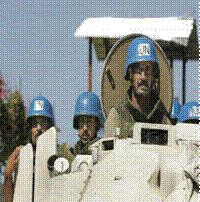
Dr of Congo: UN Denounces Re-recruitment,
Maltreatment of Child Soldiers
New York, March, 31,
2006 – Denouncing the re-recruitment of child soldiers in the Democratic
Republic of the Congo (DRC), United Nations officials have called for the
immediate release of youngsters by the various armed groups in the
faction-ridden country.
The DRC is
one of the seven countries most affected by the problem of child soldiers.
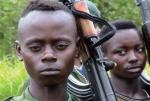
With appreciation to www.aber.ac.uk
At least
30,000 boys and girls under the age of 18 have been recruited, either willingly
or by force, by the army or armed groups since 1998 during a civil and regional
fighting, and thus exposed to hostilities, forced labor or sexual servitude,
the UN Organization Mission in the DRC (MONUC) said.
So far,
16,800 of them have passed through the demobilization and reintegration programme
that the UN is helping to organize as part of the country’s transition to peace
and democracy.
Earlier
this week in Kinshasa,
the MONUC official responsible for the protection of children, Danielle Barrot,
denounced “cases of re-recruitment of children, harassment, arrest and illegal
detention and bad treatment of youngsters who have left the armed forces or
armed groups.”
With
appreciation to UN News, Dr. of Congo: UN Denounces Re-Recruitment,
Maltreatment of Child Soldiers, March 31, 2006 at www.un.org
UN Agency to Provide Aid to Traumatized
Quake Victims in Iran
New York,
April 7, 2006 – The United Nations Children’s Fund (UNICEF), which is providing
material relief to the victims of last week’s earthquake in Iran, today
announced plans to offer psychosocial support to traumatized
youngsters in the coming weeks.
“Families
are sleeping in tents, in their cars and in makeshift shelters wherever they
can,” UNICEF country representative Christian Salazar said after visiting the
Lorestan area, where the agency immediately rushed 10,000 blankets after the
March 31 quake.
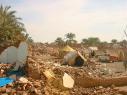
With appreciation to www.pocketpcmag.com
“The
temperature is down to five degrees Celsius,” he added, noting that harsh
conditions take a strong psychological toll.
“For children it’s very difficult.
Not only have they lost all their possessions, but they are very frightened
by all the aftershocks of the earthquakes.
They are cryng a lot and not sleeping well.”
To help
address this trauma, UNICEF plans to offer psychosocial support and temporary
schools to the community.
After the
initial quake, the Government and Iranian Red Crescent responded swiftly,
distributing tents, blankets and other supplies almost immediately. UNICEF added to this with the first
international aid to reach some of the most affected villages.
Additional
supplies, including children’s clothes, blankets, dolls and tents, were
released by officials in Bam, where they had been donated by UNICEF following
the 2003 earthquake there.
Degree Studies at the United Nations
And Distance Learning
DeLuca@UN.int (718) 698-0700
www.IgnatiusU.com
The
children and their families will continue to need considerable help. To facilitate recovery and reconstruction, an
expert team of two UNICEF child protection officers, an education officer and a
UN Educational, Scientific and Cultural Organization (UNESCO) staff member
arrived on the scene this week to assess damage to education facilities and the
psychological status of children.
Based on
the team’s findings, a plan of action will be developed and implemented with
the government and partners. The State
Welfare Organization has already agreed with UNICEF to establish 35 rural
childcare centres in the hardest-hit villages.
These, along with appropriate educational and psychosocial
interventions, should help children overcome the psychological stress and
trauma caused by the quake.
The
agency’s actions are part of a coordinated UN effort led by the UN office for
the Coordination of Human Affairs. (OCHA.)
With appreciation to UN News, UN Agency to Provide Psychosocial Aid to
Traumatized Quake Victims in Iran,
April 7, 2006 at UNNews@un.org
Psychological Considerations Re-enforced at
the UN
April 13, 2006 –
Opportunities to sit in on a general session of the United Nations and to be
briefed by a foreign-service officer of the United
States were among the perspective-altering experiences
enjoyed by a select group of students who recently were led to New York City by Harvey
Langholz, professor of Psychology at the College.
“While
visiting UN Headquarters might not be as good as, say, visiting an actual
peace-keeping mission, it was a significant help for me to put a lot of what I
read in context,” said William Cline (06), one of the participating
students.
Said Eric Reeder (07), another student “Psychology is present in
everything dealing with international relations, including conflict, conflict
resolution, peace-keeping, humanitarian aid, and more. The class and the trip enable you to see how
psychology is applicable in the real world.”
Some of the
students were members of an independent-studies class led by Langholtz that was
considering the psychologies of peacemaking and of diplomacy, topics that wave
the subjects ot the professor’s two recent books. Others simply wanted to take advantage of the
opportunity to see the United Nations with Langholtz, who serves as a
consultant to the world body.
“The
interesting topic for students is that international relations, which includes both peace and war, have some components that are
parallel with psychological relations- the psychological aspects of
interpersonal relations I should say,” Langholtz said. Some insights his students reach include the
fact that ethnically based conflicts, which are passed from generation to
generation, are difficult to resolve due to deep-seated hatreds. Citing the Palestinian-Israeli issue, as well
as the situation in Yugoslavia
and terroris, which pits East against West, Langholtz said, “In order to even
try to overcome such distances and hatreds, it takes a series of confidence-building
measures, which are very difficult to come by, and they easily erode. These ethnicly based, long-standing conflicts
are very difficult to resolve, whereas conflicts that are more political, or
geographic or economic tend sometimes to have a resolution.”
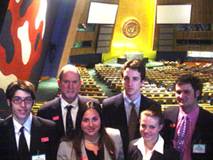
With appreciation to www.wm.edu/news
Concerning
the New York
trip, Cline said the first highlight was having the opportunity to sit in on a
meeting of the Security Council. “Our
tour guide wouldn’t take us into the chamber, since regular tourists aren’t
permitted inside when the council is in session,” Cline said. “We had official badges as Dr. Langholtz’s
companions, however, so the guard let us in when we came back after the end of
the standard tour. They were discussing
small-arms control, which is not as riveting, as say, the Iranian nuclear
program, but it still gave us the chance to see what it actually looks like for
global powers to come together and try to find solutions to problems” A second highlight for Cline was a briefing
by the U.S. delegation to the United Nations.
“We spent about an hour picking the brain of a foreign-service officer
who was surprisingly candid and gave us a rather different perspective from the
more politically neutral comments of the U.N. staff we encountered,” he said.
Reader came
away with a greater resolve to work toward making a difference for other people
in the world. “While there, we saw many
charts and posters depicting the problems faced all around the world, and that
made me realize not only how lucky we really are here in the United States but
also that we have a moral obligation to the other countries around the world
that are not as fortunate as we are,” he said.
He added, “ I am also hopeful because a lot of the conflicts around
the world are caused by social, economic and medical problems, and I see the
work that is being done by the students at this school to address these
issues. I believe that the College of William and Mary and other liberal-arts
universities around the country are hoping to educate young people on the
cultures and issues of foreign countries that then gives the students the
motivation to act and to make the world a better place.”
Langholtz
said that the study of the psychology of international relations is somewhat
unique within the broader discipline of psychology.” However, as we see Iraq and terrorism, more
and more of these questions of psychological impacts and psychological components
on conflict, conflict amelioration and conflict resolution are being given a
hearing,” he said.
Several of
Langholtz’s students have gone on to represent these psychological issues in
global forums in recent years, including two who are working for the U.S.
Department of State, one who is serving with the U.S. Agency for International
Development and several who are working through the Peace Corps.
With
appreciation to W & M News, Psychological
Considerations Re-enforced at the U.N., April, 13, 2006 at www.wm.edu/news
Pakistani Rape Survivor Turned Education
Crusader Honored at UN
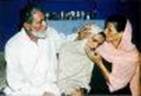
May 2, 2006 – Muktar Mai, a
Pakistani woman who became a world-renown education and women’s rights activist
after she was gang raped as clan vengeance in her native village for crimes
allegedly committed by her brother, spoke at United Nations Headquarters in New York today, drawing
praise from UN officials for her bravery.
“I think it
is fair to say that anyone who has the moral courage and internal strength to turn
such a brutal attack into a weapon to defend others in a similar position, is a
hero indeed, and is worthy of our deepest respect and admiration,”
Under-Secretary-General for Communications Shashi Tharoor said in introducing
Ms. Mukhtar, who was invited to the UN by Secretary-General Kofi Annan and
Pakistan’s UN Mission.
Mr. Tharoor
said that after the horrific crime, which occurred in 2002 in a rural village
called Meerwala, Ms. Mukhtar refused to be cowed by traditional strictures
under which she was expected to commit suicide out of shame. Instead, with the support of her immediate
family, her Imam and some journalists, she took steps to ensure the full force
of the law was levied against her attackers.
“Since
then, she has demonstrated that she is a woman of enormous courage and
conviction, by turning her horrible experience into a rallying cry against the
violence and injustice that is perpetrated against disadvantaged women in many
parts of the world,” Mr. Tharoor said.
Moderating
the event, CNN anchor Soledad O’Brian expressed admiration that, after
receiving an award from the Pakistani Government of 500,000 rupees, Ms. Mukhtar
returned to the village in which she had experienced such pain instead of
leaving the region, founding a school that now women and girls threatened by
childhood marriage and other practices.
Questioned
by Ms. O’Brian and the audience at the UN meeting room, Ms. Mukhtar explained
the importance of education for woman’s rights.
“When I was pursuing justice, the uneducated people tried to stop me and
the educated people supported me. So I
thought education was important,” the soft-spoken woman said through an
interpreter. “My slogan is: “End oppression with education,” she added,
noting that after her efforts in her rural village, attitudes there have
changed quite dramatically.
With appreciation to www.ceiberweiber.at
Under-Secretary-General
Tharoor, a native of India, recognized the scale of that accomplishment: “As someone who comes from a country that has
also struggled to find ways to overcome dire social challenges and to end the
often brutal practices of our traditional pasts without surrendering our unique
history and identity, I can assure you that the obstacles that Ms. Mukhtar Mai
and her fellow Pakistanis face are not small, and that hers is no small
achievement,” he said.
With
appreciation to UN News, Pakistani Rape
Survivor Turned Education Crusader Honored at UN, May 2, 2006 at UNNews@un.org
International Conference on Ageing and
Disability, Graz, Austria
Spring,
2006 – Conference June 8 to June 9 in Graz
– In the framework of the Austrian EU – Presidency, major European networks
have come together with Austrian Umbrella Organizations to organize a European
conference.
The number
of ageing people and disabled ageing people in Europe
is increasing rapidly. The European Commission, is therefore, devoting more and more attention
to this topic and have recently published a green paper on demographic
change. One thing becomes particularly
clear: the efforts of all European
member states, need to be stepped up if we are to meet
the challenges posed by our increasingly ageing population. This is especially the case for people with
disabilities whose needs are not always met by existing services.
The
conference is targeted at representatives of persons with a disability and
their families, to service providers and qualified personnel, concerned
authorities at all levels, researchers and politicians.
The aim of
the conference is to give an overview of the state of play in Europe on the
topic, to point the way forward, to exchange models of good practice and to
launch a declaration of Graz.
The
conference will start from a global perspective of ageing and disability and
then go more in depth of the situation of people with intellectual disability.
With
appreciation to International Institute of Ageing, UN Malta, International Conference on Ageing and
Disability, Graz, Austria, Spring 2006 at www.inia.org

With
appreciation to www.inia.org
Dr. Lee Jong-wook, Director General, WHO
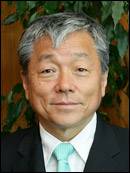
May 22, 2006 – Dr. LEE
Jong-wook, Director General of the World Health Organization, has
died. He had been in the hospital since
Saturday afternoon, where he underwent surgery to remove a blood clot on his
brain (a subdural hematoma). He remained
in intensive care. At 0743 this morning,
he was declared dead.
With
appreciation to www.who.int
All of the
staff of the World Health Organization extend their
most sincere condolences to Dr. Lee’s family.
The sudden loss of our leader, colleague and friend, is devastating.
With
appreciation to WHO, Dr. Lee Jong-wook,
Director-General, WHO, May
22, 2006 at www.who.int
Danger at the UN: Can We Protect Those Who
Protect?
May, 2006 –
Recent history documents a tragic irony.
Humanitarian workers, peacekeepers, and others who are dedicated to
protecting the most vulnerable among us find their own safety and emotional
well being increasingly endangered. The
challenge before us is to find ways to provide for their security and well being
as they address the needs of devastated populations worldwide.
The
challenge is of particular urgency at the United Nations. The Department of Peacekeeping Operations
(DPKO) at the UN reports that since the first peacekeeping operation in 1948,
over 2,150 peacekeepers died in the line of duty. In addition to these peacekeepers, the losses
of life and threats to the well being of other personnel have also been
documented. For example, from 1992 to June
2001, over 200 UN field mission staff were killed and
another 242 were taken hostage or kidnapped.
In 1999 alone, 292 cases of robbery, rape and physical assault were
reported. The bombing of UN headquarters
in Baghdad in 2003 led to the loss of life of 24
UN personnel including Sergio Vieira de Mello of Brazil, who, in the view of many at
the UN, was poised to become the next Secretary General. Compelling personal stories of the dangers of
mission life have been portrayed in both books and in film.
The
professional and spiritual satisfaction associated with peacekeeping has been
eroded by an atmosphere of danger.
Locals are less likely to implicitly trust outsiders; reciprocally,
workers in the field are also uncertain whom they can trust. As the risks of mission life have changed,
new concerns have emerged regarding the psychological effects of
fieldwork. Awareness of increased peril
to their own safety, along with continual exposure to the traumatic
circumstances of refugees and those displaced by conflict, disaster, and famine
threaten the emotional well being of humanitarian personnel. These circumstances have been shown to evoke
post-traumatic symptoms, or vicarious traumatization, in those attempting to
heal trauma victims. Failure to address
the suffering of personnel may lead to the proliferation of other behavioral
problems at duty stations, for example, substance abuse, unprotected sex,
etc. Symptomatic outcomes for
humanitarian personnel may diminish their job effectiveness and may potentially
lead to compromising the success of their missions.
At the
United Nations, these issues have garnered attention at every level of the
organization. Since the end of the Cold
War, peacekeeping operations and other missions have increased dramatically
adding to the urgency for determined efforts to provide for the safety and
security of personnel. UN officials,
Member states and non-governmental organizations (NGO’s) have recognized that
the United Nations
has provided insufficient resources to address these concerns. Stress Counselors have been hired in the UN
Security Coordinator’s Office, in the DPKO, the Secretariat and among some U.N.
agencies, including the United Nations Children’s Fund and the Worold Food
Program. Stress Counselors have made
impressive progress in crafting meaningful interventions as they travel
extensively to duty stations to address crisis on missions as they occur. However, it is widely recognized that in
spite of these additional staff, available resources simply fall short of the
extensive needs of personnel at headquarters and around the world.
Available
resources that might add additional expertise to the efforts of Stress
Counselors are members of civil society.
The United Nations, led by Secretary General Kofi Annan and the General
Assembly, has sought to extend its partnership with civil society. There are more than 2,500 NGO’s within the UN
system. A partnership between the U.N.
and interested NGO’s might contribute to diminishing the gap between the needs
for counselors and available resources.
A partnership
called the Trauma Stress Support Group has been proposed consisting of two
NGO’s – Disaster Psychiatry Outreach and the International Psychoanalytic
Association – and in conjunction with senior officials in the Department of
Public Information and UNSECOORD. This
partnership has been designed to offer pre-deployment, mission and post-mission
training, education, and counseling.
This three-point proposal derives from extensive consultation with
UNSECOORD and DPKO staff, Stress Counselors, and others, some of whom assisted
UN personnel following the attack on UN Headquarters in Baghdad and others who
were involved with establishing the UN mission in Kabul, Afghanistan.
The first
component of this plan is to provide pre-assignment mission training. In conjunction with the UN’s own briefing
program, NGO health professionals would provide education and training for
staff and their families to prepare for their adjustment to protracted absence. Mission
staff needs to be informed of the dangers they may encounter including risks to
their mental health. The development of
senior staff from among the mission staff is also proposed in order to have
managers who are alert to identifying behavioral problems as they occur. Second, the Trauma Stress Support Group will
organize a resource of mental health experts with international emergency
experience and with a particular emphasis on post-traumatic stress. This resource would include volunteers
available to assist UN staff in the field.
Special attention would be given to those professionals with field